

Snow Business or No Business
With spring warming at least most of Minnesota, residents are asking once again: Where did winter go? A deep, cold, snowy Minnesota winter like the ones we used to know?
Last month, the Federal Reserve Bank of Minneapolis addressed that question from a business perspective. As residents of an Upper Midwestern state, we’ve learned how to make the most (or at least the best) of winter. That means skiing, snowboarding, snowshoeing, ice fishing, and maybe some time in the sauna. Numerous businesses—including snow sports retailers, downhill skiing destinations, and outstate resorts—rely on revenue from those activities. But what happens when we have a winter like the one just ending?
“Since the pandemic, interest in snow and outdoor activities has increased, industry experts say,” Minneapolis Fed senior writer Tu-Uyen Tran reports. “But this increase has been tempered by inconsistent snow and cold” throughout the Minneapolis Fed’s region over recent years.
Greater variability
How much does a hearty, snowy winter contribute to Minnesota’s economy? The data is surprisingly sketchy and anecdotal. But to get a sense of how important winter can be economically, consider Northern Wisconsin. In our neighboring state’s seven “Northwoods” counties, the mild winter of 2023-24 cost tourism-dependent businesses $6.5 million in lost revenue, according to a January 2024 release from the Greater Minocqua Area Visitors Bureau and Oneida County Tourism Council. “Many businesses [reported] 75-80% year-over-year losses in the first few months of winter, and many are closing their doors,” the organization said.
One data point that is readily available is snowfall. Focusing just on the Twin Cities, the amount of white stuff has averaged 54.4 inches annually from 1981 to 2010. Since the dawn of the current millennium, only nine of 24 winters have hit that mark. True, 90-plus inches dropped on the metro during the winter of 2022-23. But that was followed by just 29.5 inches during the what the Minnesota Department of Natural Resources termed the “lost winter” of 2023-24.
Historically, winter hasn’t necessarily followed a reliable pattern. Your aging correspondent remembers the “brown winter” of 1980-81 during his college days, when snowfall barely exceeded 20 inches. The following winter, the Twin Cities’ snow total hit 95.
Though snow season isn’t officially over (and some parts of the state are still facing potential snow events), as of late March, the Twin Cities had recorded a little over 27 inches. “Last summer, we thought, ‘Oh, this is going to be a cold and strong winter in Minnesota,’” notes Stefan Liess, a research scientist with the University of Minnesota Climate Adaptation Partnership. “It turns out it was a cold and strong winter—not in Minnesota but in Kansas.”
Northern Minnesota still experiences heavier snow years than the metro, of course. In fact, Duluth set a local snowfall record in 2022-23 of 140.1 inches. And the winters of 2012-13 and 2013-14 rank in the top five for all-time snow seasons in the Zenith City. 2023-24? Just 38.7. As of March 29, the 2024-25 winter had posted a mere 45.2 inches.
Rather than say that Minnesota winters have become unpredictable, “I’d say the variability has gone up,” Liess says, and that’s “making it harder to determine what next winter will be like.” Driving this variability, he notes, is the high level of greenhouse gases in the atmosphere. As a result, “we have more heat in the atmosphere, and that means more energy in the system.” That makes the atmosphere more volatile—and weather patterns harder to track.
Liess says that while Minnesota’s winters have been trending milder in the past quarter-century or so, the northern part of the state is warming more than the southern part. Southern Minnesota will always be warmer than the north, but over time, “the differences may not be as strong,” he says.
A broad impact
The industry that feels the impact of climate change the most is, of course, agriculture. Though not an ag expert himself, Liess collaborates with those who are, and “they’re seeing that the growing season is increasing thanks to the milder winter,” he says. At the same time, “the characteristics of the growing season” are changing. “Especially in July and August, when farmers need rainfall for plant growth, the moisture is not there” Liess says. “July and August have actually been getting drier.”
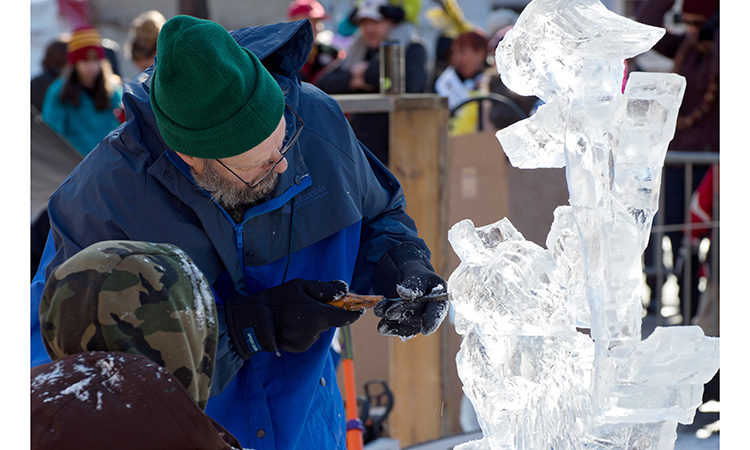
Winter’s variability has also affected tourism, though the impacts have thus far been harder to measure. Brigid Tuck, a senior economic impact analyst with the University of Minnesota Extension who studies tourism, notes that the parts of the state most affected by a lack of good snow cover are, not surprisingly, up north. Familiar examples include the Brainerd Lakes region, the Arrowhead, and areas beyond the Iron Range. And in the metro, “you think about events like the Winter Carnival and the Great Northern Festival,” Tuck says. “Those activities help drive winter tourism.” That is, when the ice sculptures aren’t in danger of melting.
While firm data is lacking, “we know from our research that when people travel [in Minnesota], visitors spend about $150 per person per day when they’re in a community,” Tuck says. Fewer visitors mean less revenue, and that shortfall “can be a pretty substantial number,” she says.
The businesses in a community that cater directly to tourists are easy to spot, whether it’s snowmobilers at a rural bar or skiers at the lifts. “What you probably don’t see is the impact on the other businesses that serve the tourism businesses,” Tuck says.
“When we do our research on tourism and economic impact, we find that if there’s less money being spent at the restaurants and the hotels, those businesses very quickly see the impact on their bottom line.” Hotels and restaurants are also paying utilities and rent, and they’re contracting with suppliers of food and beverages. Mild winters can mean lost business—and lost businesses. And that hurts vendors as well as the “tourist-facing” businesses themselves. “Entire communities can see the impact across a broad array of businesses when we have a mild winter.” Tuck says.
The Minneapolis Fed’s Tran notes in his recent report that “for remote areas with fewer economic activities, [snow sports] bring in welcome tourism dollars at a time of year when the local economy is often slower.” Though they have no way of knowing what to plan for, Minnesota winter tourism destinations will be dreaming of a white Christmas—and a real winter to follow.