

Inside Sun Country’s Quest for Profitability
A decade ago, TCB took a 10,000-foot look into Sun Country Airlines, which had new management and was looking for growth and profitability. The then-32-year-old carrier had spent most of its history in the red, and a few more such years were on the horizon. The dirty little secret about Minnesota’s favorite spring break airline was that it had relatively little justification to exist other than the generosity of a series of owners who saw something sexy, perhaps, about the swashbuckling but volatile airline industry.
By 2016, owners the Davis family (since 2011) had decided to sell the airline and focus on their Cambria home improvement business. They had conversations with Jude Bricker, then COO at Allegiant Air (a carrier with similarities to Sun Country), who encouraged them to consider Allegiant, but the Davises did not offer the airline to its nominal competitor. Bricker subsequently left Allegiant in mid-2017. Later that year Marty Davis hired him to be CEO of Sun Country (with an equity stake) with the goal of improving profitability and packaging the airline for sale. Private equity concern Apollo Capital Management was the buyer, in 2018.
“Our goal is to carry half of the (non-Delta) originating passengers at MSP.”
—Jude Bricker
Bricker, now 51, had a vision that Apollo bought into. He saw a path out of decades of red ink that would grow the value of the airline and provide Apollo with a payday IPO (which took place in 2021). Sun Country today is bigger, more diversified, consistently profitable, and earning the attention and respect of the investment community in one of the most volatile industries on Earth. And the airline has done it with a unique business model that smooths out the roller coaster turbulence that typifies the industry’s economics.
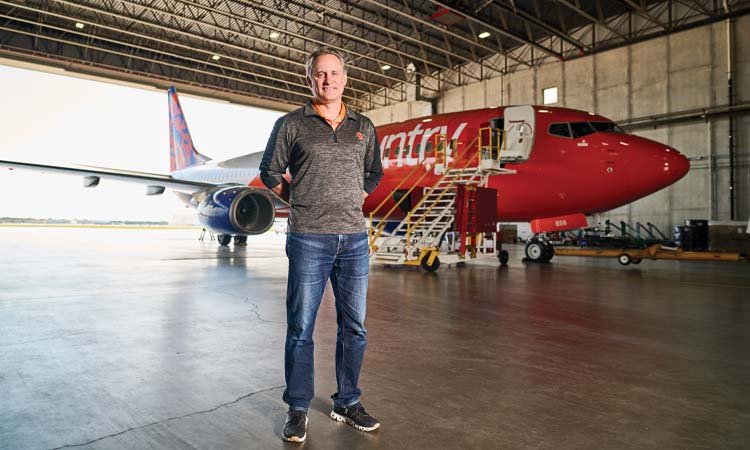
Ten years after that first company profile, TCB returned to a repurposed hangar on the periphery of MSP International Airport to take a look at how Sun Country found clear air— sort of.
A Volatile Business
Sun Country had a solid 2023 and a strong first quarter. It reported adjusted pre-tax margins of 9.9% last year, the industry’s best, on revenue of $1.05 billion, an all-time high. But in mid-February, the airline saw bookings fall off; not enough to ruin its most profitable quarter, but enough to concern Bricker and team. “Domestic demand has weakened,” Bricker told TCB, settling back to pre-2020 levels, but the industry was suddenly awash in capacity, which had been scarce since the pandemic saw tens of thousands leave jobs in the airline industry, creating chronic capacity shortages in 2022 and ’23.
On an investor call in June, the airline told stock analysts that “its planes were full, but fares are down.” Bricker says unit revenue is 20% higher than in 2019 but 20% off last year’s peak.
It’s not for lack of demand. “Ten of the top 10 air travel days in U.S. history have been this spring/summer,” notes Kyle Potter, executive editor of Twin Cities-based Thrifty Traveler, a website that tracks airfares and travel trends for frequent flyers.
Airline profits are driven by demand cycles, but the industry’s trademark volatility is a function of its inability to tailor capacity to those cycles.
Consider the last five years: a global pandemic followed by a quick rebound of travel demand to levels the industry couldn’t satisfy, which drove up fares, making even the most poorly managed airline profitable. Sun Country’s industry peers, so-called ultra-low-cost-carriers (ULCC) Spirit and Frontier, had ordered many new planes anticipating bracing demand. But Spirit’s merger with JetBlue was nixed by the feds, and many of its customers, flush with pent-up pandemic cash, traded up to carriers like Delta and United.
The ULCC niche, flying high a decade ago, now has trouble maintaining altitude. Saddled with debt on all those new Airbuses, Frontier and Spirit (and new entrants Avelo and Breeze, which don’t serve MSP) have increased flying when they should be scaling back and are cutting fares to stimulate demand. Sun Country made no similar gambles, but is nonetheless affected.
“There is a lot of unprofitable flying happening out there,” says a casually dressed Bricker, sitting at a conference table in the carrier’s spartan offices on Cargo Road.
Simply put, the ULCCs “are driving down industry margins because they are growing faster than the market,” explains aviation industry journalist Edward Russell.
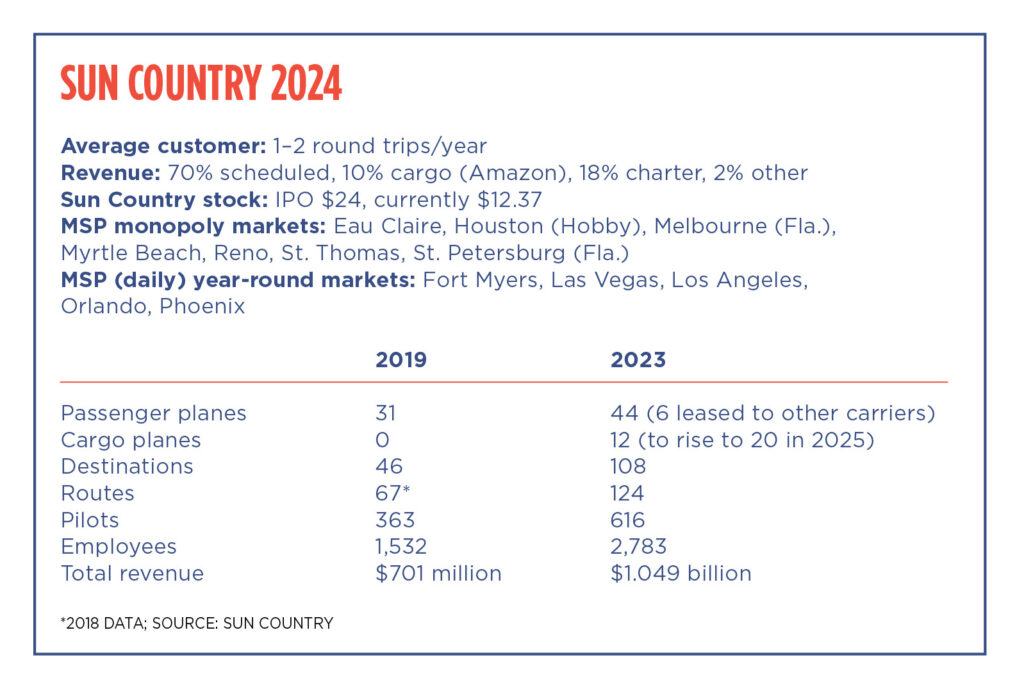
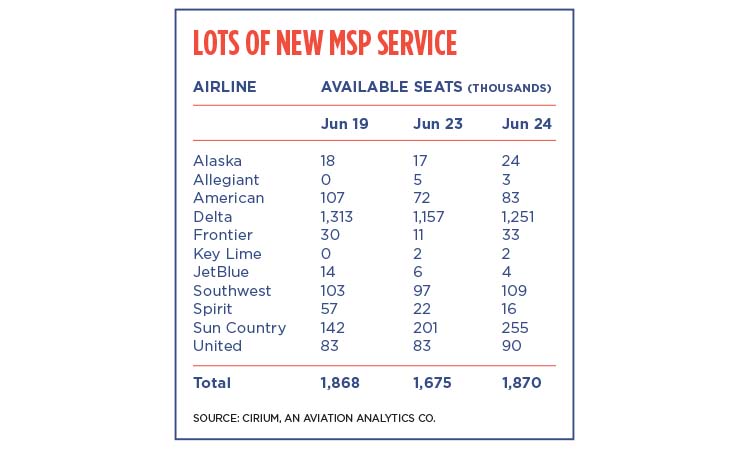
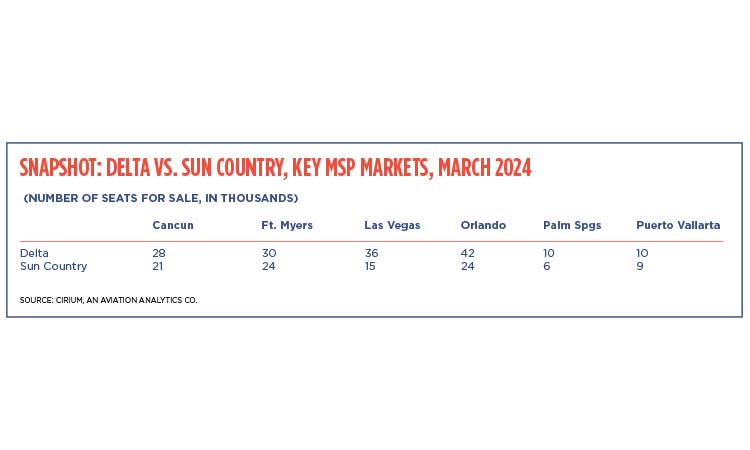
But it’s not just the ULCCs. There’s been 11% available seat growth at MSP airport in a single year. Delta is adding, Sun Country is adding, United, American too. Some are merely trying to return to pre-2020 norms (see charts), while others are growing based on last year’s demand.
“But our cost basis is significantly higher than 2019—labor, maintenance, airport expense,” says Bricker. So overcapacity is biting.
Read more from this issue
Delta, having offered too many employees early retirement in the pandemic, was beset by labor shortages and slow to rebuild its network at MSP, focusing on competitive coastal markets, which gave Sun Country an opening in 2022 and 2023. “They were bold, adding new routes, adding service to Delta markets,” says Potter. But this year Delta has focused on rebuilding its core hubs and is returning to nonstop markets it had left to Sun Country.
In such a situation, it’s challenging for Sun Country to control its own destiny, which is why the airline has lost money for so many of its 42 years. Even when it made prudent decisions, the industry often didn’t. If MSP is oversaturated, there may be other markets to serve, but the airline has no brand recognition in them. “It’s really hard for Minnesotans to understand [Sun Country is] not a household name outside MSP,” says Potter. Not even a name, really.
Network carriers like Delta are experiencing unprecedented demand for value-add products such as premium economy and first-class seating, branded lounges with high fees, and far-flung international flying. “The people willing to pay more [for upgrades] are now willing to pay [even] more than they used to,” says Potter.
But that’s not Sun Country’s niche, not at all.
It’s not unfair to ask if Sun Country should have even survived the pandemic, as thin and undercapitalized as it was. But leisure travel returned long before business travel, and while the airline was waiting for demand to return, it hit upon a stroke of good fortune: boxes.
“Sun Country is very lucky they have this other business line,” says Russell. “It was a brilliant move by Jude. His turnaround of that business has been impressive.”
Twelve Pilots and Two Flight Attendants
Sun Country was born in the early years of airline deregulation from the bones of liquidating Texas-based Braniff International Airlines. Its first 14 employees formed a charter airline and partnered with MLT Vacations to ferry Minnesotans to vacation destinations. The airline has been through numerous owners and bankruptcies, but that product is still the core of its business.
Bricker could see when he signed on that the strategy had a fatal flaw. Sun Country’s peak demand period, Christmas to Easter, is inexhaustible, but it’s never been able to profitably utilize its assets the rest of the year. All airlines are slow in May and October, but three profitable months is not enough. In a nutshell, every time Sun Country grew to make more of winter, it lost more money the rest of the year. Charter flights and leasing out aircraft in summer were a balm, not a solution.
Bricker says he did not join the airline with images of boxes in his head. “My vision was about making it competitive with capacity cuts, an à la carte [pricing] model, things I had done at Allegiant. Our capacity to grow was limited by the seasonal swings.”
Bricker wanted more planes and pilots, but needed something for them to do after Easter, and particularly in May and fall. “I recognized cargo would be helpful. It was luck, honestly. It saved the company through Covid. Reassured our lenders. We had no furloughs.”
In the past, Sun Country would have had no choice but to slash fares and serve unprofitable markets, like Spirit and Frontier do today. But this time, it wasn’t boxed in.
Enter Amazon
The Amazon partnership was announced just before Christmas 2019. The retail giant wanted more control over its shipping logistics and had enlisted several cargo airlines to fly on its behalf. Amazon provided Sun Country with 12 737s of the type its pilots already flew. Amazon tends to need Sun Country the most when the airline is naturally slow. The revenue and flying allowed Sun Country to profitably add planes and pilots to its passenger operations, expanding from 46 to 108 destinations in the Bricker era.
 “The Amazon business was like a light going on,” says aviation journalist Russell. “It’s flying with something closer to guaranteed margins.”
Cargo—and the carrier’s already robust charter business flying for casinos and sports teams—smooth out the volatility of the business. “This way they are not over their skis with aircraft orders and don’t need to do a lot of unprofitable flying,” explains Helane Becker, a managing director at Wall Street firm TD Cowen, who follows the airline industry.
“[Flying for] Amazon is a whole lot better than $19 fares to Asheville,” adds Potter, referencing a 2022 ULCC competitive bubble out of MSP.
In fact, if you think about Sun Country as a traditional ULCC, its executives will quickly object. It’s different than Frontier and Spirit in a key respect: Sun Country actually wants to minimize flying. It calls itself a “low-utilization leisure carrier,” meaning it only flies when there’s strong demand. Palm Springs in summer? Forget it. San Fran or NYC in winter? No way. In fact, the airline only serves five daily markets year-round; extra credit if you can guess them (see fact box).
Management likes to say the strength of its model is “cross-utilization,” meaning its 737s can fly to Cancun in March, operate casino charters in summer, and its pilots then do double-duty for Amazon during the holiday run-up. (The Amazon business averages 40 daily departures.) “This business needs Amazon to be as big as they are to sustain spring break and Christmas [passenger flying],” explains Bricker.
In June, as the airline was alerting analysts to softening demand and passenger margins, it announced a near-doubling of its business with Amazon, to go into effect after first quarter 2025. Given the demand environment, the airline will also scale back its off-peak passenger schedule next year, hoping to return to growth in ’26.
It’s worth noting that Amazon flying generated negative margins in FY22 and 23, and 24 is trending similarly. Bricker says that’s due to the increase in pilot costs since the Amazon contract was negotiated and because certain of the airline’s fixed costs are overallocated to cargo flights. Sun Country has told analysts its new contract with Amazon will provide margins consistent with historical passenger norms, meaning Amazon is paying more.
Positive Rate
In the Amazon investor call, the airline’s management reaffirmed its intention to grow the overall business by 10% a year. In 2024 that meant adding destinations like Billings, Montana; Boise, Idaho; Cleveland, Ohio; Grand Rapids, Michigan: and Syracuse, New York. In 2025 it means 63% more Amazon flights.
There are other factors limiting passenger revenue growth. The once seemingly bottomless well of add-on fees is one. ULCCs have developed something of a reputation for offering loss-leader fares and charging for everything including printing a boarding pass at the airport. The federal government is trying to mandate fee-inclusion in airline marketed fares, but Sun Country offers a rather limited range of upselling to begin with.
Bricker believes “ancillary products are now factored in by consumers. Public perception is a bit unfair, because we don’t want you to pay for products you don’t need [or] to feel screwed-over on ancillary products.”
He also notes the large network carriers got better at competing with the ULCC pricing model. Delta now offers a “basic economy” fare that, in the MSP market, seems priced to keep Sun Country on its heels, notes Thrifty Traveler’s Potter.
The lowest-hanging fruit for Sun Country, from a passenger perspective, is more March. The airline could build a virtual air bridge to Ft. Myers, Orlando, and Phoenix if it could occupy those planes and pilots the rest of the year.
Key in that calculus is MSP Airport and Terminal 2. Sun Country’s operating model is a bank of flights around dawn to the coasts and Mexico and the Caribbean. Some of those planes return midday and then cycle to a domestic destination, returning late at night or on a red-eye. The airline believes it needs to stick to this pattern, meaning growth requires more overnight 737 parking at MSP and more gates at T2.
The airport is doing its best. “The challenge is to accommodate Sun Country’s growth given their operating patterns. I’ve asked our staff to be creative in the near term,” says Metropolitan Airports Commission CEO Brian Ryks. “Busy/slow is a challenge for us. We’ve acquired a modeling software that helps us optimize those periods of white space.”
MAC creativity has resulted in a plan to add two jet bridges this fall on Sun Country’s side of T2 adjacent to gate H1. They are coming from Delta’s C concourse, where it is reducing the number of gates to accommodate larger aircraft. The MAC is also adapting the international baggage claim at T2 to flex for domestic flights. Ryks says two gates and 168,000 square feet of space will also be added to the Southwest Airlines (north) side of T2 by 2027. (There are also plans for 17 additional gates at T2, but no firm timeline has been established.)
One of the risks for the MAC in focusing a large capital project around a single airline is simply the volatility of the industry. “We never want to be in a position where we can’t serve an airline due to capacity,” Ryks says, “but we don’t control the industry, which seems to reset every seven to 10 years. If you overbuild, your costs go up, and airlines don’t like that.”
Sun Country appreciates the confidence the airport has shown. “MSP is a fantastic asset, forward-thinking,” says Bricker. “More gates allow us more flying. Our model depends on this pattern of flying.” But he is quick to note that the airport’s focus “has to be on keeping external costs under control, air traffic control, new terminals, etc.” (Airlines pay fees for using the airport. Each flight and gate add more cost.)
Beyond the Horizon
If Sun Country is to grow at 10% a year for the foreseeable future, it will need more than Amazon and gates at MSP. From a product standpoint, it evolves slowly, finally adding a smartphone app in early ’24. But for those who keep asking, adding WiFi to its planes isn’t in the cards, due to the substantial expense to modify aircraft and the airline’s sense that WiFi will be difficult to monetize and its core customer doesn’t expect or need that level of connectivity.
Its flight attendants are without a current contract, working at rates established by Bricker’s predecessor in 2015. They turned down a 17% pay raise recently but “are delivering the same high-quality service as before the contract expired,” says Bricker. The current demand environment is not a good omen for maximizing wages; Amazon boxes don’t need a safety demonstration.

“There is a lot of unprofitable flying happening out there.”
—Jude Bricker
Sun Country president and CFO Dave Davis broached the possibility of a second “focus city” at an industry conference in March. It would need to be a place that complemented MSP’s seasonal patterns, but right now, most secondary markets are deluged with ULCCs. “There’s not an obvious [airport] to do it in,” says Bricker. But given the overcapacity, “there’s going to be a shake-up eventually and in the interim, we’ll grow other parts of the business.”
There’s been speculation that the carrier, which now owns 50 passenger aircraft, could become a takeover target, given widespread aircraft shortages, but “I’d say not until 100 planes are they a takeover target,” guesses Russell.
Sun Country purchased used 737s throughout Covid, inexpensively. Bricker says the airline will not need to go into the aircraft market until 2028, given its current plans. As for MSP, “there’s still growth at MSP. We’re really struggling for growth off-peak, but Amazon adds the possibility of growth in peak come ’26-’27.” He notes that every time Sun Country adds a destination, Delta quickly does too. “They’re not going to allow us a monopoly. If we’re carrying passengers, they’re going to add it.”
Apollo still owns 20% of the airline, but “we expect Apollo to sell the rest of its position,” says TD Cowen’s Becker, who, like all the industry insiders TCB spoke to, has gotten to know Bricker and come away impressed. “At some point I can see Jude running a bigger airline,” she says. “But I’m not sure he’s done there yet.”
Sun Country can’t stay still or shrink in weak demand environments, as it would have when it was privately held. But Becker says all Wall Street wants of Sun Country is to keep its nose pointed upward. “Their focus should be to continue to grow profitably. At some point maybe another focus city, but there aren’t too many places where there’s space anymore, and they are a rational competitor. Jude’s plan isn’t to do stupid stuff.”