

Q&A: Sun Country’s Outgoing CEO Jude Bricker
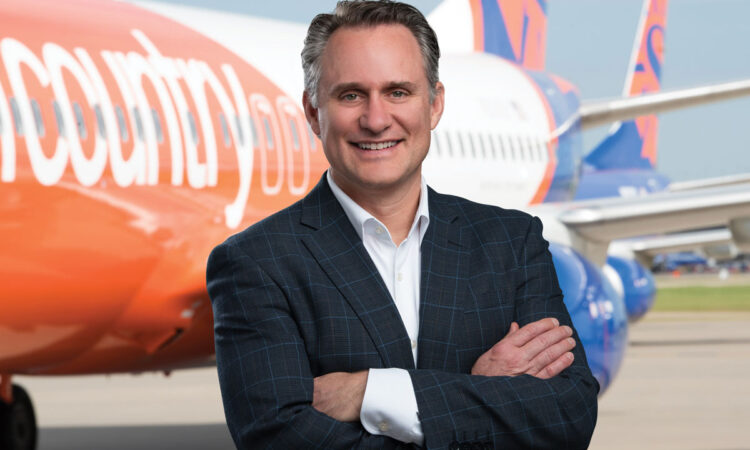
Jude Bricker is closing in on his ninth anniversary as CEO of Sun Country Airlines but will not quite get there. Today, as its shareholders approve a merger with Allegiant, Bricker will evolve into a short-term advisor to the surviving carrier and, for a while longer, a board member.
Sun Country is a 44-year-old brand. When it was formed, MSP had three airlines headquartered here, and it was the last. Sun Country’s entire history was tumultuous, including under Bricker: from private to public ownership, then Covid, then major shifts in business model. He rebuilt an airline that never made much money into a margin powerhouse, found ways to insulate the business against the traditional volatility of aviation, and grew it in scale and scope.
Whether what remains of Sun Country flies high or withers is anybody’s guess, but Bricker’s tenure at MSP should qualify him for a big role at an even larger airline, because he’s an executive who sees beyond conventional horizons.
This interview has been edited for length and clarity.
Is it a little weird here now? Do you feel like you’re living in a house you’ve sold?
It’s a little sad. This headquarters is moving to Vegas. It’s not what we expected to happen, was not in our long-term plans.
What’s the timeline look like?
The sale will close, presumably, a few days after the shareholder vote on May 8. Then Sun Country will become a subsidiary of Allegiant Travel Co. The brand isn’t going anywhere immediately. Then there’s a couple milestones in the future, the single operating certificate, that will be 14-24 months. We will roll this brand under the Allegiant brand, being able to merchandise both airlines on our websites, a single website, joint collective bargaining agreements. All of that could take through the end of the decade.
Is the Sun Country brand going away?
It will be a single branded carrier, and the brand will be Allegiant.
Is it clear what operations will remain at this building after the merger?
We have this building on lease through 2030 so there will be some back-office functions that persist, but it won’t be very big. Thus far there’s been more jobs in Vegas than people willing to relocate. A lot of people don’t want to leave Minnesota. A charter function will remain here, some support functions, most of the tech ops aren’t going. So bits and pieces will remain.
Allegiant and Sun Country seem to have different business models. They are a leisure carrier serving small and underserved destinations, limited service, a couple days a week. How does a single-hub-driven leisure carrier, where all flights begin or end at MSP, fit into that business model?
It’s a reasonable question. The strategic solution the merger gives us is we’ve been undergrowing our potential. We need scale, we need geographic diversity, we’re super concentrated which leaves us exposed to risk, and we need airplanes. The strategy of flying on average seven hours a day requires low capital -cost aircraft, and the world is short on planes right now. On the other side, [Allegiant] needs market opportunities for growth and they need the stability that we provide with presence in a major market and with our cargo and charter businesses. Our business will outperform by a wider margin the more stress there is in the industry.
So, the idea that Allegiant is really just acquiring pilots and planes—is that correct?
We have three assets Allegiant can’t create organically. We have 72 airplanes. You can’t go buy that fleet in today’s market. It’s worth a lot more than it is on our books. We have a large presence in MSP that’s been well-defended, our market share has doubled since I’ve been here. Third thing is the cargo business. You can’t go into Amazon and say I want a cargo business. We’re the top performing airline in the industry by margin, which adds to [Allegiants’s] P&L. I think it makes a ton of sense.
Was there a realistic scenario where Sun Country could have gone it alone and thrived over the next decade?
Coming out of Covid we expected to be the next Southwest Airlines. We had found something that worked really well: lower frequency operations. We had great margins, major markets. What changed after Covid was, we had trouble acquiring aircraft cost-effectively because the values accelerated, we couldn’t get pilots to upgrade—the employees don’t want to [live] outside Minneapolis. We tried starting a base before Covid in Portland and it didn’t work.
I had thought those growth attempts foundered on customer response. It was more about workforce?
Without a residential crew base in a market, it’s hard to operate that market cost effectively. MSP to St. Louis isn’t a good market. St. Louis to Orlando, St. Louis to Vegas might be good markets, but you need crews based in St. Louis. Allegiant has 24 crew bases. It’s a chicken and egg thing; you need scale to support a base. We’ve flown a lot of markets that didn’t touch MSP over the years, and it eventually came down to Minneapolis-based flying being a better opportunity, and we still haven’t maximized this market to some extent.
It appeared in winter that the pricing environment was great from an airline standpoint. I saw nearly $1,000 advance purchase roundtrips on Delta to Phoenix, Fort Myers, etc. And you guys weren’t far behind.
We had positive increasing unit revenues by double digits. There’s strong demand and it’s rising faster than seat availability, so fares go up. Delta ‘s Minnesota seats were down 1.3%, so they’ve been conservative on allocating capacity. There’s a lot of upward fare pressure. We provide the downward pressure on fares at MSP.
Despite the K-shaped economy, you’re seeing rising demand?
If you’re buying airline tickets, even on us, the assumption is you’re in the upper part of the K.
OK, fuel. Not your first rodeo with fuel spikes. How do you manage through this?
A good rule of thumb for us is every passenger takes 16 gallons of gas. Fuel rises by $1/gallon, we need $16 more per passenger to maintain the same dollar margin. Fuel is up $2 from what we expected. The way to respond to that is to [not operate the flights that fly with the lowest average fares]. Tuesdays, Wednesdays, May, September. Which raises the average fare of the flights we do operate.
If you can’t break even on a flight, you don’t want to operate it?
That’s right. The way you raise airfares is to cut low-fare flights. May schedules are down 10% over what we expected and that’s us going through and identifying flights that lack demand to cover increased fuel costs.
So, how is Sun Country advantaged in this environment?
Of all the flights [Amazon and charter] we fly, about 40% of them have pass-through fuel economics [meaning fuel is priced at actual cost]. The business model is designed to insulate against shocks. We still expect to be profitable this year.
What is putting similar carriers like Spirit and JetBlue at risk?
Well, it’s not easy to go bankrupt if you don’t have any debt. We have a great balance sheet and assets we own. We’re set up for crisis. [They had/have a lot of debt.] Our margin advantage will widen in crises. We’re still hiring. But if fuel prices stay where they are we might start pulling back.
How long would that take?
March is our highest demand period. We have pretty good summer demand. If we get to Labor Day, Strait of Hormuz is closed, fuel still at $5, we’ll probably start shrinking. As will others. That would actually be good for Sun Country because capacity will leave the system and that will be good for the airfare environment. There’s a lot of what I call “dumb capacity” in the market, carriers flying for cash flow not for profit.
But is there a risk your customer won’t be able to afford to fly?
Yes, that’s a big risk. If we see demand fall off that’s a different situation. Right now, demand remains good. But fuel costs are going to flow through all consumer goods in time, food costs, shipping costs.
Is the local team already putting together a new Q1 schedule?
Yes. We can’t coordinate planning until the merger happens. After it closes, we can optimize.
I stumbled across a podcast where former Delta CEO Richard Anderson said one thing that concerned him about the industry is that the large network carriers derive more profits from the frequent flyer relationship with banks than flying, and at some carriers the flying itself isn’t break-even.
That’s his [old] airline by the way. This airline makes money flying. But it’s a growing trend. Think of it this way. Loyalty around airlines is strong because travel is popular. Delta earns $8 billion through its co-brand card, far in excess of its pre-tax profit.
Is that bad or just smart on its part?
I think it’s bad because it provides leverage to scale. What’s happened since 9/11 is we had massive consolidation. The four biggest carriers are 80% of US capacity. Those premium [airline-branded] credit cards charge merchants a 4% processing fee. It’s a distribution from small merchants into the hands of the wealthiest individuals who are part of these loyalty programs, at the expense of the budget traveler. Chase pays that money to United which gives benefits to people who can afford an $800 annual fee and put $200,000 a year on a credit card. Europeans have a [credit card processing] model that is open-sourced and more competitive.
Thinking ahead, what does the Sun Country operation at MSP look like in five years?
For the consumer I think more markets and more seats. A lot of the justification for the merger is optimizing our operation at T2. Because all our crews live here, there’s only so much flying we can do when every plane has to start and end the day in MSP using 11 gates. When you have bases elsewhere you can fly those airplanes into the gaps at MSP, that’s a real opportunity.
For the crews based here there’s going to be more opportunities because one of the benefits of the merger is Allegiant’s order book of 70-so 737s which will come into the airline and take the Sun Country model into other markets. The people who get hurt are headquarters employees who don’t want to move to Vegas. Six of the 10 mainline carriers are reliably profitable. [Not] Frontier, JetBlue, and the startups Avelo and Breeze. Those carriers have not made any operating cash flow since Covid. If they [continue] to struggle it’s more opportunity for us. The low-cost space will be wide open.
Do you want to stay in the industry, or are you thinking you could become a health care executive like Richard Anderson did as a palate cleanser between Northwest and Delta?
[Laughs.] I think it’s difficult for CEOs to transition industries. I love airlines. I love that we deliver a product that people love and does good for society. I’m joining Allegiant’s board, I’m on [SAS’s] board. We’ll see.
You’ve done very well in your time at Sun Country. I’m guessing you’re in a different personal wealth stratum than in 2017.
That’s true.
Given that, do you have a changed perspective on wealth disparities in this country?
Let me start by saying this: I get professional joy seeing the people in my organization succeed financially. We’ve done new contracts with every work group that’s unionized, we pay high wages, we go pretty deep into the organization with equity compensation—so it’s a focus to share in the upside. The enterprise value here has risen about 14x from when I arrived. Pilots are making 140% more per hour flown than when I got here. That’s an [outlier] example maybe, but I think we’ve done a decent job of trying to allocate the success across the company.
Now, both my wife and I grew up pretty modest. You pay a lot of taxes as a higher-income W2 earner, salary and bonus. Now I’m part of an investor class that gets income through returns on capital and its embarrassingly efficient. The system is rigged in that we’re heavily taxing labor and not heavily taxing capital. If you have a lot of capital, it’s pretty easy to stay that way. Most of the money I’ve made here has been in the form of capital gains.
There’s the argument that taxing capital gains like income will depress investment. Apollo might not have bought Sun Country, you might not have accepted compensation in stock, etc.
That’s bullshit. C’mon. [Laughs.] If I’m wealthy I won’t invest? No. I guess I’m getting cynical. The system is written by and for the benefit of the people with capital. The older of our population are reliable voters and derive most of their income from capital versus young people who derive it from hard work.