

Minnesota’s Stratasys Draws Bipartisan Support for Its National Security Role
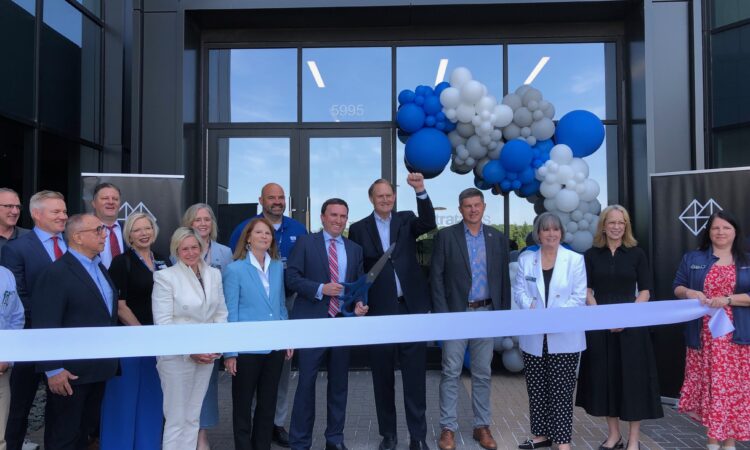
On the eve of Minnesota’s DFL and Republican state conventions, three of Minnesota’s U.S. House members gathered Thursday at the headquarters of Minnetonka-based Stratasys to show bipartisan support for federal government contracts for the 3D printing company.
Stratasys, co-founded in 1989 by Scott and Lisa Crump, hosted a grand opening Thursday for what its leaders call the ARCH—Americas Regional Corporate Headquarters. Stratasys, which had been doing business in Eden Prairie, consolidated much of its Minnesota-based operations into two buildings that have been part of the United Healthcare campus in Minnetonka.
But most companies don’t attract three members of Congress when they move into new office space. Half of Minnesota’s U.S. House delegation nearly attended the Stratasys event.
In a moment of delegation harmony, it was U.S. Rep. Betty McCollum, a Fourth District Democrat, who shared with the audience that U.S. Rep. Tom Emmer, the No. 3 Republican in the House, was unable to be in Minnetonka.
“Don’t believe everything you read in the newspapers. We work together as a delegation,” McCollum said, referring to the Minnesota U.S. House delegation of four Democrats and four Republicans.
“We work together on making sure that Minnesota has a strong economy moving forward, and we work together on national security and advancing opportunities for health care and the environment,” McCollum said. “It’s a great delegation, but you probably won’t read about it that way in the newspapers.”
McCollum, dean of Minnesota’s delegation, serves as the ranking member on the U.S. House Appropriations Defense Subcommittee. “If you look at the cost of defense programs over a lifetime, most of our costs are actually due to maintenance and repair,” she said. If something breaks on an aircraft carrier, McCollum said it would be cost-efficient to be able to make a replacement part on a 3D printer and quickly solve the problem.
“We have to change the way the Department of Defense is constantly doing its regulations, so that 3D printing can be more easily and more widely used for repair and maintenance,” she said. “This Minnetonka facility here at Stratasys is going to keep moving forward, and we need to be partners with you—and those that you’re supplying—on how to make those contracts work better in the future.”
Serving the defense industry
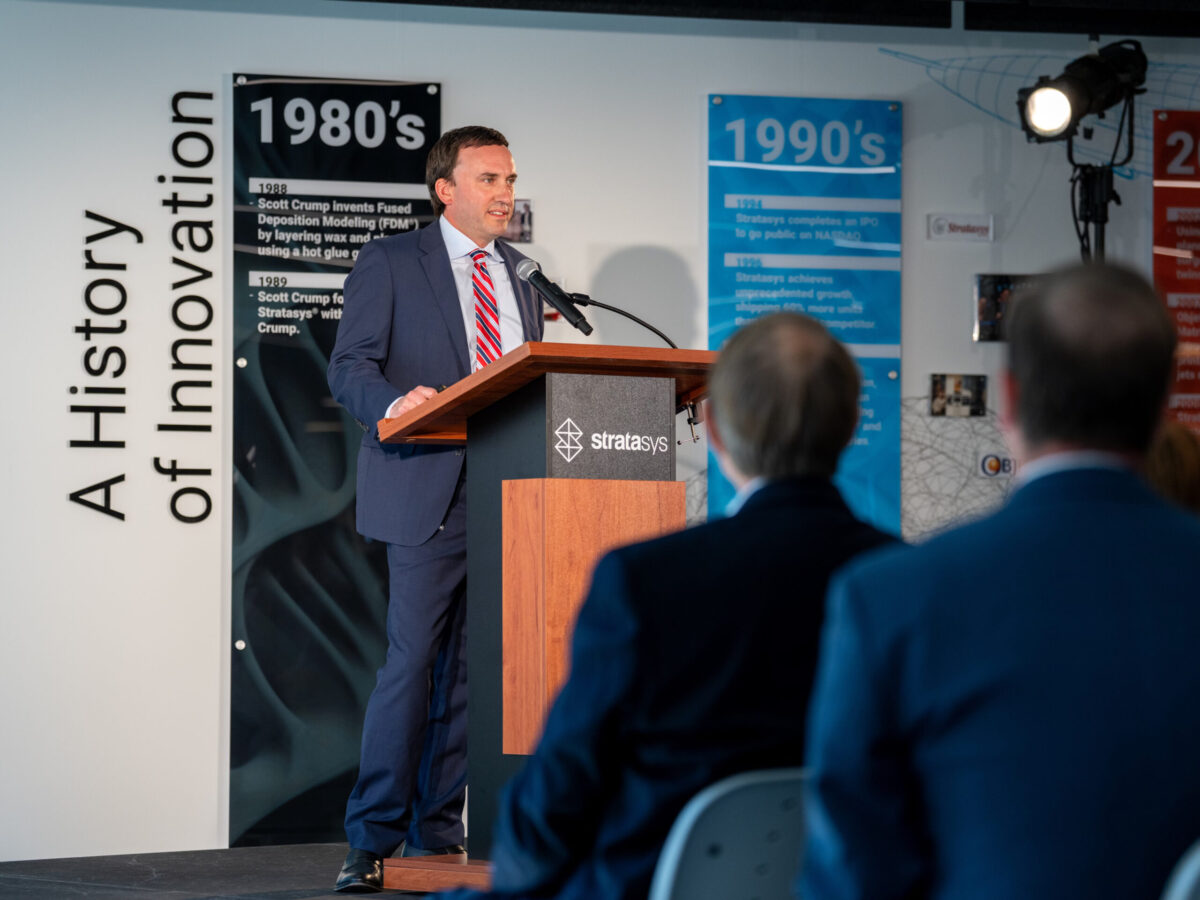
Rich Garrity, Stratasys, Inc., president and chief business unit officer, explained that the company serves the aerospace, defense, automotive, and health care industries.
In the defense sector, he said that Ukraine’s effective use of drones has modernized warfare. “3D printing is at the center of making that possible,” Garrity said. “You can create customized, lightweight drones where you need them, when you need them.”
Drone part production is a growing opportunity for Stratasys. “There is a big push now in the U.S. to build up local suppliers that are capable of meeting the needs of what we need to do in terms of quantities produced. Stratasys is a great answer to do that,” he said.
“In this building, we have over 100 industrial printers running 24/7, many of them are packed with drone components right now,” Garrity said.
“We’re also seeing modernization as we think about spare part production in the military,” he said. “We have a program that we started in 2023 with the U.S. Navy. They have our industrial printers in many bases around the country and around the world.”
The printers enable the military to keep its assets in operation. “They are printing spare parts on demand for aircraft that otherwise would be down and not up in the air,” Garrity said. “They’ve done that together with us and created a digital library of certified parts that you can print in any of these bases at any time, provided you follow the recipe of our process.”
Stratasys Direct chosen for federal program
In March, Stratasys announced that Stratasys Direct, its parts-on-demand business, was selected to take part in a federal program called the Joint Additive Manufacturing Acceptability (JAMA) IV Pilot Parts Program.
“In 2025, Stratasys saw double-digit annual revenue growth from aerospace and defense, demonstrating that additive manufacturing is becoming a key capability for defense sustainment and supply chain resilience,” Foster Ferguson, vice president for the industrial business unit at Stratasys, said in a March news release.
“Stratasys Direct already ships over 100,000 parts annually to the defense industry, and programs like JAMA will accelerate qualification of parts so organizations can deploy them faster across operational platforms,” Ferguson said in the release.
U.S. Rep. Brad Finstad, a Republican who represents Minnesota’s First District in southern Minnesota, spoke Thursday about his tenure on the House Armed Services Committee.
He emphasized his collaboration with Democrat McCollum, who has a leadership role in appropriating funds for defense. “We work closely together to make sure as we hear the concerns of the [defense] industry, as we hear what you all are working on, we transform that into legislation and we make sure it’s properly funded,” Finstad said.
Finstad spoke just before U.S. Rep. Kelly Morrison, a Democrat whose Third District includes the Stratasys headquarters. Finstad dropped a large funding number on his audience during Thursday’s Stratasys event.
“I’m proud of the fact that Betty and I and Kelly, and others in the delegation, worked closely to get $23 million for this project,” Finstad said, which sounded like a new contract or some form of funding for Stratasys. “I would say this is just the start. The ecosystem that we are building in this state is so important.”
The three members of Congress didn’t take media questions Thursday, so it’s unclear precisely what type of funding Finstad was alluding to when he mentioned the $23 million figure.
During her remarks, Morrison said that a major part of her job is regularly meeting with businesses in her district and understanding their challenges and opportunities.
“The impact of Stratasys operations really cannot be overstated,” Morrison said. “This grand opening represents a commitment to investing in our community, creating jobs, growing manufacturing, and bolstering our economy and our national security.”
CEO leads Stratasys from Israel
In December 2012, Twin Cities-based Stratasys, Inc., and Objet Ltd., based in Israel, completed a merger. The company’s stock trades on NASDAQ in the United States.
By combining, the companies said they had formed “a leader in 3D printing and direct digital manufacturing.”
In 2026, Yoav Zeif, the Stratasys CEO, leads the company from Israel. In February 2025, Stratasys announced that Fortissimo Capital, an Israeli private equity fund, was investing $120 million in the company.
Fortissimo had held 1.5% of Stratasys issued and outstanding ordinary shares. Following the $120 million transaction, Fortissimo held 15.5% of issued and outstanding ordinary shares.
In March, Stratasys reported that its revenue for 2025 was $551.1 million, down from $572.5 million in 2024. Stratasys recorded a net loss of $104 million for 2025.
On March 5, Stratasys provided a 2026 outlook in which it anticipated that its annual net loss would be reduced to $67 to $83 million. It projected an increase in revenue to $565 million to $575 million.
It stated those estimates were “based on current market conditions and assuming that the impacts of global inflationary pressures, relatively high interest rates, increased tariffs and other supply chain costs do not impede economic activity further.”
On May 7, when it released first quarter 2026 results, Stratasys maintained its financial outlook for 2026 revenue and a net loss.
“Recurring revenue from consumables and customer support continued to provide stability, while Stratasys Direct delivered strong 23% organic growth year-over-year across a diverse range of industrial applications, led by drone customers,” CEO Zeif said in a May 7 release. “As we look forward, our current pipeline in high requirement applications, especially in defense, continues to build as we gain confidence in our ability to win prominent contracts in 2026 and beyond.”