


How Mawadda’s Disposable Hijabs Are Solving a Problem for Hospitals
Firaoli Adam was sitting in the lobby of a Twin Cities hospital five years ago with her aunt who was scheduled for an MRI. Adam had come along to help translate for her aunt.
When it was finally time for the MRI, a doctor approached the two women, both wearing hijabs, and told them they couldn’t wear them into the room for hygienic reasons. The doctor offered Adam’s aunt a towel instead.
“[My aunt] looked at me and said, ‘This is what you do to people?’” recalls Adam, who works in healthcare as a respiratory therapist.
From that moment, Adam knew change was needed because there wasn’t a sufficient way for Muslim women to cover their hair and neck in healthcare settings. Many times, at hospitals, Muslim women wear hijabs underneath a surgical bouffant cap. The only problem is that hijabs can slip out from underneath the cap, creating a potentially non-sterile environment.
Yasmin Samatar, who met Adam while studying at St. Catherine University in St. Paul, recalls a moment when she was working in an operating room as a respiratory therapist. As she gowned up, her preceptor told her to tuck her hijab in.
“I was getting a little nervous,” Samatar says. “I was like, ‘Oh, I stick out now.’”
Her story isn’t uncommon. Many hospitals across the country don’t offer disposable hijabs to Muslim patients and hospital workers.
That’s why Adam and Samatar launched their St. Paul-based startup, Mawadda.
What is Mawadda?
The name Mawadda comes from an Arabic word meaning the loving affection, deep fondness, and warmth you feel at the beginning of a relationship.
Adam and Samatar’s Mawadda relationship began five years ago when the two were in Boston, Massachusetts, for work. Samatar heard concerns from physicians that hair nets provided in operating rooms didn’t cover the physicians’ necks.
Samatar wanted more personal protective equipment options for Muslim women in healthcare.
Adam thought, “Why not us? If I can protect one patient and myself, that is a big deal for me.”
Adam and Samatar started to search for a manufacturer, and they signed with one based in New York in 2022. Mawadda officially launched the same year.

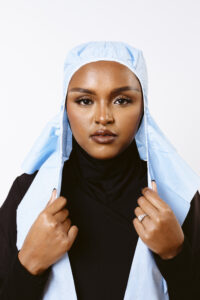
Mawadda received FDA approval in 2022 for its opaque, disposable hijabs that come in two styles. One wraps around the neck while the other can be pulled over the head. Mawadda also filed for a provisional patent, which the U.S. Patent and Trademark Office approved last spring.
Concurrently, Adam and Samatar worked their full-time jobs as respiratory therapists.
“We had to make our own way,” Samatar says, working so they could invest in the business. “It was quite hard.”
Since June, Adam and Samatar have cut their hospital hours to focus more on Mawadda thanks to an increase in orders. The two co-founders are picking up two to three hospital shifts weekly.
Mawadda’s reach goes beyond the United States. Samatar says people from the Maldives and India have contacted the startup to buy their products.
In Minnesota as of this past spring, Mawadda provides its disposable hijabs to North Memorial Health’s hospitals in Maple Grove and Robbinsdale.
North Memorial Health buys into hygienic hijabs
So far, North Memorial Health has purchased 1,470 hygienic hijabs from Mawadda.
Jessi Kingston, North Memorial’s system director, says the purchases “ensure that our patients and team members have a way to maintain their faith and cultural practices and maintain safety in that care that we are providing.”
RELATED: North Memorial and Sanford Health Unveil Merger Deal
North Memorial Health appreciates that Mawadda is local, women-owned, and that Adam and Samatar are experts in the medical field, Kingston adds.
Mawadda acts as a national supplier that serves other hospitals across the U.S. It has also had its hijabs at Duke University, Ohio State University, Advocate Health, and HCMC in Minneapolis.
Adam and Samatar are now evaluating partnerships and working to scale the business to meet demand from additional hospital groups. They’re exploring investment opportunities and non-dilutive funding options, including Small Business Innovation Research grants.