

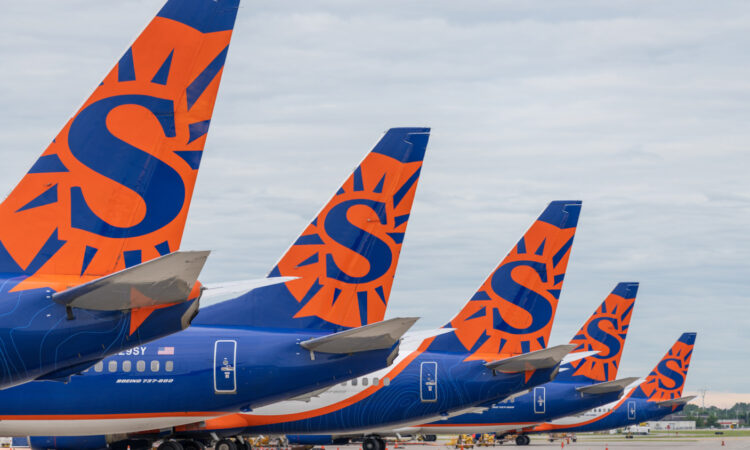
Las Vegas-Based Allegiant to Acquire Sun Country Airlines
Sun Country Airlines, which survived two bankruptcies in the past 25 years, will be acquired by Allegiant in a $1.5 billion deal.
For Minnesotans, the transaction means the loss of Sun Country’s Minneapolis headquarters and the disappearance of the Sun Country name.
Details of the combination were revealed in a Sunday announcement. The merger will be subject to federal regulatory review, but it’s unlikely that the Trump Department of Justice would attempt to block the deal.
The combined airline will be headquartered in Las Vegas, carry the Allegiant name, and retain Allegiant CEO Gregory C. Anderson. Sun Country’s current president and CEO, Jude Bricker, will serve as an advisor to Anderson during the integration of the carriers. Bricker and two additional Sun Country board members will sit on the Allegiant board, which is being expanded to 11 people.
Bricker served as president of Allegiant before he was hired in 2017 by Sun Country owner Marty Davis to become the chief executive of Sun Country. Under Bricker’s leadership, Sun Country grew its operations and became a public company in 2021.
Sun Country is a big player at the Minneapolis-St. Paul International Airport. For 2024, Sun Country’s passenger market share was 11.5%, coming in second behind Delta Air Lines at 69.5%. Southwest was third with 4.8%. American and United each had about 4.4% market share. Those statistics were reported by the Metropolitan Airports Commission.
“Over Sun Country’s 43-year history, we have grown to become one of the nation’s most respected low-cost, leisure airlines with a unique business model for serving scheduled service and charter passengers as well as delivering cargo, with a strong brand and deep roots in Minnesota,” Bricker said in Sunday’s joint news release.
“Today marks an important step in our history as we join Allegiant to create one of the leading leisure travel companies in the U.S.,” Bricker said. “We are two customer-centric organizations, deeply committed to delivering affordable travel experiences without compromising on quality. Importantly, we believe this transaction delivers significant value to Sun Country shareholders and an opportunity to continue to benefit from our growth plans as a combined company.”
For 2024, Sun Country’s operating revenues were $1.076 billion, and its net income was $52.9 million. Its scheduled service passenger flights produced the largest amount of revenue at $409 million. The ancillary category brought in $308 million in revenue, followed by $197 million from charter flights and $107 million from cargo operations.
Under the merger, the two airlines said their passengers would have access to more flight destinations. “The combination brings together complementary route networks across Allegiant’s small and mid-sized localities and Sun Country’s larger cities and will provide more than 650 routes, including 551 Allegiant routes and 105 Sun Country routes. This combination will connect MSP to Allegiant’s mid-sized markets, and expand nonstop service to popular vacation spots, with a continued focus on underserved markets across the U.S. while expanding opportunities into international locations.”
Allegiant exited the Twin Cities airline market in August.
Louis Johnston, an economics professor at St. John’s University and the College of St. Benedict, said Sunday night that he’ll be watching what happens at regional airports.
“You have to wonder how this [merger] will affect the St. Cloud and Sioux Falls airports,” Johnston said. “Allegiant flew out of both, and now with [merger] flights out of Minneapolis-St. Paul International Airport, that might drain some traffic from those airports. In St. Cloud, Allegiant was the only airline, so that might hurt it badly if they decide to shift their flights to MSP.”
Merger effects in Minnesota
The two airlines created a website, soaringforleisure.com, which answers questions about the planned merger.
The acquisition is expected to close in the second half of 2026. So there won’t be an immediate impact on Minnesotans traveling on Sun Country Airlines. Flight schedules and ticketing procedures will remain the same for Sun Country passengers.
Collective bargaining agreements at both airlines will remain in effect. The carriers pledged a “smooth and transparent integration process” for pilots, flight attendants, mechanics, ground staff, and dispatchers.
However, it can be challenging to negotiate one labor agreement for an employee group that comes from two airlines with different contracts and cultures. Sun Country has about 700 pilots who are represented by the Air Line Pilots Association. While the Teamsters union represents about 1,400 Allegiant pilots.
Big benefits flow to shareholders from the deal. “Allegiant will acquire Sun Country in a cash and stock transaction at an implied value of $18.89 per Sun Country share,” the airlines said in their announcement. “Sun Country shareholders will receive 0.1557 shares of Allegiant common stock and $4.10 in cash for each Sun Country share owned, representing a premium of 19.8% over Sun Country’s closing share price of $15.77 on Jan. 9, and 18.8% based on the 30-day volume-weighted average price.”
After Sun Country merges into Allegiant, none of the top five carriers serving Minneapolis-St. Paul International Airport will be based in Minnesota. Northwest Airlines was based in Eagan for many years. Then the George W. Bush administration cleared the way in 2008 for Northwest to be combined into Atlanta-based Delta Air Lines.
Sun Country’s tempestuous past
At two critical junctures in the past 25 years, Sun Country Airlines was knocking on death’s door. So its sale for $1.5 billion is a stunning accomplishment.
A few months after the Sept. 11, 2001, terrorist attacks, three of Sun Country’s creditors filed a Chapter 7 petition in U.S. Bankruptcy Court to liquidate the airline.
Sun Country ultimately managed to convert its bankruptcy to a Chapter 11, so it could restructure and remain an ongoing business.
Its next bankruptcy filing came in 2008 after its then-owner Tom Petters was arrested for running a massive Ponzi scheme.
Sun Country’s financial condition became so risky that credit card companies insisted on a 100 percent “holdback” when passengers bought tickets on the airline. It was an advantage for passengers who still wanted to fly on Sun Country.
Under the holdback, the credit card companies wouldn’t transfer money to Sun Country until after the flights occurred. If Sun Country went belly up, then passengers would get a full refund.
At the time, Sun Country’s leaders made a bold move that helped save the carrier. Shortly after Petters was jailed, the airline filed for bankruptcy to protect its assets and decouple itself from the Petters’ fraud case.
Threatened by a cash shortage, Sun Country executives did a 50% pay deferral for the airline’s employees. But nine days after the bankruptcy filing, then-CEO Stan Gadek was able to increase employee compensation to 70% of prior wages.
In 2011, the Davis family bought Sun Country out of bankruptcy. Brothers Mitch and Marty Davis sold the airline in 2017 to Apollo Global Management, a New York-based investment firm.