

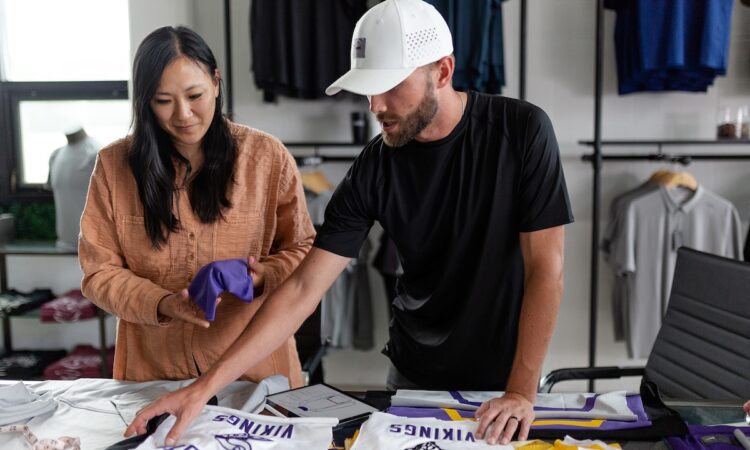
UNRL Clothing Company Absorbs New Tariff Burden
After President Trump announced a tariff regime in April, Michael E. Jordan, CEO of the UNRL athleisure company, decided he wouldn’t pass his new tariff costs along to his consumers.
“We ate it and did not adjust our pricing on anything,” Jordan said, referring to the extra expense of doing business in China. One of Trump’s stated reasons for placing a high tariff on China is to force U.S. companies to make their products in U.S. factories.
“It’s been painful, no doubt,” Jordan said, of the sudden escalation in his manufacturing costs. Jordan is the sole owner of the St. Paul-based company he founded in 2013, and he talked about his business and tariff effects in a recent TCB interview. Before Trump announced 2025 tariffs, Jordan said, “it was already a pretty sizable duty tariff importing [goods] from pretty much anywhere in Asia.”
Volatility and uncertainty are two words closely associated with Trump’s tariffs. He imposed varying levels of tariffs on April 2, reduced them a few days later, created base tariffs, established a 90-day pause for negotiations, sent mid-summer letters to a variety of countries with likely tariff levels, and has pledged to put a revised set of tariffs in effect on Aug. 1.
During a Sunday press conference from Scotland, Trump said he was “close to a deal” with China. While in Scotland, he met with the president of the European Commission and announced Sunday that he’d negotiated a trade agreement with the European Union. A 15% baseline tariff will be placed on European products, including autos. The tariff level on steel and aluminum will remain at 50%, Trump said.

UNRL’s clothing is cut and sewn in the Shanghai region of China, which at one point was subject to tariffs at more than 100%. In this unpredictable environment, Jordan didn’t want to disrupt his carefully constructed pricing structure.
He sells athleisure garments for men, women and children in retail stores and online. UNRL also produces licensed apparel for many professional sports teams. Generally, UNRL products are more expensive than Nike and Under Armour clothing, but less expensive than Lululemon clothing.
Jordan said there also was a practical reason for why he didn’t immediately hike his prices. “When you’re selling into a big box retail store, like a Scheels, or Von Maur [department store], you’ve already sold that inventory six to eight months prior,” he said. It would have been a “tough pill for them to swallow,” he said, if he had suddenly asked his retail partners to share some of the new tariff costs with him.
“We decided we would [absorb] this one on our own, take our medicine, and try to rebound and recover,” he said.
While Chinese factory workers are producing the UNRL garments, finishing work—adding embroidery, trims and sports patches—is done by UNRL workers in St. Paul.
Consumers have responded well to the quality of garments sold by the Minnesota-based athleisure company. “UNRL has seen exponential growth over the past decade, with revenues now well into eight figures annually,” Jordan said.
The company has been consistently profitable, and Jordan has been pleased with the workmanship in the China-based factories that make UNRL products.
Keeping manufacturing in China
When Trump raised trade concerns with China during his first term in office, Jordan said UNRL didn’t flee to another country or return manufacturing to the U.S. “We held firm and tried to weather that storm because it’s about quality for us, quality of not only the product, but the relationships that we have with our key factories over there,” he said.
He’s aware of some U.S. companies that shifted their manufacturing to Vietnam and Bangladesh in recent years. While he’s glad that he stayed put in China, he’s concerned that he doesn’t know what the future holds for China tariffs.
In 2025, Jordan didn’t have any control over tariff levels on China, but he did have control over deciding to continuously ship UNRL goods out of China.
“We didn’t play any games of pausing shipments,” he said. So, he’s paid the tariffs associated with his shipments out of China. “It’s better than having no inventory,” Jordan said.
Treasury Secretary Scott Bessent has said that Trump’s been using “strategic uncertainty” in his approach to negotiating with other countries on tariffs. Commerce Secretary Howard Lutnick told Fox News on Sunday that Aug. 1 is a hard deadline for reaching trade deals. Lutnick used the phrases “no extensions” and “no grace periods,” so new tariff rates are expected to take effect on Aug. 1. However, he added that trade negotiators who want to talk with President Trump beyond Aug. 1 can still do so.
The U.S. Chamber of Commerce has consistently opposed broad-based tariffs on foreign goods produced around the globe. On its website, the U.S. Chamber states: “A tariff is a tax on imported goods paid by the U.S. business or individual receiving those goods at their port of entry. Broad-based tariffs raise prices for consumers and businesses and harm economic growth. They cause uncertainty and disrupt supply chains and are an especially big problem for small businesses that don’t have as many resources to withstand them.”