


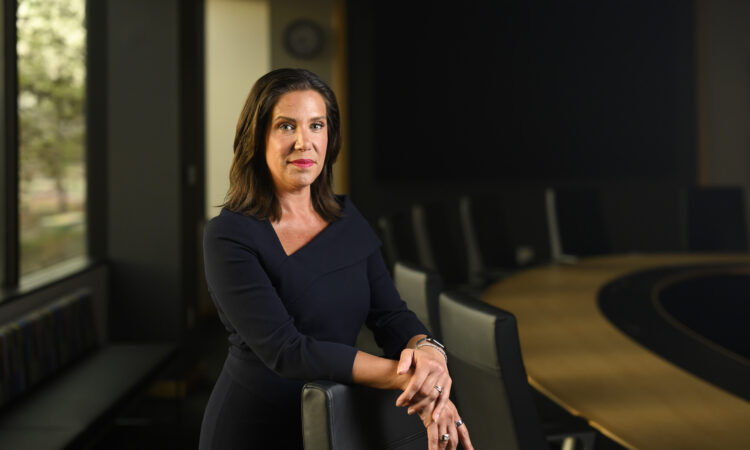
With a Nudge from Hubert Joly, Best Buy’s Corie Barry Became CEO
After the news broke Wednesday that Corie Barry will leave her Best Buy CEO’s position in six months, I immediately recalled how she didn’t want the job.
Originally, she had no intention of becoming a candidate for Best Buy CEO. But she agreed to do so after then-CEO Hubert Joly encouraged her to pursue the top job.
Two years ago, Joly spoke candidly about the process of nudging Barry to seek the CEO post. It was during an interview I did with him for a Twin Cities Business article. Joly described how he helped Barry recognize that she had the talent and experience to succeed him.
Joly’s account appeared in my article “Women at the Top—Gender barriers still exist for two power positions: CEO and U.S. president.” The article was published online and in the April/May 2024 issue of Twin Cities Business magazine.
Here is the section of the 2024 article that charts Barry’s rise to CEO and Joly’s role in helping her advance at Best Buy.
Corie Barry’s career path
When Hubert Joly joined Best Buy as CEO in August 2012, he had no idea that Corie Barry would succeed him seven years later.
“Corie was a junior officer,” Joly says. “She had been with the company for more than 10 years, had been in the field, had been in finance. She was the head of finance for the merchant organization at the time.” He viewed Barry as “smart and thoughtful,” but Joly didn’t pay special attention to her.
In a phone interview from Boston, Joly chronicled how Barry flourished in executive roles at Best Buy but then opposed his recommendation that she become a CEO candidate. Joly currently is a senior lecturer at Harvard Business School.
In late 2012, Joly hired Sharon McCollam to become Best Buy’s CFO, whom Joly described as exceedingly talented and a great partner for him in transforming the Best Buy business model.
“Sharon had a passion for the development of Corie,” Joly says. “She took a genuine interest in her and wrote six-page memos every six months to emphasize areas that Corie needed to work on. She was very direct but really caring. Nice and kind are two different things. She was kind because she was telling the truth.”
Under the sponsorship and coaching of McCollam, Barry strengthened her leadership capacities.
Over time, Joly says he started giving Barry challenging assignments. He asked her to serve as interim president of Best Buy’s services organization. He also asked her to lead the strategic growth office, where the company incubated new ideas.
Joly describes Barry as having “a great strategic mind and a fabulous ability to understand what it takes to get things done.”
He recalls that he had to convince her to take on the hard assignments. Joly says that Barry would ask: “Why do you have confidence in my ability to do these things?”
Joly discussed Barry’s doubts about her leadership ability during a mid-February class he taught at Harvard to 80 senior executives. Barry joined the class via Zoom.
Barry’s tenure with the company was included in a Harvard case study titled Best Buy’s Corie Barry: Confronting the Covid-19 Pandemic, which was co-authored by former Medtronic CEO Bill George, a senior fellow at the business school.
“Corie, with encouragement, stuck her neck out. When she had these assignments, she always vastly exceeded my high expectations. She was able to handle new things that were not part of her expertise. That taught me that she had a great learning ability,” Joly says.
“In this world of multiple intersecting crises and chaos, experience and expertise are interesting,” he says. “But ability to learn and adapt creatively to unprecedented events is a key attribute that I think boards should look at when they promote people to the C-suite and particularly to the CEO job.”
In 2016, Barry succeeded McCollam as Best Buy’s CFO.
The reluctant CEO
After Barry was named CFO, Joly says he told her: “I think there is more in you. I think you could be potentially a CEO successor.” The message wasn’t welcomed by Barry. “She was very clear. She said, ‘I don’t want to do it,’ ” Joly recalls.
He laughs heartily as he tells the story. “The board told me at the time, ‘Stop bothering her. You just made her the CFO. Leave her alone.’ ”
Joly gave Barry space to do her CFO job without the distraction of planned succession.
But by December 2018, Joly had another key conversation with Barry. “It had become clear to me that the time had come for me to think about transitioning the role. I told Corie, ‘Look, this is what I’m thinking. So this is now real. I’m not asking you to say yes. I’m asking you to consider and evaluate the opportunity,’ ” Joly says.
He recognized that Barry still had multiple reservations about taking the CEO job. He told her: “Why don’t you write them down. Then we can talk about it.” Barry drafted a memo with her objections, and the last page contained her rationale for why she might be interested in the job.
Joly had asked her to think about the question “What would need to be true for you to be comfortable and be excited about wanting the job?” He emphasized that reframing of issues was helpful.
Among Barry’s concerns were work-life balance and being compared to Joly, who was credited with successfully turning the company around.
“We had a dinner conversation about her memo, and we talked about all of the objections. She was able to have other conversations with a number of people,” Joly says, and within four to five weeks she told him that she wanted to be a candidate for the CEO job.
Joly says that Barry shared with his Harvard class that the evaluation process “forced her to clarify her leadership approach and, if she was given the job, how she would do it.”
Barry’s first reaction to the CEO opportunity is similar to many women who are hesitant to pursue a promotion opportunity. The reluctance factor is documented by research. Joly says author Sally Helgesen wrote about the behavior pattern in a book titled How Women Rise.
Of course, generalizations don’t apply to all women or all men. But there’s a tendency for many men to seek promotions when they lack some qualifications, while women may not apply for a job in which they meet all of the job requirements, Joly says.
If a woman is offered a promotion, Joly says she might say: “I’m not sure. I’m not done with what I was doing. I’m not sure I want the limelight.”
Joly says a corporate leader should not assume that response is a final answer. “The lesson here is to decode what a man and a woman are going to say and lean in to have a more in-depth conversation,” he says.