

The Mall Comeback: Not Just for Class A?
Over the past few years, the comeback among “Class A” malls has tripped up that pandemic drumbeat of “malls are dead.” Look at Mall of America and Rosedale. “Those are malls that have very cannily worked out how to have ‘shopping plus,’” says Mary Van Note, a partner with Ginger Consulting in Minneapolis. “So, it’s shopping plus entertainment, plus dining, plus events and activations and things like that. So, you’re not just going to shop.” Think: back-to-school events, Nickelodeon Universe—or Rosedale announcing its like-nothing-before addition of BRKTHROUGH, an interactive gaming experience with “challenge rooms.”
“Class C” malls still struggle, she says. Typically, the lower-tier problem is that they’re “over-stored,” she says, full of “also-rans.” “They have another Banana Republic, and they have another Gap. Everybody already knows where the other ones are.”
This could have been the Shoppes at Knollwood, the 450,000-plus-square-foot shopping center in St. Louis Park—“except,” Van Note says, “they have very smartly pivoted to off-price. They have a cluster of stores that are value oriented, and that’s a differentiator in the market.”
On Aug. 20, Knollwood sold to KPR Centers, a New York City-based real estate firm. KPR bought it for $85.2 million from Chicago-based Heitman, according to a certificate of real estate value. That price is slightly higher than the appraisal.
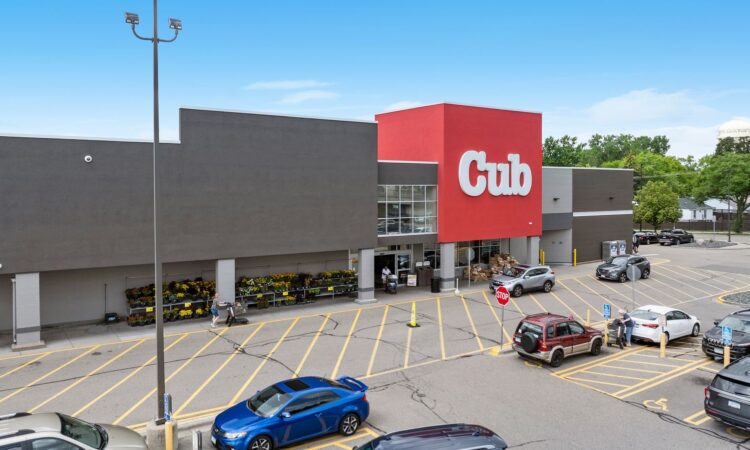
Knollwood is anchored by Cub Foods and features Banana Republic Factory, DSW Shoe Warehouse, HomeGoods, J. Crew Factory, Nordstrom Rack, Old Navy, Total Wine & More, T.J. Maxx, and Ulta Beauty, along with several restaurants. It’s close to 99% leased, KPR reports. But the Kohl’s there is predicted to move out in the next year or so, with a lease set to expire.
“It’s a great lineup,” agrees Andrew Frank, KPR’s COO and general counsel. “This isn’t a high-end lifestyle center, right? … These are brands like T.J. Maxx and HomeGoods and Total Wine,” which feel “really recession-proof.” Aside from some metro outlet stores, this is Knollwood’s niche.
Cub is a differentiator, too, and speaks to KPR’s acquisition strategy: An anchor grocer, arguably the most recession-proof, can drive traffic. “It’s not just apparel shopping, right?” Van Note says.
“Other traffic drivers include the Foss Swim School, Chick-fil-A, Total Wine, and a Target across the street,” Beth Perro-Jarvis, also with Ginger Consulting, says in an email. (“Note the difference in quality (lower!) of the other stores in the Target strip mall versus Knollwood,” she adds. “It’s striking.”)
Still, bumps are anticipated. “We’ve had some Joanns. We’ve had some Party Citys,” Frank says. “Like, we get it. There’s always going to be bankruptcies. But we feel like the economy is in a good place right now, and while we expect some vacancy … to be honest, there’s no one that stands out at the Shoppes of Knollwood that we’re particularly concerned about.”
The Strategy
KPR has been rapidly absorbing shopping centers like Knollwood nationally.
On a self-described “buying spree,” it is after “high-performing grocery-anchored retail centers.” In the past 18 months, that has meant about $400 million for 12 retail properties. Frank says KPR stands out from other firms in that it doesn’t outsource operations, completing all leasing in house. At this point, KPR owns and manages nearly 50 properties. That’s about 10 million square feet of retail space across 20 states.
Most recently, KPR bought: a mall in Kokomo, Indiana; a grocery-anchored shopping center in New Jersey; and a grocery-anchored center in Denver. Earlier last year, the group purchased an eight-property portfolio with shopping centers in the Midwest and Florida—1.5 million square feet in total. It includes Milwaukee and St. Louis.
The Midwest used to trade retail real estate at “a slight discount” compared to the East Coast, Frank says, but at about the same level of quality and regional affluence. Today, that gap is narrowing. KPR has been monitoring the greater Twin Cities market since 2016, and this is the first deal here they’ve closed.
Knollwood appeals for its fundamentals. The median household income in St. Louis Park is $100,250, per census data; the population density, more than 4,600 per square mile. “Those the two things, from a market perspective, are why we like it.”
Competition was fierce, Frank says. “There are a lot of groups like ourselves—competitors—and I can’t tell you why they [sold] to us, but we have a good reputation.”
Knollwood fits the KPR strategy in its anchor format, too. “We’re big believers in the hub-and-spokes model,” Frank says. “We always plant the flag … with the dominant grocery—the No. 1 or No. 2 grocer in the market. And from there, we typically like to buy other properties in the surrounding area.”
The plan for KPR is to expand in the Twin Cities. “There’s definitely more money entering into the retail space,” Frank says. “So, it’s more competitive. And, by definition, when you get awarded the deal, typically that means you’re paying the highest price.”
Market Conditions
What has spurred KPR’s buying spree? “There’s very limited new supply,” Frank says. “And there’s historically low vacancy levels.”
This retail comeback story—even if it turns out to be provisional—is long in the making. “Before [the pandemic], everyone was worried about the Amazon threat, right?” he notes. “Online shopping was going to destroy retail. Well, guess what? People still want to leave their houses.”
The anticipated departure of Kohl’s would mean growth potential for KPR. It’s a chance to “refresh” that side of the center, says Stefanie Meyer, principal of Mid-America Real Estate in St. Louis Park. If Kohl’s leaves, it would be “because their sales aren’t high enough or productive enough to stay.” Kohl’s continues to see sales declines, Van Note points out, with second-quarter comparable sales this year down a little more than 4%.
There would be multiple options for the Kohl’s space, Meyer says—“either find a tenant to take the whole box, or you could subdivide it.” As for what should go in, “adding entertainment or fitness into different types of retail settings is really helping retail bring in people either more often, on the fitness side,” she says, “or, on the entertainment side, you’re bringing people from a farther distance.”