


Municipal Liquor Stores Log 28th Consecutive Year of Record Sales
If you’ve lived or still live in a smaller outstate city or a larger Twin Cities suburb, chances are you’ve bought a six-pack or a bottle of wine at your community-owned municipal liquor store.
And a lot of those munis are doing pretty well. This month, the Office of the Minnesota State Auditor published an analysis of municipal liquor store operations for 2023. According to the report, Minnesota’s municipally owned liquor retailers posted overall sales of $437.4 million—an increase of 0.9% over 2022 and the 28th consecutive year of record sales. In addition, the combined net profit of all munis totaled $31.6 million in 2023, a 15.3% increase over the prior year.
This doesn’t mean that all munis are booming. Many have closed in recent years, and many others have been unprofitable. Still, it’s remarkable how enduring this unique Minnesota institution remains.
Munis: A Minnesota thing
The state of Minnesota authorized the establishment of munis after the repeal of Prohibition in 1933. The idea was to allow communities with fewer than 10,000 residents to control local sales of alcohol—and how much and in what form it’s consumed. This legislation is part of our state’s notably hardy blue-law tradition. Liquor retail sales on Sundays became legal only in 2017. Minnesota also is the last state in the union that prohibits grocery retailers from selling any beer with an alcohol content above 3.2%. (There is a bill currently filed in the Legislature to allow the retailers to stock stronger brews.) Despite ardent attempts over the years to overturn long-established state rules, Minnesota grocers still can’t sell any alcoholic beverage other than beer, and none stronger than 3.2
And while other states certainly control how alcohol is sold, only Minnesota allows city governments to have a monopoly over retail liquor stores within their boundaries.
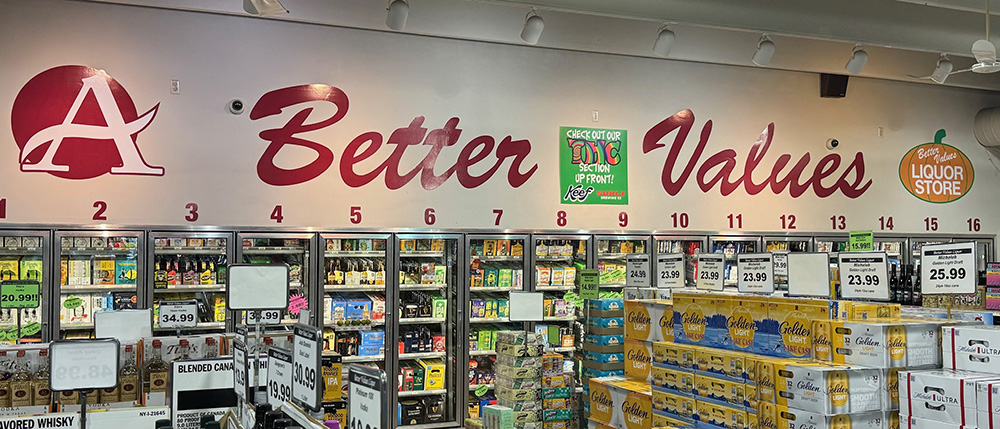
Photo courtesy of Better Values Liquor Stores on Facebook
More than 90 years after Minnesota enacted the muni law, 176 communities still handle their own liquor retailing. Nearly 90% are located in Greater Minnesota. But many metro-area suburbs, including Eden Prairie, Wayzata, Robbinsdale, and Columbia Heights, also operate municipal liquor stores. Several cities have more than one retail outlet—Richfield has four, Edina has three—which is why there are 210 stores counted in the 2023 report. Though these suburbs’ populations have long exceeded 10,000 residents, grandfathering allows them to stay in charge of liquor retailing.
Whatever municipal liquor retailers’ original restrictive (and sometimes busybody-ish) purposes, for many communities in Greater Minnesota, these government-owned businesses often meet a need that private enterprise didn’t address. Municipal liquor operations also provide their hometowns with additional revenue to fund programs and maintain public amenities. That is, when they’re profitable.
Greater Minnesota’s complex picture
The overall profitability that the State Auditor report identifies isn’t spread evenly throughout Minnesota. The 18 metro-area stores earned 26.1% of the net profits of all munis statewide, as well as 33.1% of total sales. To be sure, these stores operate in more populous markets. But they also have competition from neighboring towns and often higher overhead. Outside of the metro, Detroit Lakes tallied the highest sales in 2023 among outstate munis—$9.3 million, sixth among all municipalities. Number one was Lakeville, whose four stores posted $22.7 million in sales.
But 31 Minnesota cities endured net losses on their municipal liquor operations in 2023—28 of them were in Greater Minnesota. The State Auditor’s report also notes that 76 cities experienced declines in their net profits between 2022 and 2023. Most of those (68) were located outside the metro.
Meanwhile, the number of munis has been shrinking, from 235 in 2014 to 210. The rural towns of Hanska, Littlefork, and Spring Grove closed their stores in 2023. Elmore (population 550) shut down its unprofitable operation in 2024; Keister closed its muni just this month. The factors that the report cites that can push a community to close its muni include lack of profitability, onerous insurance costs, and competition from privately owned stores within driving distance. Technically, any community with a population of 10,000 or fewer residents can still apply to open its own retail liquor operation. But none have done so in recent memory.
Still, outstate munis rank often high when net profit is measured as a percentage of sales. Lake Park, for instance, despite having a population of a little over 700, posted a net profit of 24.1% on $1.1 million in sales in 2023. That was the highest percentage recorded by any muni still in business. Compare that to powerhouse Richfield, with a profit percentage of 10.1% on sales of just a shade under $14 million. That percentage ranked Richfield 35th among all community liquor retailers, though its $1.4 million net profit was the highest of all Minnesota munis in 2023.
One reason for the ongoing success of many community alcohol retail operations: increasingly savvy marketing. Early on, they were typically called just the Municipal Liquor Store. These days, they’re likely to have branding such as Better Values (Anoka), Mountain Spirits (Proctor), and the Grog Shop (Glenwood). In January, the Two Harbors muni, which ranked 46th for gross sales in 2023, moved into a newly built 10,500-square-foot location with a brand-new name: Breakwall Bottle Shoppe. (The operation’s previous moniker: Two Harbors Liquor Store.)
In other words, though their numbers have shrunk somewhat, most munis have learned how to survive. The Minnesota Star Tribunerecently reported that cannabis-infused beverages have provided a profitable high for many community stores. (THC potables also have kept several small breweries afloat.) Recent history suggests that we’re likely to see more municipal liquor stores shutting their doors in the coming years. But for munis with good locations and nimble management, the future of this distinctly Minnesotan tradition seems assured—and worth at least a toast or two.