

A Hard Year for Minnesota Craft Beer … Or Was It?
Is Minnesota’s craft beer industry facing a reckoning? A casual glance at the headlines over the last year might leave you with the impression that the industry is in something of a freefall.
September saw the closure of Eastlake Craft Brewery at the Midtown Global Market in Minneapolis. A month later, Dangerous Man shuttered its Northeast Minneapolis taproom. November ushered in a closure announcement from Clutch Brewing at St. Paul’s Keg and Case food hall. In early December, Loring Park brewery Lakes & Legends announced plans to close before the year is over.
Back in the first quarter of 2022, Tin Whiskers owner Jeff Moriarty ominously told Axios that a “reckoning is going to happen” around the time he closed his St. Paul taproom.
Have his predictions come true? Well, not so fast, industry advocates say. A closer look reveals that there have actually been more Minnesota brewery openings than closings in 2023, according to data compiled by the Minnesota Craft Brewers Guild, an industry trade group that represents about 80% of the state’s brewers. That’s not to say things are entirely rosy, though. A more apt characterization for the industry? Craft brewery advocates and observes argue that it has simply “matured” after growing at a breakneck pace over the last decade.
Bob Galligan, director of government and industry relations at the Minnesota Craft Brewers Guild, says he’s been asked whether the “brewery bubble” has popped after almost every closure over the years. “This is a conversation we’re going to continue having; it’s not necessarily going anywhere,” he says.
Galligan acknowledges that his group “has seen somewhat of an increase” in closings this year compared to others – six in total, as of mid-December. At the same time, though, he notes that eight breweries opened this year, and seven more are actively in development. In general, Minnesota’s level of closures and openings is largely in line with other states’, Galligan says.
As of 2022, Minnesota counted 233 craft breweries in total. That’s up significantly from 2011, when the state had just 35. That’s the same year Minnesota lawmakers passed the so-called “Surly bill,” which enabled brewers to sell beer on-site and paved the way for a big boom in taprooms over the years that followed.
But times have changed since those golden early years. Ingredients have become more expensive. So has rent. Saturation doubtless plays a role, too, especially within the boundaries of Minneapolis and St. Paul proper, where there are several breweries in close proximity to one another.
“We’re not seeing the explosive openings we saw from 2011 through 2019, that’s for sure,” Galligan says. “I think those days are certainly behind us.”
The urban-suburban divide
Location has certainly begun to play a bigger role in the fate of breweries and taprooms these days. Metro-area breweries tend to face a tougher time than suburban ones. Sarah Bonvallet, co-owner of Dangerous Man in Northeast Minneapolis, says that’s certainly been her experience.
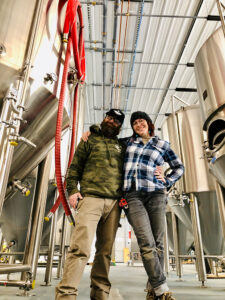
“We had a lot customers that were driving in from the suburbs to experience that Minnesota craft beer scene,” she says. “Now those suburban communities are getting their own taproom experience. I think metro taprooms were kind of reliant on that suburban traffic.”
After Covid-19 struck, Dangerous Man’s taproom traffic never returned to prior levels, which made it less and less economically feasible.
But Bonvallet says she and co-owner Rob Miller ultimately decided to close their taproom and switch to a distribution-only model for a “kaleidoscope of reasons.” The brewery’s lease in Northeast was expiring, for one. Plus, the couple’s commute to the taproom from their hobby farm an hour outside the city began to wear on them.
As the couple weighed the decision to close the taproom, a close friend approached them with an idea that finally sealed the deal. A group of real estate investors backing local chef Yia Vang were looking to purchase the building that housed Dangerous Man. “Once I found that out, I was like, ‘This is universe is telling me this is the right decision.’” says Bonvallet. Vang, who’s become “close buddies” with Dangerous Man’s founders over the years, is now planning to open his new Vinai restaurant in the taproom’s former space.
Bonvallet and Miller are still making and selling Dangerous Man brews from a Maple Lake production facility that began running in March. The facility is much closer to the couple’s home, she notes.
To be sure, Dangerous Man’s fate runs in stark contrast to other brewing operations in more far-flung suburbs. Consider Hackamore Brewing Co., which opened its doors in Chanhassen in spring.
Hackamore founder Zac Gleason left his longtime corporate gig in real estate with Bigos Management to open the brewery. He says the decision to open a suburban brewery just off Minnesota State Highway 5 was “very intentional.”
Gleason notes that there’s “lots and lots of population and homes within one mile” of his business.
“‘Location, location, location’ is definitely the real estate term everyone knows, and I took that into consideration, as well,” says Gleason, who also runs the popular Sota Eats account on Instagram on the side.
When Gleason first applied for an LLC for his business two years ago, he was well aware of rapid changes in the beer industry. Yet he was undeterred. “I didn’t feel like I was guessing at anything,” he says. “I came up with very specific and educated financial numbers to back up the entire plan.”
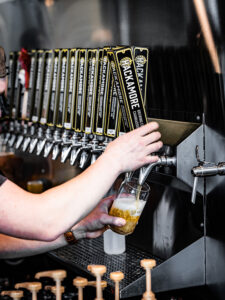
(Photo by Erik Eidem)
Just several months into opening, Hackamore has generated a steady stream of patrons, says Gleason, who adds that he does everything he can to ensure the brewery is “very, very family friendly” to cater to locals. It’s also open seven days a week, with several regular events to attract patrons. More than anything, Gleason says, it’s all about creating a unique “taproom experience.”
Tales from the other side of the river
That’s not to say all urban breweries are struggling. Take Pryes Brewing Co., just about a mile from Dangerous Man in Northeast Minneapolis. Where other breweries are downsizing or closing, Pryes actually tripled the size of its taproom in April, says president Mike Corneille. Traffic has “definitely” been up this year compared to last, in part due to an increase in taproom events in 2023.
Corneille also notes that Pryes gets a “ton of traffic” from the North Loop, which has seen something of a resurgence in recent years. “There are more and more people are living in the North Loop,” he notes.
Pryes, which is now the second largest taproom in the state after Surly, also sells brews to bars and restaurants – a business segment that has been growing year over year, Corneille says.
“We’ve seen more restaurants opening, and people are open for more hours. All of that has been great,” he adds. Pryes’ sales to liquor stores have been flat, though, which Corneille says is largely in line with industry trends.
| Year | Number of craft breweries operating in Minnesota |
| 2011 | 33 |
| 2012 | 47 |
| 2013 | 52 |
| 2014 | 73 |
| 2015 | 105 |
| 2016 | 112 |
| 2017 | 158 |
| 2018 | 178 |
| 2019 | 196 |
| 2020 | 217 |
| 2021 | 226 |
| 2022 | 233 |
Source: Brewers Association
Long live the brewpub?
While taprooms have faced plenty of struggles in recent years, another longtime industry player is still standing strong: the brewpub. In Minnesota, they’ve existed for decades before taprooms. They face tighter caps on production, though, and unlike full-scale breweries, they can’t sell beer offsite, with the exception of crowlers and growlers.
But, over in Robbinsdale, the Travail-owned Nouvelle Kitchen & Brewery isn’t having any trouble attracting traffic. The brewpub is an outgrowth of Pig Ate My Pizza, which first opened back in 2013 and morphed into Nouvelle at the start of 2022.
“Almost immediately after” the rebrand, the brewpub saw its beer sales nearly double, says Nouvelle head brewer Andy Goettsch. Production has continued to increase since then, too.
“The idea to switch to Nouvelle was to put more of a spotlight on the beer and the brewing we have here,” he says. These days, he has 23 brews on tap.
“We don’t have the challenge of finding a consumer out on the shelf or in a restaurant,” Goettsch says. “This model kind of goes against the downfall of some of these production breweries.”
While traffic isn’t a problem for Nouvelle, inflation is hitting the brewpub all the same. “The price of ingredients, shipping, CO2 – all these things have skyrocketed since 2020,” Goettsch says. “Grain and hops are starting to kind of come down a bit, but shipping costs are still really high. That has ultimately impacted the price of beer.”
The THC question
Bonvallet of Dangerous Man says the price of the product is something that continues to weigh on her and other brewers. With increasing costs, it’s becoming harder to sell affordable beers. “Beer has always been the working man’s beverage. It’s not the price of a cocktail,” she says. “From a philosophical point of view, it’s almost like we’re kind of fighting with ourselves on what we are and who we are.”
The advent of cannabis beverages in Minnesota poses another philosophical question for brewers in the state. Though they haven’t been a total cure-all, they’ve certainly been a boon for brewers across the state. Bonvallet says Dangerous Man has experimented with a few THC beverages, though her main focus will always be on beer.
Galligan with the brewers guild says it’s clear that THC has saved some members.
“I wouldn’t say that it pays the bills for the majority of members,” he says. “But I also can say with a straight face that there are probably a handful of breweries that would have shuttered had THC not come into play.”
Whether they choose to sell beers, hemp beverages, or both, Galligan argues that breweries serve as an important “third space” in a rapidly digitizing world – a space outside home and work.
“There’s such a lack of third spaces nowadays, in general,” he says. “Coffee shops, taprooms, and bars are some of the last remaining bastions.”