

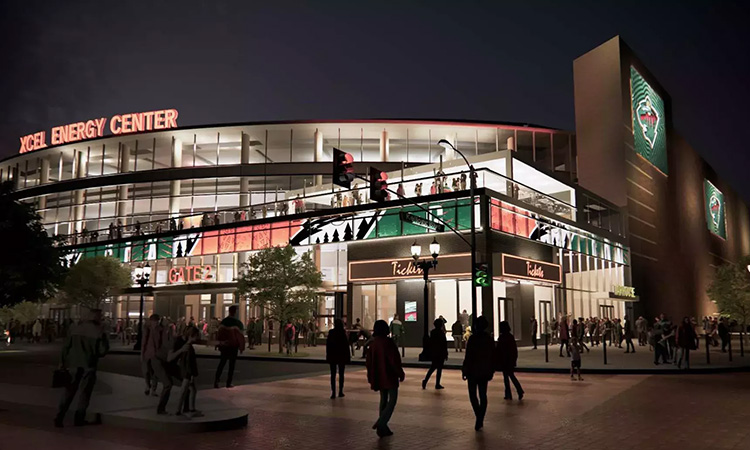
Minnesota Wild Owner’s ‘All In’ for 2025 Arena Funding

While the Minnesota Wild hockey team focuses on securing a playoff spot, owner Craig Leipold is competing for funding at the Minnesota Legislature for a Wild arena renovation project.
Earlier this month, Leipold and St. Paul Mayor Melvin Carter jointly appeared before the investment committees in the Minnesota House and Senate to seek $395 million in state funding.
That money—proceeds from appropriation bonds sold to bondholders—would represent about half of the money needed to modernize Xcel Energy Center, as well as the adjacent Roy Wilkins Auditorium and Saint Paul RiverCentre.
Whether a bonding bill will be approved by the 2025 Legislature remains an open question, but Leipold is definitive in how he views the timing issue.
“We are ‘all in’ for this year,” Leipold said in a Friday interview with Twin Cities Business in his Minnesota Wild office in downtown St. Paul. During a wide-ranging interview, Leipold was joined by Matt Majka, the Wild’s CEO, during discussion of the arena-complex issue.
“It’s priority No. 1 for the mayor,” Leipold said. The three buildings in the Xcel Energy Center complex are owned by the city, which estimates it attracts more than 2.1 million visitors a year and $383 million in spending within the city.
When Carter announced the funding package outline on March 19, he said the total cost of renovations and improvements would be $769 million. Carter indicated the city would ask the state of Minnesota for $394.6 million, Wild owner Leipold would fund $215.8 million, and the city of St. Paul and local partners would provide $158.8 million.
Leipold and Majka are going full throttle in advocating for the funding package. Leipold divides his time between homes in Racine, Wisconsin, and St. Paul. “I’m here three or four days a week,” Leipold said, and he and Carter have been meeting individually with legislators. On the days he’s out of town and a legislative meeting slot opens, “the mayor and Matt will go up and talk with them,” he said.
Carter and Minnesota Wild leaders have positioned the arena complex as an economic engine for downtown St. Paul, which has struggled since the onset of the 2020 pandemic.
Noting the intense competition for entertainment dollars, Leipold said that Xcel Energy Center needs structural and design upgrades, and the other buildings need to be modernized to attract conventions and other big events.
Owner funding of sports facilities
The state funding request from the city and Minnesota Wild surfaced not long after state lawmakers received a projection for a future budget deficit. The renovation package also was assembled at a time when federal funding to local governments is uncertain, and local taxpayers have pushed back against property tax increases.
Critics of government funding for professional sports facilities often state that the wealthy team owners should pay the full cost of new or renovated arenas or stadiums.
During the interview, when asked how he would respond directly to a critic, Leipold explained the Wild’s position as well as how he arrived at the Wild’s proposed contribution to the renovation package.
“This is a building that I would have to remind them that is owned by the city,” Leipold said. “Our job is that we have paid all the maintenance in this building.”
He stressed that the arena is used for 41 home games during the Wild’s regular season as well as for playoff games. “Half of the events [in the Xcel arena], maybe even less than half of the events, are Wild games. The other ones are concerts, high school hockey games, high school wrestling. There is so much going on in that arena that [doesn’t involve] us. We pay a lease.”
The first season the Minnesota Wild played in their current arena was 2000-2001. The NHL awarded Minnesota a franchise in 1997.
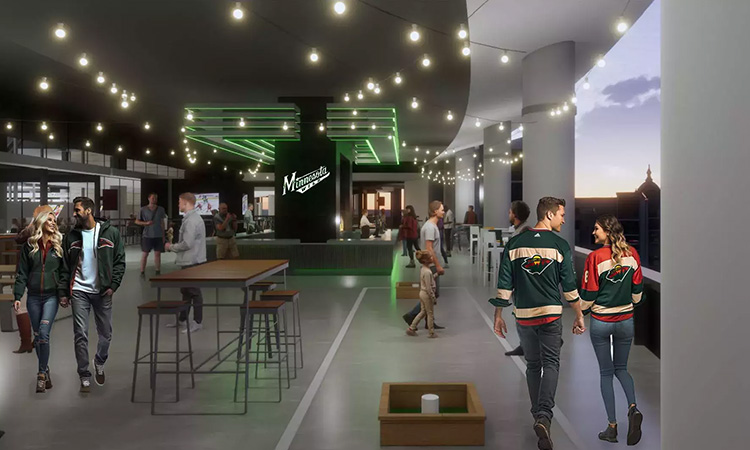
(Image courtesy of Populous)
The city of St. Paul said the arena cost $173 million, with 70% coming from the Minnesota Wild and 30% from public sources.
Majka was part of the original Wild staff and worked for founding owner Bob Naegele Jr. He’s well versed in how the funding came together and the financial ramifications over time. “Here’s the way it worked,” Majka said. “There were two loans, $65 million from the state and $65 million from the city. So that’s $130 million. We wanted to make the building a little better, so Bob [Naegele] put an extra $40 million in right out of the chute.”
Over 20-plus years, Majka said, the Wild have been repaying the loans to the city and state and ultimately will end up paying between 70% to 80% of the building’s cost.
Wild’s share of the arena renovation
Under the proposed funding breakdown, the Wild would pay roughly 30% of the renovation cost of the three-building project.
When asked how they arrived at that figure, Leipold and Majka said they looked at pro sports facilities in other cities as well as funding packages for Minnesota pro sports teams.
“We went out and visited a lot of different facilities, brand new ones that were being built,” Leipold said, recalling visits to seven pro sports buildings.
“Most of the time, we were with someone from the mayor’s office,” he said. “We would ask them, ‘How was it financed?’ and the 30% [owner contribution] was kind of right in the middle. It was kind of the number that was comfortable, and it also mirrors what the Twins have done.”
Dr. Bill McGuire, owner of the Minnesota United pro soccer team, built Allianz Field in St. Paul without government funding. However, there was public funding involvement in the construction of CHS Field in St. Paul and Target Field and U.S. Bank Stadium in Minneapolis.
For the Minnesota Twins ballpark, Hennepin County paid a majority of the construction cost by using a county-wide sales tax as the revenue source.
Leipold, a 16-year Wild owner and downtown St. Paul resident, said Xcel Energy Center doesn’t meet today’s arena needs.
“This arena was designed in 1997 and 1998, and it was designed to last for 25 years,” Leipold said. “Our kitchens are woefully underperforming for what we need to do.”
He emphasized that restroom access needs to be improved as well as the ability of people to move more quickly throughout the building. “Behind the walls, the technology has changed dramatically, and the wiring that is needed for today’s technology to telecast the games is very different,” he said.
Leipold noted that hockey fans are looking for different experiences than they sought decades ago. “They want more communal areas,” he said. “We have 74 corporate suites, and the new facility would have 50.” For example, he added, one could construct an area with its own bar for 70 people, but there wouldn’t be seating for that many people so attendees could mingle in the space. Also, he said, smaller spaces could accommodate groups of eight, such as friends or work colleagues attending a game.
If the Wild nail down a financing package this year, Leipold said that construction could begin in the summer of 2026. If the Wild continued to use their existing rink during the renovation, Leipold said construction would take three years to complete. However, if the Wild played elsewhere in the Twin Cities, he indicated that contractors could complete their work over 18 months.
The Wild haven’t decided which of those two options to pursue. Leipold declined to say which sports facility would host the Wild if they decide to relocate during construction.
In addition to modernizing the arena, Leipold and Majka stressed the need to upgrade Roy Wilkins Auditorium and Saint Paul RiverCentre. They said plans call for increasing convention center space from 100,000 to 140,000 square feet.
Across from the Xcel Energy Center complex is an old parking ramp where Leipold said he’d like to see a hotel development. In the past, he said, hotel leaders have said St. Paul’s convention center space was too small for them to make an investment in a hotel.
However, he said the increase of 40,000 square feet of space would push St. Paul into a size category that makes the city much more appealing to hotel developers.
While Leipold said he doesn’t want to get into the hotel business himself, he strongly believes that St. Paul needs a convention hotel. “We’re not going to own the hotel,” he said. “We’re not going to pay for it, we’re not going to build it. We’re just going to [help] get a convention hotel.”