

Why Are We So Angry at the Pohlads?
On July 30 and 31, the Minnesota Twins traded away what was thought to be the league’s deepest bullpen, 11 players in total. The team had played a lethargic brand of baseball, despite analytics that had picked it to win the AL Central. At least the Twins would have new owners for 2026, outraged sportswriters crowed.
Two weeks later, the Pohlad family announced it had pulled the team off the market, ensuring family ownership for the foreseeable future. The opprobrium was swift. Dreams had been “crushed,” the team was “financially mismanaged,” the family “didn’t care” about anything but lining its pockets.
2025 will be the ninth losing season of 16 at Target Field, a ballpark fans were promised would generate revenues to finance winning baseball. Those years have included five playoff appearances, with a record of 3–12. (In its final decade in the Metrodome, the Twins had eight winning seasons and five playoff appearances, with a record of 6–18.)
Minnesota has a curious legacy of teams that can’t win. For some, like the Vikings and Wild, the playoffs are kryptonite. For the Twins and Timberwolves, it’s years of failure to draft or develop the right players. Add in bad luck, and injuries, and it’s Loserville, with the longest stretch without a championship of any four-sport town—34 years.
But rarely does a fan base and media place blame entirely on ownership the way we do the Pohlads. I grew up in Chicago, where the Cubs have been terrible most of my lifetime, and the ire is typically directed at players and management. In Denver, where frugal Monfort family ownership keeps the Rockies losers, fans still fill Coors Field.
But here in the 612, the phrase “cheap Pohlads” is as native to Twins fans as “Dollar Dog Night” and “Bomba Squad.” The Athletic surveyed its readership and found 98.5% wanted the team sold.
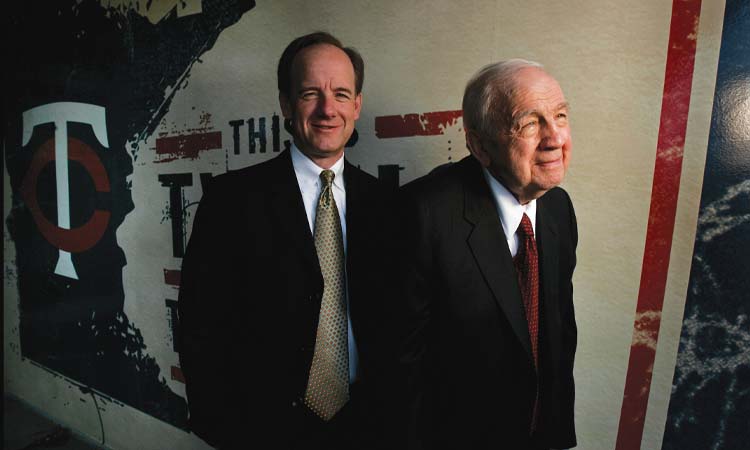
Were the sins of the father being visited on the sons? Wasn’t it Carl, the dour, penny-pinching patriarch, who engaged in a sham sale of the team and faux contraction to extort a new ballpark out of taxpayers? (He bought the Twins in 1984 from Calvin Griffith for $44 million.)
The Strib’s Pat Reusse, dean of the local baseball scribes, thinks not. “Carl had a good decade” post-chicanery with six division titles. Memories are short.
The primary issue in the Pohlads’ tenure (fourth in longevity of MLB ownership) is fans’ belief that the family starves the team of the resources to win. (Baseball teams are privately held, and information about finances is gleaned through lawsuits, leaks, and educated guesses.)

The team has been owned by Carl’s sons, Jim, Bob, and Bill, for most of the last 20 years. They are humble, reticent, community-minded, politically liberal men whose record of munificence is unappreciated. (Google the Pohlad Foundation.) The team was one of only a handful in pro sports that did not furlough its workforce during Covid. Executives who have departed non-baseball Pohlad companies over the last decade insist the team loses money on an operating basis. (Yes, accounting is a parlor game, and the family’s 40-year gain on the Twins is about $1.6 billion.)
The decision to retain the baseball club and bring in limited partners solves several problems. It will pay off a reported $425 million in debt, a cause célèbre among sportswriters. The Twins, say CNBC, are also No. 4 in baseball in leverage, at 24%. At 10% interest (probably high), that’s $42 million in debt service annually. CNBC estimated the Twins’ EBITDA at $41 million last year.
The minority partners had not been named at press time, but if the family sells a third of the team, it will generate enough capital to eliminate the leverage and create liquidity for a third generation that seemingly lacks unanimity about the value of owning a baseball club. The Pohlads remain in real estate, manufacturing, and entertainment businesses, but the Twins are their largest asset.
I spoke to a limited partner of another local pro club who noted that limited partners are chosen for their alignment with the majority owner and have neither veto power nor much input on player spending. The thesis that these investors are arriving to revolutionize the “Twins way” is a fantasy.
Twins player payrolls have historically been in the lower middle tercile of MLB, commensurate with our No. 16 market size (New York City, Chicago, and LA each have two clubs). For 2024, the team was thought to be spending $154 million on payroll, out of $324 million in revenue, according to Forbes and Spotrac. Its revenue was 23rd of 30 teams, and it was 20th in payroll.
The Twins have lost approximately $50 million in annual broadcast revenues due to the collapse of the regional sports network business, which left the Twins producing and selling its own broadcasts. “I’d be surprised if they are doing much more than breaking even on that,” an executive with another local team told me.
MLB is one of the few pro sports where stadium revenue remains a driving force in team economics. The Twins have never had two consecutive seasons of attendance growth at Target Field, and this year’s attendance will be the worst since the Metrodome era (and Covid).
Read more from this issue

The oft-prescribed prescription is to elevate payroll above league average. This year, that would be north of $173 million, about $20 million more than it was spending at season’s start. Teams with payrolls in that range—Seattle, Kansas City, and Baltimore—reveal dismal playoff records. Said one former MLB exec I spoke to, “If [Minnesota] wanted regular playoff runs, they would need to spend $100 million more a year, not $25 million.”
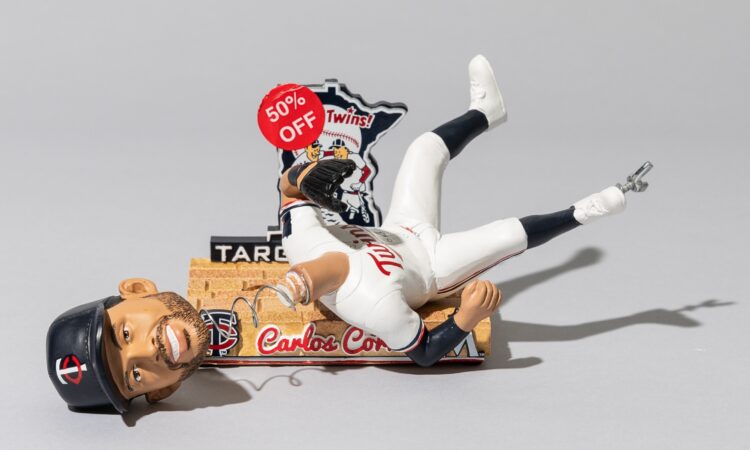
The exec pointed to the addition of Carlos Correa for $36 million a season, which did not much alter the team’s fortunes. Reusse points out that teams like Tampa Bay and Milwaukee regularly make playoffs with payrolls well below the Twins. “I don’t want a number on spend,” he says. “I want it wisely spent.”
Only a small minority of MLB teams—the Dodgers, Blue Jays, Mets, Yankees, Red Sox, and Padres—all in much larger markets with revenues nearly twice the Twins’, are spending $100 million more on payroll. An even smaller number spend 70%+ of revenue on payroll, yet entities like The Athletic and Twins Daily insist a new owner would do just that.
Brothers Justin and Mat Ishbia were rumored to be bidding on the Twins in winter. Majority partners in the NBA’s Phoenix Suns, they lead the NBA in payroll and have a reputation for the kind of aggressive spending and accountability mentality with coaches and players that fans clamor for. Yet the Suns have no playoff wins over recent seasons, and the Ishbias are being sued by minority shareholders alleging mismanagement.
We can stipulate that it was garbage optics to cut payroll after the ’23 playoff run, whatever the team’s finances. But the community’s ire might be better directed at baseball leadership, which has produced only two teams with more than 87 wins in the Target Field era and a gaudy 0–18 playoff record from 2005 to 2022.
The Twins are an organization of genial, prudent men—from Joe Pohlad to Derek Falvey to Rocco Baldelli. And we know what Baseball Hall of Fame manager Leo Durocher said about nice guys.
This story appears in Twin Cities Business’ Oct/Nov issue, out soon.