

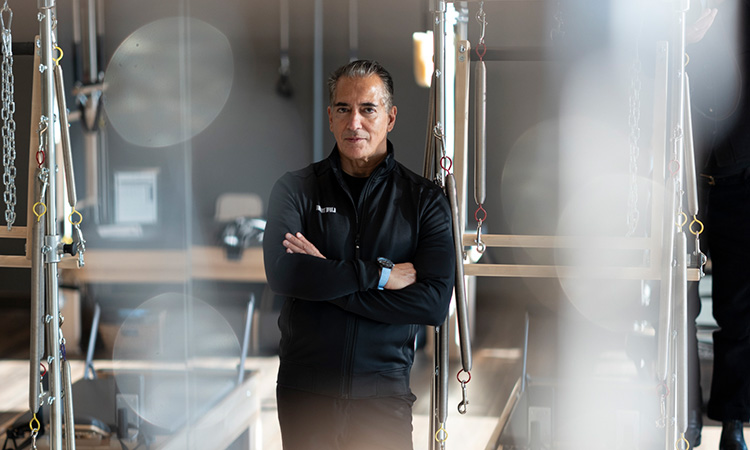
Inside Life Time’s Pivot to Luxury
On St. Patrick’s Day 2020, Bahram Akradi, founder, chairman, and CEO of Life Time, sat in his corner office surveying the company’s Chanhassen campus. The parking lots were empty, the adjacent fitness club shuttered by state order. Life Time’s multiple office buildings were devoid of life as well.
Akradi had faced trials before—a 2008 margin call, an activist investor in 2015. But Covid was ambiguous, of indeterminate scope and duration. A panic gripped the country, and there was no clarity on when people would be willing to congregate again.
“I’ve been through four or five times where the probability of not making it might have been 90-plus percent,” Akradi explained on a cold day this past January from behind a large round table in that same office. He speaks with the accented English of the immigrant Iranian entrepreneurs of his generation, who continue to inject dynamism into Minnesota’s business community. Dressed in casual slacks and a quarter-zip pullover, he nibbles on small ramekins of pistachios and green olives in front of him.
“At no time did I allow that thought to take root in my head,” he says. “You have to believe you’re going to make it.”

For a while it was just Akradi and a small core of lieutenants who populated Building 2 in Chanhassen, but as soon as it was allowed, Life Time employees returned to the office and the company reopened its clubs. The pandemic brutalized the fitness business, but it allowed Life Time to accelerate a reinvention of its own: a new business model. Coworking. Residential. Digital. And though the clubs look the same from the parking lots, that part of the business has been radically rethought as well.
“Tough times are good for great companies,” says John Danhakl, who is managing partner of private equity firm Leonard Green & Partners, the largest shareholder in Life Time (NYSE: LTH), and sits on the company’s board. “Great companies reinvent themselves and emerge into a world of weaker competition.”
Bahram Akradi was 31 when he founded Life Time in 1992. In year 33, the company has never been more ambitious or successful. It’s not hyperbole to describe Life Time today as Minnesota’s most dynamic public company.
“Bahram is a force of nature,” says Danhakl. He has tremendous courage, is an outside-the-box thinker, is willing to try things, fail, and adjust. There’s no one quite like him.”
Akradi describes his job more modestly: “I design, create, iterate, and then problem-solve.”
This is the story of Life Time’s second life.
Break with the past
Like many baby boomer founder/entrepreneurs, Bahram Akradi’s vision was never primarily about business. “It wasn’t meant as a place to make money. It was never to be just a fitness club,” recalls Akradi. “Our goal was to build places you would want to be instead of your living room. If I achieved that, I could get you fit.”
But what evolved was a sales-driven business, consistent with the sector, “jamming people into a small space telling them you had to be on a contract” and offering incentives to sign one or renew. Akradi says he was uncomfortable with that model and always intended to move Life Time from a sales-driven culture to a experience-driven one, but it was slow going until the pandemic provided a pivot point.
With nothing to sell, many of the company’s 700 salespeople departed, and Akradi and team decided to do away with the role altogether. Gone were contracts and promotions. Life Time would make it on the desirability of its product and its team members’ ability to “create a magical experience,” says Akradi.
“Look, species either adapt or die. Corporate America is no different. … The species that adapt fastest are capable of transforming. We have been adapting nonstop.”
—Bahram Akradi, founder, chairman, and CEO of Life Time
Life Time now calls its clubs “athletic country clubs,” as many contain all the amenities of a country club except a golf course. Its current generation of clubs contain resort-style pools, dining, and a full range of spa services. One thing people want at country clubs is a sense of personal space; as business came back, Life Time capped membership levels and raised prices. Many clubs have waitlists, some in the thousands (Tampa north of 10,000). Akradi says it was less about exclusivity than creating an experience consistent with his vision.
Read more from this issue

“It’s worked like a symphony,” he says. “We have the highest member retention in our history. Our employee morale and customer experience [measured by Net Promoter Scores] are higher than ever. Our margins are better than at any time.
“Look, species either adapt or die. Corporate America is no different,” he continues. “The species that adapt fastest are capable of transforming. We have been adapting nonstop.”
A club in Brooklyn Park
Life Time Fitness (“Fitness” has since been dropped from the brand) got its start in 1992, when Akradi opened a fitness club in Brooklyn Park. He had emigrated to the United States in 1978 as a teenager and opened and led US Swim & Fitness’ Minnesota region beginning in 1984. US sold to Bally Total Fitness in 1986, and he departed the company in 1989 to prepare to found Life Time.
A second, larger Life Time in Eagan followed in 1994, when spa services debuted. In 1999 Akradi opened his first club out of state, in the Detroit region. Life Time went public in 2004, and two years later it bought Twin Cities-based Northwest Athletic Clubs, dramatically expanding its local portfolio. It crossed a billion dollars in revenue in 2011, and in 2012 it opened its 100th club, while expanding to Canada. Clubs in the competitive New York and LA regions followed a few years later. 2018 brought the first Life Time Work (near Philadelphia), and a year later the first Life Time Living opened outside Las Vegas. (The company has always had a suburban bent.)
Akradi’s education was as an electrical engineer, and it fuels his attention to detail. “I love problems; if there is no problem, what do I do?” he says. The phrase “hands-on” doesn’t do him justice. He is involved in all aspects of club design. No new location is ready until his notes from the pre-opening walk-through are implemented.
The company has moved and evolved throughout. “Fitness is a fad; it changes,” Akradi notes. “But health and wellness is a megatrend.” That truism ensures Life Time a loyal consumer base, but only if it can iterate through the chaos of trends. Tennis and basketball are waning, step and spin boomed and declined, while pickleball and yoga are ascendant. That, too, will change.
Leisure and recovery are growth areas. Clubs boast new recovery spaces featuring stretch programming, hydromassage, cryotherapy beds, compression boots, percussion massage guns, and foam rollers. Life Time will offer more than 80 cold plunge pools by mid-year. The company is adding Life Cafes and enlarging existing ones, expanding outdoor beach clubs with more lounge seating and bar access, and creating pickleball lounges with more seating and self-serve drink areas (including beer and wine).
But if iteration is baked into Life Time’s DNA, the evolution of the last five to seven years has been more fundamental. Calling it the company’s “most exciting phase,” Akradi is leading a reimagining of the company’s capacities and purpose, with an eye rearward to his initial vision of Life Time as a provider of core features of a person’s existence.
“If I could put more of what you want and need under one roof,” he suggests, “I can make your life more convenient, healthier, and happier. We haven’t deviated from that goal since the beginning.”

A path to 500
“I built the right clubs but priced them wrong,” says Akradi. “The clubs were too crowded to deliver a Four Seasons [Hotels]-type experience.”
Life Time started addressing that two decades ago, but its sales culture required those changes be incremental. “There was no way I could fire 700 salespeople,” says Akradi. “That was my weakness.”
The fitness business has three sectors, according to observers. Upscale clubs like Equinox, Bay Clubs, and Life Time are expensive to develop and complex to operate. They require high usage so members feel the premium price is justified. (Equinox, though smaller, is Life Time’s nearest competitor, privately held, openly promoting “luxury” and concentrated in urban parts of the nation’s largest metro areas.) Companies like value-driven Planet Fitness and locally based Anytime Fitness constitute the other end of the market—low-usage workout floors that members rarely visit (two times a month is average). Then there are the in-between clubs, LA Fitness and 24-Hour Fitness, which are physically larger than the low-usage clubs and try to straddle a middle ground.
“The pandemic forced people to work out by themselves and created an influx of online programming,” hurting demand at boutique fitness studios, explains Tyler Quinn, CEO/founder of Alchemy 365, a boutique club that recently ceased local operations. “The big boxes [like Life Time] are doing well because people became habituated to doing it themselves.”
Life Time says luxury is not a strategy but an experiential outgrowth of its redesign. “Luxury pricing [alone] won’t work in our business,” says Akradi. “Not with 8,000-9,000 members in some markets. Status through inaccessibility is not our mission.”
Nonetheless, its average member income is at an all-time high of $157,000. Member visits have risen from nine times a month to 12 since 2020. A more affluent customer is less affected by economic downturns, and high usage makes the clubs more essential to their lives.
“Our pricing varies by club and market,” says CFO Erik Weaver. “The algorithm is sophisticated and based on use and distance from you. Long-term members pay slightly less than rack rate. If you drop [a membership] you might go on a waitlist.” The most basic clubs charge slightly under $200 a month, while ones with the newest amenities or in expensive real estate markets top out at $329 ($379 at one club in Orange County, CA).
“You need to remember, the average cost per person to a family is $120 [a month], or $12-$14 per visit,” says Akradi. “The value proposition is very good.”
It costs Life Time $15 million to $20 million to build into an existing shell, $25 million to build from scratch. The move away from a marketing culture has allowed Life Time to drop its marketing spend to 1.4% of revenue, versus the industry standard of 5%-6%. It has 100 new clubs in the pipeline, 18 of which are under construction.
The company hasn’t saturated most markets like it has the Twin Cities, notes Owen Rickert, a senior research analyst at Northland Capital Markets, who follows Life Time: “There are only five in Florida, for example.”
Rickert, who is based in Tampa-St. Petersburg, is a Life Time member. “[The clubs] smell luxurious, they look luxurious,” he says. “People are happy to be there. It’s never too busy or crowded. Attention to detail and focus on quality is superb.”
The company believes this has made Life Time the most desirable large-format fitness club from both a member and employee standpoint. “We create the best version of what’s becoming hot; we try to stay a bit ahead of the fitness trends,” explains Parham Javaheri, who leads Life Time’s club operations and property development. “We are the gold standard for the industry. In Frisco [Texas], we recently had 2,600 applicants for 200 jobs.”
Akradi believes the U.S. could easily support 500 clubs: “Ten years ago you couldn’t have put a club in Rosemount,” because there was no population there. “So there will be locations we can’t imagine,” where competitors can’t penetrate. “Our model is so complex no one can replicate it.”
“Life Time has masterfully navigated the middle ground” between boutique and basic, says Alchemy’s Quinn. “They bring a lot of what a boutique venue can offer. They’ve figured out that sweet spot and have the capacity to rapidly adapt.”
The new anchor
Life Time’s announcement that it planned to gut and remodel a defunct JC Penney at Southdale raised eyebrows. Struggling Southdale was “dilapidated real estate,” in Akradi’s view. The struggles of regional malls aligned with the decline of brick-and-mortar retail, particularly department stores.
Life Time built a club and Life Time Work attached to the northeast side of the mall in the ex-Penney space. With dedicated (even covered) parking, it is no harder to access than a standalone club. The complex just turned five, and the fitness portion is in waitlist status. Akradi says he personally facilitated Kowalski’s Edina expansion into the mall’s empty Herberger’s as a proof of concept of an all-in-one work-live-play venue.
Life Time’s first mall conversion was actually a Brookfield Properties-owned mall in Oklahoma City. “A month after opening, [mall] traffic was up 10%. Life Time draws more traffic than a department store,” explains Danhakl. “Malls bring great real estate at prices we never imagined we could get. The number of opportunities is stunning.”
Yet the story goes that it was challenging for Akradi to convince Simon Property Group CEO David Simon to come to Minneapolis to meet, though Simon now seems happy with the result. “[Life Time’s member is] a great customer, with different traffic patterns than department stores. The demos are good for us,” explains Mark Silvestri, president of Simon Development. “It creates a center of gravity; people bring their whole families. We look for anchors with longevity. They are a great partner that is creative, dynamic, always looking ahead.”
Life Time currently operates in 17 malls, with five in development.

Home is where the club is
Life Time’s hope is to eventually complete the circle at Southdale with an apartment complex, known as Life Time Living. If you’re asking what the congruence of fitness and work and housing are, you can hear the engineer in Akradi: “Every suburban household generates nine road trips a day. That’s time, CO2, gas. This [live-work-play] model cuts 60% of these road trips, while it eliminates waste and consumption.”
So far Life Time operates 15 coworking sites and four apartment complexes, all adjacent or very close to a club. Residents and coworking tenants have free access to the fitness clubs.
On the apartment side, “we’re partnering with developers who want to increase retention,” explains CFO Weaver. Longer term, Akradi says his plan is to raise a billion dollars to create a “private equity-type REIT.” Life Time would develop and manage the housing, while the REIT provides financing. When asked about the challenges of expanding into vastly different businesses, Akradi confidently waves the question off: “Coworking and living are 1/100th the difficulty of running a club.”
Life Time’s downtown Stamford, Connecticut, Living complex commands the highest rents in the region and features Bosch appliances and Restoration Hardware light fixtures.
“We want to manage anything with our name on it,” adds Weaver. “We’re not going to leave our reputation to chance.”
Life Time is packaging its clubs as the magnet for both office and residential real estate, much as Whole Foods Market has done in major cities. “We will disrupt the multifamily space. It’s a phenomenal growth engine,” says Javaheri. “Coworking was a concept needing amenitization. We asked, ‘What if Life Time was the amenity?’ ”
Akradi says Life Time has “a pipeline of opportunities,” but it must convince Wall Street the growth can be done in a cash-flow-positive environment.
The wages of Wall Street
Life Time’s financial history is complex. The company went public, then private, and public again over the last two decades. It has never been an investor favorite, but that may have more to do with the sector it lives within.
In the early 2000s, Akradi pledged Life Time stock he owned as collateral against investments. The 2008 market crash precipitated a margin call that put Akradi’s entire stake in Life Time at risk. He was fortunate that Los Angeles-based private equity firm Leonard Green & Partners had taken a liking to Life Time. As the stock dropped, it was buying, which created a floor for the stock.
The 2008 real estate recession then exposed weaknesses in the fitness business model. Life Time built and owned all its clubs, which was historically common for consumer businesses and a hedge against volatile retail trends. (Real estate is a passion of Akradi’s, say those who know him.) Wall Street, though, had soured on the practice, preferring “pure play” companies, and its stock languished. “I made that mistake,” says Akradi.
“Owning real estate makes the business capital-intensive,” says Danhakl, “which made it tough for Wall Street. Growth is slower, which turns off traditional equity investors, and real estate investors don’t see the predictable cash flow they need. So there are no natural buyers.”
In 2015, activist investor group Mercato Capital Management started buying Life Time stock, threatening a takeover and urging the company to spin off its real estate. A consortium led by Leonard Green swooped in and took Life Time private for $4 billion. Life Time subsequently sold off about half its real estate to pay down acquisition debt.
Leonard Green is private equity, so its intent was always to sell, and in 2021, Life Time returned to the public markets, though Leonard Green remains its largest shareholder. (Akradi owns 7% of the company.) “It’s a special, one-of-a-kind company,” says Danhakl.
Roughly 70% of Life Time’s revenue comes from club memberships, while 30% is value-add services like personal training, cafes, spas, or kids’ aquatics. (The company does not yet break out housing and coworking metrics.)
At press time in late January, Life Time’s stock was at $27, near its five-year high, but the company feels it’s nonetheless undervalued. Its earnings are strong and growing. Thirteen percent of its stock is held by insiders, a sign of the confidence within its HQ.
Life Time’s 2024 results “blew past my expectations. … I am confident in the long-term model/success of this business.”
—Owen Rickert, analyst, Northland Capital
“Nobody in our industry matches Life Time’s financial profile and balance sheet,” says Danhakl. He thinks Wall Street has undervalued the company for a number of reasons. “Certainly, Peloton soured a lot of investors on fitness when its stock dropped from $60 to $3.”
Also “the speed and scope of the reinvention and the sustained business momentum is just hard to comprehend without parallel really,” Danhakl continues. That said, “Wall Street is starting to take notice, the stock having doubled in the last 11 months.”
Life Time’s 2024 results “blew past my expectations, and guidance for 2025 was way above my expectations,” adds analyst Rickert. “Pretty spectacular that they can overdeliver consistently. I am confident in the long-term model/success of this business.”

Big side bets
Life Time has dived deep into the digital space with a free app that offers fitness and wellness advice and tracking, as well as access to Life Time’s nutritional supplement line. Within it is Life Time AI Companion (L.AI.C). Akradi’s belief is that “AI will be like electricity; you won’t be able to live without it. L.AI.C can monitor your sleep and offer recommendations about how to live, eat, and work that day.”
Akradi is an advocate of supplements—he takes 12 fish oil capsules each day and 80 total supplement pills—and the company offers an expanding line of them. Life Time moved into the space, branded LTH, after Akradi submitted an array of commercially available supplements for testing and found they were at best lacking promised ingredients and at worst impure. “LTH can be a $1 billion revenue company,” says Akradi. “There’s no spend on marketing. We own the science and the customers.”
The quest for dominance
It’s difficult to know how much stock to place in Akradi’s master plan. In his 33 years at Life Time, he’s built a $2.6 billion company that operates 179 athletic country clubs, survived a destructive pandemic, and now leads its industry in both scale and innovation. But at 63, his master plan is so ambitious that it’s hard to imagine it can come to fruition in what remains of Akradi’s functional career. It’s also difficult to imagine Life Time without his audacious vision and belief in Life Time’s vast potential.
“I ask club general managers why they are with Life Time,” explains Northland Capital’s Rickert. “Nine of 10 say Bahram and his vision.”
He’s a CEO who will “run through a brick wall for his team and family,” adds Javaheri. “That loyalty is not common.” Which is why, despite Akradi’s reputation as occasionally difficult and demanding, many of the company’s executives have grown through multiple roles over multiple decades.
The future beyond Bahram is intriguing. “It will take more than one person to replace him,” says Danhakl. “He works like a maniac. He’s a detail and vision guy, which is rare.” The transition is something Life Time’s board is beginning to talk about, he says.
Unsurprisingly, Akradi has a plan for life after BA, as he is known by many in the company. “We’re in a transformational build period. I will soon have 30 to 40 leaders between [age] 30 and 40 that I’m hand-selecting to run parts of the business, unrestricted. Someone will emerge,” Akradi explains. “You see, I’m seeding the company with entrepreneurs. They see the future before others, but [you] need to teach them how to merge their vision with the patience of a leader.”
After 90 minutes of conversation, a neophyte is tempted to take Akradi at face value when he says Life Time is “just at the beginning of this journey.”
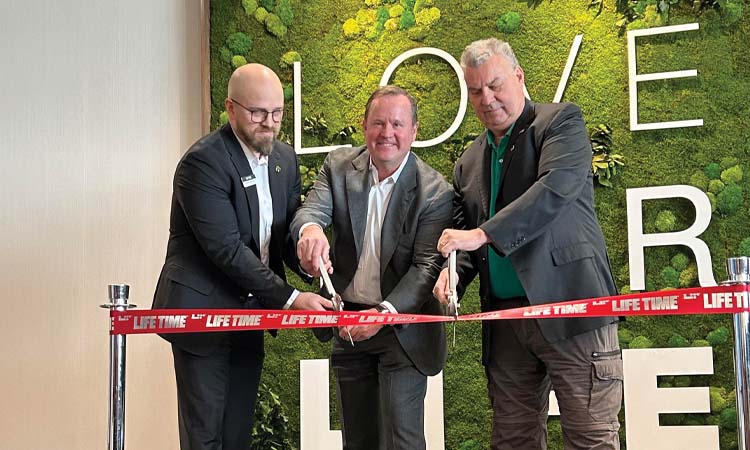
Life Time Inc. at a glance
Headquarters: Chanhassen
179 athletic country clubs
29 states (and Toronto)
15 Life Time Work
4 Life Time Living
$2.62 billion revenue*
$675 million EBITDA*
*FY 2024 (Company estimate, actual earnings due 2/25/25)