


Theater Economics Need to Change. But How?
It’s Monday, late August, around 7:30 p.m. at Artistry, Bloomington’s performing and visual arts center. An after-work energy hangs in the air. On the proscenium stage is New York City—the brownstone world of In the Heights, showing through the month. Except, tonight, there’s not just one scrappy protagonist, and no opening scene with Lin-Manuel Miranda making the best of bad milk; instead, there are more than 60 scrappy theater workers—actors, directors, administrators, many handling a combination of roles—filling less than a fifth of the seats, here to deliberate: How can we keep theaters from closing?
The model needs to change, the artistic director of a small St. Paul theater says onstage, in the tone of someone repeating something for the umpteenth time.
Theater’s never been easy. Recently, though, it has become more expensive, less attended, and harder to fund than ever.
The model that needs to change is the nonprofit theater model. That’s what most U.S. theaters use. This national “crisis,” as some in the industry call it, has been long coming, but the impetus for tonight’s meeting is the Jungle Theater in Minneapolis. There may be no better local exemplar of theater’s troubled prospects.
The Jungle was founded in 1991 and, with a neon palm tree on its Lyn-Lake marquee, became known for inspired artistic direction, run by luminaries who raised the local bar. In April, the Jungle put its building up for sale. A few months before, it had canceled its season. A cash-flow crisis stemmed from many sources, which are common to the industry: a retreat of season-ticket buyers; a drop in corporate, foundation, and government giving; higher expenses from inflation. Plus, the building cost about $250,000 a year to maintain, and government relief never arrived to offset road-construction woes. (Jungle founder Bain Boehlke—celebrated as a visionary who helped elevate smaller-scale theater—died months later, Sept. 11 at age 87.)
29%
Drop in total ticket income for nonprofit theaters between 2019 and 2023, based on national sample
The Jungle’s not the only local theater to founder in recent memory. Intermedia Arts sold its building in 2018 after reported financial hardships. HUGE Improv and the venerable Old Log Theatre closed in 2024, as did the Cowles Center, which had been the metro’s premier dance venue.
Mixed Blood, the theater in Minneapolis’ Cedar-Riverside neighborhood, faces a 20% structural deficit, per artistic director Mark Valdez—as do most nonprofit theaters, regardless of size, Valdez reports, based on conversations he’s had with local and national colleagues and with a private foundation that supports the performing arts.
The Jungle, at least, remains a theater company. A new model is being studied, but leadership wasn’t open to discussing it at press time.
If the problems are myriad, the fixes may be, too. “There’s not one solution,” says John Sullivan, who served as the Jungle’s board chair in the 2000s. “It’s a little bit of everything.”
The result may look like an overhaul. In July, Oskar Eustis announced he would be stepping down after 23 years as artistic director of New York’s Public Theater, one of the country’s biggest (and oldest) nonprofit theaters, known for Free Shakespeare in the Park and Hamilton. “I think the American nonprofit theater movement is over,” he told The New York Times. “That doesn’t mean any individual theater is over. But every individual theater is having to make its own case and come up with its own business model.”
The thesis on Monday night echoes Eustis: It’s time to rethink revenues, expenses, operations—or, more dramatically, theater’s very purpose.
“It always felt like there was this need to mask how difficult it really was,” Rachel Murch-D’Olimpio, the Jungle’s managing director, says over Zoom. “You do rely on people giving you money, and people aren’t going to give money to an organization that they feel is struggling. … It’s probably helpful, in the great scheme of things, that we can have an honest conversation about what’s really going on.”
The Fabulous Invalid
“The theater is the only institution in the world which has been dying for 4,000 years and has never succumbed. It requires tough and devoted people to keep it alive.” —John Steinbeck
So what is going on, really?
This isn’t strictly a pandemic story, but it’s possible the pandemic has been the single worst event to happen to nonprofit theaters. “The only comparable incident that I can think of, historically, is when the Federal Theatre Project during the 1930s was closed by Congress,” says Corinna Schulenburg. She leads research at New York’s Theatre Communications Group (TCG), a national service organization for nonprofit theaters.
Theater lovers are used to morbid forecasts. In the 1930s, playwrights coined the epithet “the fabulous invalid,” and it stuck as a way to describe theater—frail yet resilient.
It’s the hard existence of a nonprofit. Artistry Theater, for example, reported 10 deficits and nine surpluses from 2001 to 2019. For nonprofit theaters, contributions have traditionally made up 40–60% of revenue—coming from corporations, foundations, governments, and individual donors. Ticket sales and other services, such as event rentals, have filled out the rest.
But Covid-19 threw the model off-balance, tilting it more heavily toward contributions. Total ticket income fell 29% from 2019 to 2023, adjusting for inflation, according to TCG and SMU DataArts, a Texas-based arts research center. (In a 2025 report, they gauge trends based on 137 U.S. nonprofit theaters tracked from 2019 to 2023.)
11%
Drop in total contributed income for nonprofit theaters 2019–23, based on national sample
The theatergoing habit breaks easily, directors say. “What we know in our field is how important recency is,” says Trisha Kirk, managing director of the Guthrie, Minnesota’s biggest nonprofit theater. “People are more likely to attend if they’ve attended recently.” The pandemic pause meant, “OK, it’s going to be a bit of a climb back”—perhaps especially amid a growth in digital-entertainment options known for their own habit-forming qualities (see: Netflix, TikTok).
After a burst of pandemic-era federal funding, to keep theaters afloat, contributed income has fallen, too—11% from 2019 to 2023. “Total contributed income fell 15% year over year [2022 to 2023], emphasizing the need for new funding strategies,” TCG reports.
The result has been scene shrinkage. Many theaters have slashed plays from their seasons to cut costs. And this may be permanent. “2019 is never coming back,” Schulenburg says, except for an “extremely small” number of theaters.
It’s the decline of genuine invalids: Two U.S. economists in the mid-1960s described the performing arts as suffering from “cost disease.” As inflation drives up expenses—for materials, staff, insurance, utilities—theater’s inherent disadvantage is that it can’t seem to exploit technologies of scale. “It is difficult to reduce the cost of producing, say, a Shakespeare play,” Schulenburg says. Most theaters can’t easily add seats to sell more tickets. And they try not to price out audiences whose own budgets are tightening. Which is where philanthropy comes in.
“I would say that what we’re really seeing [today] is the inevitable consequences of cost disease,” Schulenburg says.
“The Twin Cities was just the unicorn, the envy of the entire country, because the local philanthropy was so significant.”
—Mark Valdez, Mixed Blood
Next Act
What kind of nonprofit-theater scene emerges from the upheaval? Where do we see recovery?
Brandon Boat is a local improv artist and co-founder of Danger Boat Productions in Minneapolis. Curious about theater finances, he parsed the forms of 93 Twin Cities nonprofit theaters, tracking them from 2011 to 2024, the latest year of consistent reporting. He categorized five theaters as large (with revenue of at least $10 million), 27 as midsize ($500,000–$5 million), and 60 as small (under $500,000).
He noted some recovery. Total revenue in 2023 and ’24 rebounded to 2019’s level while nearly regaining a pre-pandemic balance of earned versus contributed income. But it didn’t keep pace with inflation, and the big theaters skewed the outlook. “Strip out the Guthrie, Hennepin Theatre Trust, and Children’s Theatre Company, and the picture changes dramatically,” he wrote on his website in August.
Midsize theaters, such as the Jungle, appear most at risk. Many sit in a difficult in-between: with fewer resources than large theaters but the same escalating costs and maintenance-hungry buildings. About half ran worse deficits in 2024 than pre-pandemic, Boat found.

Jack Reuler is the now-retired founder of Mixed Blood. He says size can be misleading, and theaters have “the same problems with different numbers of zeroes.”
In that case, the Twin Cities’ large theaters seem to be doing something right.
The Guthrie, indeed, is feeling good. In 2025, it reported $32.8 million in revenue and a $50,946 surplus. Contributions sit at 33% of revenue, back to normal and down from about 55% in 2022 and ’23. Audiences are returning.
But it’s been a rocky re-entry. In 2023, the Guthrie incurred a deficit, unusual for the theater, of $3.8 million. It pared back its season and saved costs through “relentless incrementalism,” Kirk says: picking a show with a smaller cast, choosing to run one 10-week play versus two five-week plays.
Still, the Guthrie’s 199-seat Dowling Studio can’t seem to cover its own expenses. “Our labor costs are no different if we’re producing in that space versus if we’re producing in the [1,100-seat] thrust [theater],” Kirk says. Leadership is working on a new business plan.
Theater’s middle tier, meanwhile, has grown sharply in dependence on the kindness of others: Contributions rose from 55.6% of aggregate revenue in 2019 to a whopping 71% in 2024, Boat found.

At the same time, theater directors report contributions from foundations and companies are down, citing competition from more-urgent social causes since 2020. “What that has meant for us is increased individual giving,” Kirk says, “and that is going to be more expensive to fundraise, versus having received significant gifts from a fewer number of entities.”
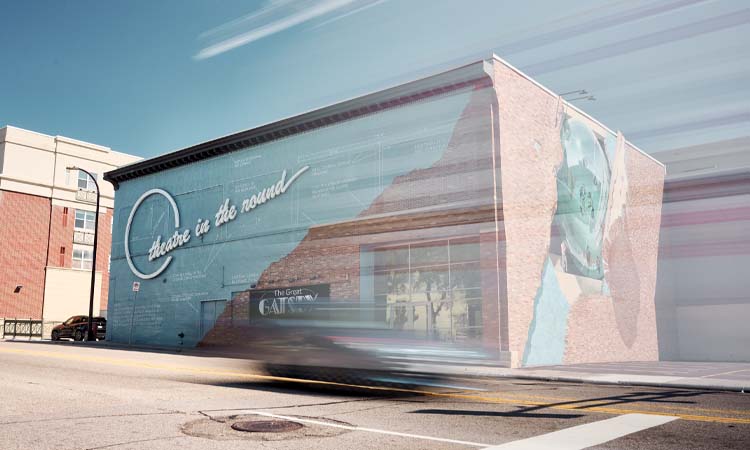
Theatre in the Round has acted on the shift. The Minneapolis company’s ticket income last year made up about 55% of revenue, down from about 75% pre-pandemic, says executive director Larisa Netterlund. She hired a full-time staffer to handle fundraising, grant writing, and sponsorships—part of a bigger change to the model. “We’ve been able to keep up with rising prices and do some growth,” she says.
What makes this shift frustrating is that funding sources drift away. The Jungle says a foundation sunsetted a major chunk of recurring support before 2020, opening a hole that Covid relief papered over. “We have a huge amount of maintenance needs for our building,” Netterlund notes—$2.5 million over the next 10 years. And maintenance is “not very sexy for donors or funders.”
Someone at Artistry compared the world of grant writing to The Hunger Games. Without more revenue—or more public investment, which Schulenburg says is needed—that vibe is likely to intensify.
Golden Era
At one point, theater in the Twin Cities felt deeply supported.
“The Twin Cities was just the unicorn,” recalls Mark Valdez, who became artistic director of the midsize Mixed Blood in 2022—“the envy of the entire country, because the local philanthropy was so significant.”
Best Buy, 3M, Ecolab, Medtronic, Target, big law firms, “you name it,” he says—“they all saw themselves as stewards of the community and had some responsibility for making sure arts and culture were available and supported.” Many corporations still give to the arts, but he characterizes the reduction in corporate giving as the biggest blow to the scene. He and others say that giving started to decline 15–20 years ago.
Reuler suggests reasons for the reduction: corporations losing local ownership; shifting priorities; and shrinkage of the 5% Club, a group of Minnesota companies giving 5% of their pre-tax earnings. “It wasn’t malicious,” he offers, “just unfortunate.”
Minnesota’s public funding of the arts, meanwhile, remains exemplary: The state cut arts funding by 22% over last year yet is still among the nation’s leaders in total and per-capita spending on the arts. That’s largely thanks to appropriations from the Legacy Amendment, a sales tax that worked to fill in for less corporate spending, Reuler says, rather than “infusing all these new dollars into arts and culture.”
Meanwhile, politics have chipped away at federal arts support, which has diminished dramatically over the decades. The most recent blow: The Trump Administration last year proposed eliminating the National Endowment for the Arts and began canceling hundreds of its grants. A couple local theater leaders say they didn’t bother with NEA grant applications after Trump banned the use of federal funds to promote diversity, equity, and inclusion (DEI) or “gender ideology.”

The Unmasking
At one point, theater in the Twin Cities also just grew and grew.
The local scene was flowering in the 1970s. It was part of a nationwide proliferation of hundreds of theaters that really took off in the ’60s, known as the regional-theater movement. Theater shouldn’t be reserved for New York City, the thinking went; it should enrich all communities. The movement’s operating support came from groups and initiatives like the Ford Foundation, the NEA, and the federal Comprehensive Employment and Training Act. Nonprofit status upholds an ideal, that theater should commit to community and bold art, not to the market.
In 1976, a 22-year-old Jack Reuler was part of it, founding Mixed Blood, Minnesota’s first multiracial theater. He kept his salary low, starting at $700 a month. A founding theater director back then might even skip paychecks, he says, to keep the dream alive—an ethos that seems old-fashioned today, following a post-lockdown push by theater workers for better wages and benefits. “There were no ‘good ol’ days,’” Reuler notes.
Subscriptions, though, made the days easier. Year after year, from the ’70s to the early-’90s recession, they multiplied, Schulenburg says. “Sometimes, more than half of an audience would be subscribers, and that would cover a significant portion of expenses.” Subscriptions masked cost disease, she says, providing income stability. Directors felt comfortable taking risks with programming. And subscribers entered a pipeline to donorship, maybe even board membership.
But the model began a descent in the ’90s. Possible reasons abound, Schulenburg says: the culture wars, the AIDS epidemic’s impact on the arts, the erosion of trust in institutions (including theaters). This worsened with the Great Recession—and even more with the pandemic.
The Jungle felt it. Pre-pandemic, it might have handled a cash crunch by opening a line of credit, recalls managing director Murch-D’Olimpio, knowing subscription revenue would cover it. “Covid really did a number on [subscriptions],” she says. Last-minute ticket buying became more common.
Boat mentions the “loneliness epidemic,” too—a 2023 diagnosis from the U.S. surgeon general. “The No. 1 motivator for audiences, consistently across years, has been going with somebody,” he says, pointing to the NEA’s annual report on audience motivation. A big reason people don’t show up? “They have no one to go with.”

A Matter of Nuance
Another possible reason for turnout troubles, though hard to measure: audiences not liking what’s on stage.
Mo Perry is a union actor who has performed in the Twin Cities for two decades. She wrote a Star Tribune commentary in May suggesting some theaters were alienating longtime patrons. She described a decade-long trend of theaters recasting themselves as “engines of social justice” and trending toward “didactic, polemical pronouncements, with identity as the primary lens for every programming decision.”
“Obviously, there are really worthy conversations to be had around race and identity,” Perry says. Her favorite local show of the past five years, 2024’s The Ally at Mixed Blood, explored identity vis-à-vis Israel, Palestine, and Black Lives Matter. But that show felt substantial and nuanced, she says. Many post-2020 conversations on these and other social topics “launched into a much more religious-fervor quality that bled into programming, messaging, the way [theaters] talked to audiences” as well as how artists talked among themselves, she says.
One longtime Twin Cities theatergoer, who requested anonymity, agrees—to an extent. He doesn’t see it as much of a trend but mentions two works in the Jungle’s last season that didn’t meet his standards for the theater. One “wasn’t even close to being ready for public consumption.” He notes that it platformed racial diversity.
Murch-D’Olimpio says programming always morphs with the times, “with what’s happening in the world”—and in 2020, a lot happened. Every play won’t please all audiences. She adds that stage productions make up only about a third of the Jungle’s revenue. So, the many structural challenges to the theater model, not programming, led to its crisis.
“You do rely on people giving you money, and people aren’t going to give money to an organization that they feel is struggling.”
—Rachel Murch-D’Olimpio, Jungle Theater
Name in Lights
If programming revenue can be so minor as to hold little to no sway over the financial outlook of a nonprofit theater, another question emerges: How much are theaters actually responsive to the market? Might they begin to serve only a small niche?
Theater artists adamantly say they don’t want that. At Artistry on Monday evening, about a third of the attendees convene in a smaller group to discuss marketing. The scene can’t just be artists supporting artists, someone says. The hope is to reach new audiences.
A major issue, they agree, is that people don’t know what’s out there. Local arts journalism has shriveled over the years—many in the theater industry bring this up with an air of grief—and outlets today rarely cover smaller theaters.
Shows can still sell out, several directors note, and many theaters have found their niche. The viral hype this past spring around Bug Ballet, at Minneapolis’ Southern Theater, was a case in point.
Some theaters are getting inventive. Netterlund picked two shows for Theatre in the Round’s next season that share a set, thereby saving costs: Dial ‘M’ for Murder (based on the Hitchcock film, adapted from a play) and Acting Can Be Murder (a world premiere about a community theater staging Dial ‘M’ for Murder). It’s a “fun Easter egg,” she says, and hopefully works as a double feature.
It helps that Dial ‘M’ is a known crowd-pleaser. One irony is that, often, the theaters that most need marketing—for original or lesser-known plays—can least afford it.
$1.91B
Ticket sales for Broadway’s 2025–26 season, its highest grossing on record
Broadway, meanwhile, is bigger than ever. The New York City hub just recorded its highest-grossing season, $1.91 billion in ticket sales. The New York Times credited it to higher ticket prices, star-studded shows, and strong demand.
Downtown Minneapolis hosts Broadway tours, mounted at the Orpheum Theatre by the nonprofit Hennepin Arts. The program does well; subscriptions sell fast. Attendance over the last three years (about 74% of shows reached 80% capacity or more) has nearly achieved pre-pandemic levels (78%).
Chanhassen Dinner Theatres, a Twin Cities institution in the southwest metro, is similar. The area’s only for-profit theater opened in 1968 and bills itself as the nation’s largest professional dinner theater. In 2025, it saw its strongest season for ticket revenue because of Grease and White Christmas, says Tamara Kangas Erickson, president and artistic director. Tariffs and inflation have increased expenses—since 2021, putting on a show costs 30% more—and ticket prices have risen in tandem. But pre-sales for Annie were great, she says, and CDT has been applying a 21st-century approach to marketing: hiring social media influencers.
Back at Artistry, the group complains that advertising on social media is all pay-to-play. But Ross Phernetton has a solution. The chair of Minneapolis’ small Combustible Company theater, he launched a website this summer, 79 Seconds on Stage, designed to list all Twin Cities theater shows in one place. He used AI to code a tool that scrapes theater websites of details. It’s free to use, with no ads.
Others in the group decided they will pool funds to staff booths at festivals and events. Rather than advertising any one Twin Cities theater, the goal is to promote all of them.
“[Theater is] not just plays on the stage.”
—Meena Natarajan, Pangea World Theater
Curtain Call
It’s impossible to list all the ideas that bubble up: Minneapolis should use tax dollars for grants to midsize nonprofit theaters. Foundations should spend down 7–10% of their endowments per year, not 5%. Theaters need more board members knowledgeable about theater.
It may also be time to transform. Some are on their way.
“Theaters are taking on not just arts but community wellness,” Schulenburg says. She points to Penumbra’s evolution into a St. Paul racial healing center. “We’re definitely in a time period where having multiple entry points and multiple revenue streams is very, very helpful for theaters.”
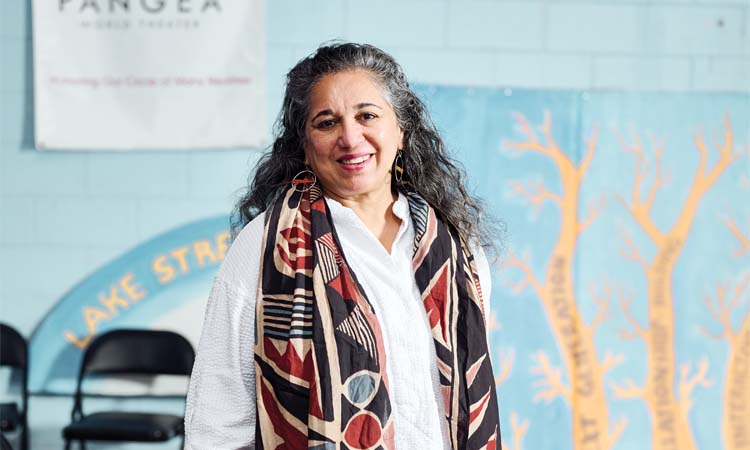
Pangea World Theater, in fact, is building. The 31-year-old theater has long engaged with community, artistic and executive director Meena Natarajan says. “[My co-director and I] both come from India, so the theater has always had a very expansive meaning,” she says. “It’s not just plays on stage.” Pangea is known for site-specific work like the recent Seed Syllables, performances of poetry inspired by community conversations.

Pangea plans to construct a 126-seat performance space as part of a new Center for Peace and Justice several miles east of its current 50-seat location in south Minneapolis. Planning began around 2018. Part of the business strategy: not paying rent for larger stages and renting out its own spaces.
Of a $6 million goal, the theater had $2.6 million to raise at press time. It needs $500,000 by year’s end to start construction. Five years down the line, the plan is to build another performance space, of 250 seats, in the adjacent lot.
Mixed Blood is evolving, too. Valdez estimates Mixed Blood has three years to find a new operating model, accounting for current grants and cash reserves. By then, it’s likely to look even less like a conventional theater than it does today. Plays are “the least interesting thing that Mixed Blood does,” he says.
That may sound heretical from an artistic director. But Mixed Blood, like Pangea and other equity-driven theaters, earns very little from ticket sales. Since 2011, it has practiced “radical hospitality,” not charging for shows.
Perhaps more importantly, Valdez believes Mixed Blood fell short of its potential amid the events of 2020. Traditional theater “talks at people,” he says. The company “could have been creating pieces that got people to talk to each other.” In 2021, Mixed Blood announced its transition to a social justice organization. Responding to Operation Metro Surge, Mixed Blood used theater as a tool in role-play sessions: Actors played federal agents; attendees practiced saying their rights out loud.
Transformation is bound to elicit some confusion. The company has lost at least one donor—a fan of traditional plays, Valdez says. It’s an awkward space: Mixed Blood now seems “too social justice-focused for arts funders and too artistic for social justice funders.”
If more theaters go this way, a philosophical question arises: Is it the purest expression of nonprofit theater, or not theater at all?
For Reuler, it’s a logical evolution of the movement: “Stages and seats and words and intimacy—they might be part of the future,” he says, “but not all of the future.”