

First Take: Hennepin Arts’ New CEO, Kimberly Motes
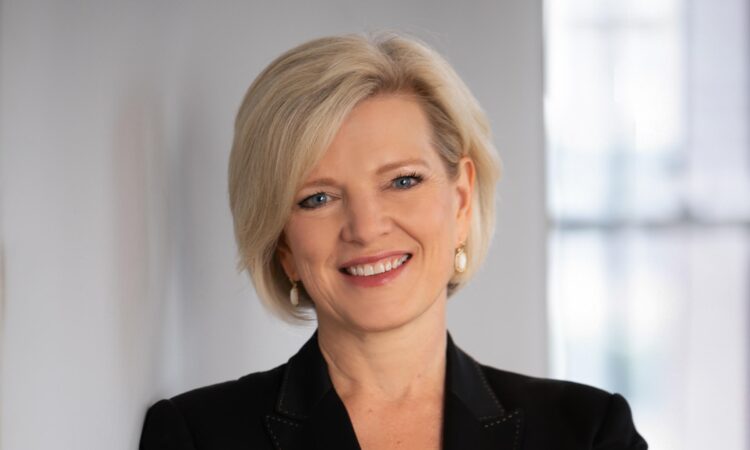
Hennepin Arts has named its new president and CEO: a veteran of Twin Cities theater who left for Chicago and now returns, Kimberly Motes. She’s departing her role as executive director of Chicago Shakespeare Theater to helm the Minneapolis nonprofit, which owns four theaters in west downtown’s theater district and hosts Broadway tours.
The leadership transition comes at a pivotal time for Hennepin Arts. The organization has seen pandemic recovery despite higher operating expenses and audiences’ slow return following Covid-19. In downtown’s post-pandemic era, some also see spectator events filling in for the bars and happy hours that once drew more regular traffic.
Motes “is a true visionary leader,” Hennepin Arts board chair Dan Tenenbaum tells TCB, noting he anticipates she will build “a super vibrant Hennepin Theatre District in the core of Minneapolis to enliven the downtown.”
Hennepin Arts’ mission is to promote downtown economic vitality, and it reports it draws more than 600,000 annual visitors while hosting more than 470 ticketed events a year. Since paying off city debt in 2022, the nonprofit has owned its three historic theaters: the Orpheum, the Pantages, and the State. It bought the Dudley Riggs theater in 2021. All are within three blocks.
The leadership transition marks a homecoming for Motes, who grew up in Cottage Grove, attended the College of Saint Benedict, and spent the bulk of her career—22 years—in the Twin Cities. She held senior leadership roles at Children’s Theatre Company, Theater Latte Da, the Cowles Center for Dance and Performing Arts, the University of St. Thomas, and the College of Saint Benedict.
Motes takes over Hennepin Arts programming Nov. 30, including its popular Broadway series at the Orpheum, which delivers “more than $68 million in downtown economic impact,” according to a Wednesday news release. Hennepin Arts books local and national musicians and comedians, as well, and provides arts education for nearly 8,000 students statewide.
“I’m fortunate that I spent 22 years of my career in Minnesota,” Motes says, noting she wants “to get on the ground and get a sense of the history, of what has been presented, and think curatorially about it, to look at the overall landscape of the Twin Cities and the arts ecosystem, and then say, ‘What should we be bringing? What voices do we do we want to bring to our community?’”
Hennepin Arts’ Broadway shows are an outlier in the local story of nonprofit theaters struggling to break even: Over the past three years, attendance at these shows has nearly returned to pre-Covid levels, with about 74% of them reaching 80% capacity or more, compared to 78% pre-pandemic—as reported in TCB’s most recent cover story, breaking down the decades-long problems inherent to theater economics.
Hennepin Arts also has lately invested nearly $6 million in its building at 900 Hennepin Avenue, extending the Orpheum. Tenenbaum says the building’s donor lounge had its soft opening Tuesday, with an official opening likely in the next couple of months.
As Hennepin Arts describes it, Motes is leading a “chapter of growth and impact, statewide and nationwide.”
Her national experience includes starting her career in D.C. as a program manager at the John F. Kennedy Center for the Performing Arts, per LinkedIn. She has served on grant panels for the National Endowment for the Arts, according to the release, and facilitates a national forum for leaders of large theaters through Theatre Communications Group, the New York-based service organization for nonprofit theaters.
Motes has led the 40-year-old Chicago Shakespeare Theater since 2023, where she, with artistic director Edward Hall, has produced 10 world premieres and two shows that went to Broadway.
She helped the theater grow in a tough landscape: “In three years, ticket revenue increased 67%, total earned revenue rose 60%, and contributed revenue grew 20%,” the release states. Chicago Shakespeare Theater pulled $17.2 million in revenue in 2025 but posted a $5.1 million deficit, according to its public 990 form.
Motes replaces interim Hennepin Arts CEO Andrea Morkos, who stepped in after Todd Duesing ended his tenure earlier this year. In 2023, Duesing succeeded Mark Nerenhausen, who’d taken the CEO role in 2018. Local firm Cohen Taylor led Hennepin Arts’ nationwide search for new leadership.
Ahead of her Nov. 30 start day, TCB asked Motes about her view of nonprofit theater’s troubled model, her approach to partnerships, and her work at the Chicago Shakespeare Theater.
This interview has been edited and condensed.
You oversaw three years of growth for the Chicago Shakespeare Theater. What initiatives did you lead during this time that allowed for that growth in the post-pandemic era?
There are a number of things. I came [to Chicago Shakespeare Theater] with a new artistic director and a co-leadership model. The Chicago Shakespeare Theater has three theater spaces, so we wanted to fully animate the spaces. We really increased the amount of programming.
Chicago Shakespeare Theater does Shakespeare in a beautiful thrust space, but we also have a 720-seat [theater] called the Yard Theater, which is where we do a lot of world-premiere and North American–premiere work—so, largescale musicals and plays. During our time, we had two productions transferred to Broadway: Illinoise a couple of years ago and, most recently, in August, Paranormal Activity. … So, we’ve done a lot of work with commercial producers. [Editor’s note: This is “commercial” theater as opposed to nonprofit theater. Broadway is the most prominent example of commercial theater.]
We also brought in a number of international presenters. We brought companies and work from everywhere, from Ethiopia and Peru to the return of the Royal Shakespeare Company to Chicago after decades of it being away. That kind of international and national work is something that I think has been a hallmark of what we’ve done, and audiences have come from all 50 states and 56 countries.
That idea—of driving tourism with events and activities and live entertainment experiences—is something that we were really intentional about. That’s something I’m interested in exploring, in terms of the programming in Minneapolis and what we can do to garner that kind of excitement and energy. Purple Rain’s a great example. There was a lot of national and international presence around that. Those kinds of events and activities are great for cities in terms of economic development, civic engagement, and arts impact.
The nonprofit theater model is notoriously difficult, and the pandemic worsened those difficulties. Has your view of theater’s purpose shifted, or your view of how the model can work?
Producing theater, I think, has lagged behind the other arts disciplines in terms the full recovery. Producing theater is a very intensive process of creation. So, you’ve got a lot of people who come together collaboratively to produce a work of theater. We have seen shifts and changes in terms of the amount of arts coverage in the media—when there is a lot of coverage and buzz and energy, you see more participation. We also have seen changes in philanthropy. We’ve seen changes especially on the institutional, on the corporate, and on the foundation side. And we’re really relying on individuals in terms of our philanthropy.
I also think that we’re seeing a lot of success. A lot of us, we’ve had incredible audiences for a lot of our projects, or most of our projects. I think a lot about the time share. How are we gaining as much of people’s time, and what are the experiences that we can create around the performance so that people want to spend more time? How can we get them going backstage? Helping them understand how this magic happens, of live entertainment?
In this world where we’re on screens so much, and with AI, we know that live performance is real. … There’s a study out of the UK where they put heart monitors on audience members and, literally, during the performance, their heartbeats synced in the theater space.
The Minnesota Orchestra’s fairly new CEO has talked about how partnerships are important among downtown organizations, as a way to revitalize downtown. Could you tell me about your approach to partnerships?
In the arts, we are always interested in collaboration. At Chicago Shakespeare Theater, we do a lot of partnerships. We partner with commercial producers on productions. More and more regional theaters are doing co-productions together. So, for example, Paranormal Activity was a partnership with Center Theatre Group in Los Angeles, ACT [American Conservatory Theater] in San Francisco, and Shakespeare Theatre in D.C. That idea of taking a production—which, as we talked about, is a is a huge effort—and then being able to share it with different communities around the country, it just creates an efficiency and a visibility. Ultimately, it’s important that everything has a future life as much as possible. That’s where those partnerships can be really important.