



AI Can Be a Wolf. It Can Also Be a Watchdog.
Not long ago, someone called my 91-year-old grandma pretending to be me. I was in trouble, the voice said, and she needed to wire money. Luckily, she told him she doesn’t drive anymore and someone would have to come pick up the money. That ended the call fast.
I think about that call a lot. The tech that made it possible is the same tech I use every day to build my company.
Right now the dominant story about AI is fear. It’s coming for our jobs. It’s putting data centers in our backyards. It’s watching us. Much of that fear is justified. I’m worried about it too. I worry we’ll trade away privacy and civil liberties before we notice. And that bad actors will put AI to work against us faster than the rest of us can catch up.
AI can be a wolf. It can also be a watchdog.
Our parents and grandparents knew how to keep the wolf out. Hang up on strangers. Don’t open the door. Know your banker by name. They had some of the best fraud defenses any generation has had.
Fraud existed. Big Tobacco lied for decades. Bernie Madoff stole billions. Telemarketing boiler rooms called about prizes that never came. But the villains were few in number, they had names, and most eventually got caught. The wolf had to knock.
Then the door moved. In 2012, 13 percent of Americans 65 and older owned a smartphone. By 2025, 78 percent did. The front door is now in every pocket.
Economists George Akerlof and Robert Shiller have a blunt name for what happens next: a “phishing equilibrium.” Whenever there’s profit in exploiting a weakness, someone will exploit it. Today that means overseas scam compounds, crypto rug pulls and AI voice clones. If you don’t know what those are, you likely will soon enough.
Today’s scam shows up looking like your bank’s logo, a familiar news site, or a grandson’s panicked voice. Even experts aren’t immune. A founder I know who builds in this space recently got a scheduling link from an investor he trusted. The investor’s account had been taken over, and the link was built to get into his computer.
In 2016, Americans 60 and older reported $340 million lost to online fraud. In 2025, they reported $7.75 billion. Nearly 23 times as much in nine years. Minnesotans 60 and older reported about $111 million last year, roughly double the year before. Those are just the reported losses.
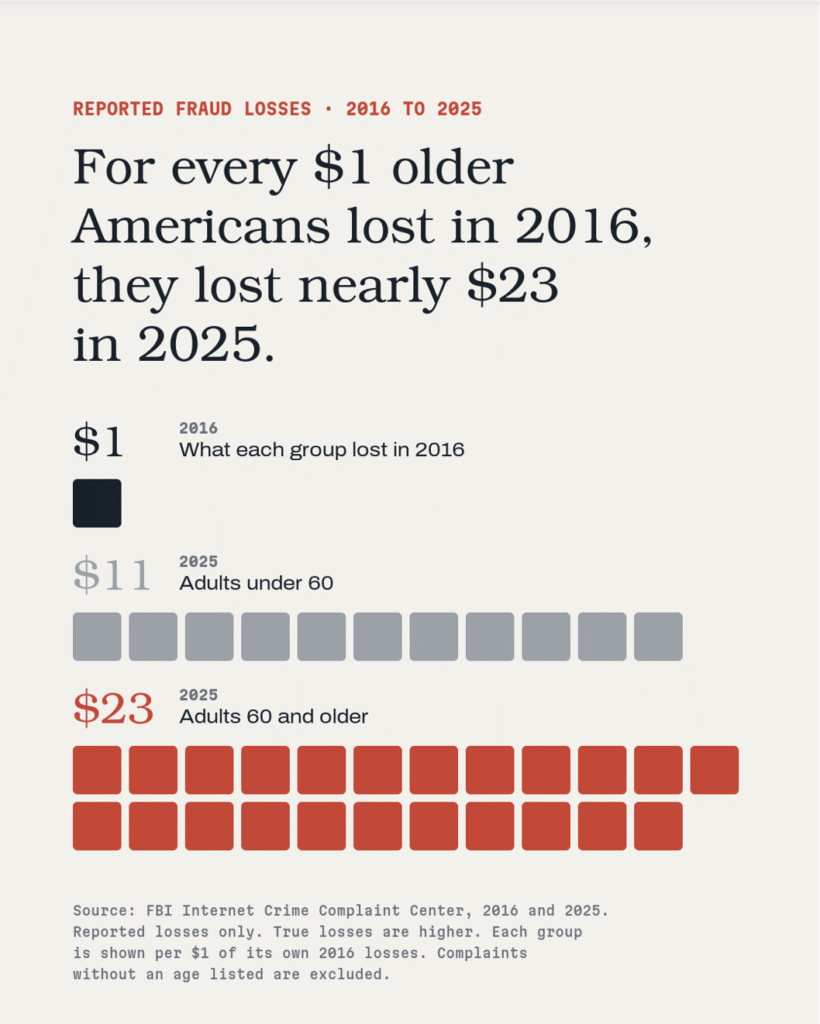
Graphic: Reported fraud losses per $1 of 2016 losses. Source: FBI Internet Crime Complaint Center. Graphic by Mike Ebener.
Half of U.S. adults have tried an AI chatbot. Only 23 percent of adults 65 and older have, according to Pew. The scammers are fluent in AI. Their targets mostly aren’t. Not exactly a fair fight.
Big tech platforms aren’t always helping. In 2025, Reuters reported on internal Meta documents projecting that 10 percent of the company’s 2024 revenue, roughly $16 billion, would come from ads for scams and banned goods. Rhode Island sued Meta over it in October. Meta calls the suit unfounded and says it removed 159 million scam ads in 2025. With incentives like these, protecting you is a cost center.
We spend a lot of time talking about the wolf. I think we should spend more of it building the watchdog. That’s why I built Ask Safely. When I started, I was choosing which AI model to put in our first app, so I read every one of their privacy policies (back when I still read them myself, now Ask Safely does the first pass for me). There wasn’t one I felt comfortable putting in an app built for my mom.
So we built one she could trust. Her chats clear on a timer she sets, and she decides what it remembers. When a text looks off, it gives her a plain answer about whether it’s likely a scam, and how to check safely.
Five years ago, a team our size couldn’t have built this.
As a solo founder, I was also our Chief Quality Assurance Officer, losing half my week chasing bugs our users were finding before I did. So I set up an AI agent that walks through the app before release the way our users do, logs each bug and files it for the team. It often catches 5 to 10 defects a release before anyone is impacted.
Scammers and builders are using the same tools. The difference is what we choose to build with them.
My grandma didn’t beat that scammer with technology. She beat him with common sense: make them come to you. That instinct still works. The job now is building AI that has it too.
AI is already in your mom’s phone tonight. I think the generation that taught us to check the door can learn to check the text before tapping the link. We’re building her a watchdog. The wolf can find another door.