


New Growth Data Proves That Something in Minnesota Has To Change
Economies are like trees. If you don’t grow, you die.
A report this week shared some numbers that should alarm all of us. The Minnesota Chamber of Commerce’s annual Business Benchmarks report showed that Minnesota’s growth rate has slowed to a crawl.
The numbers make a very clear case for one thing – something in Minnesota has to change.
First, some context
The report was headlined by a number that’s been widely shared – our growth rate per capita over the past five years ranks 49th out of 50 states.
Contextualizing those numbers is important, because digging into the details shows some obvious places to look for solutions. No, our per capita GDP is not 49th – we actually come in at a respectable-but-could-be-better 19th out of 50 states, just below Wyoming and ahead of South Dakota. But our growth rate has shrunk to being essentially bottom of the pile.
It’s also important to note that we are suffering, in part, from a regional flu. Our neighbors are sitting alongside us in the slow lane. From the report: “Minnesota’s low economic growth rates reflect broader trends within the upper Midwest. Each of Minnesota’s neighboring states ranked in the bottom twenty states nationally in per capita GDP growth since 2019, with South Dakota ranking 33rd, Wisconsin 38th, Iowa 40th and North Dakota 41st.”
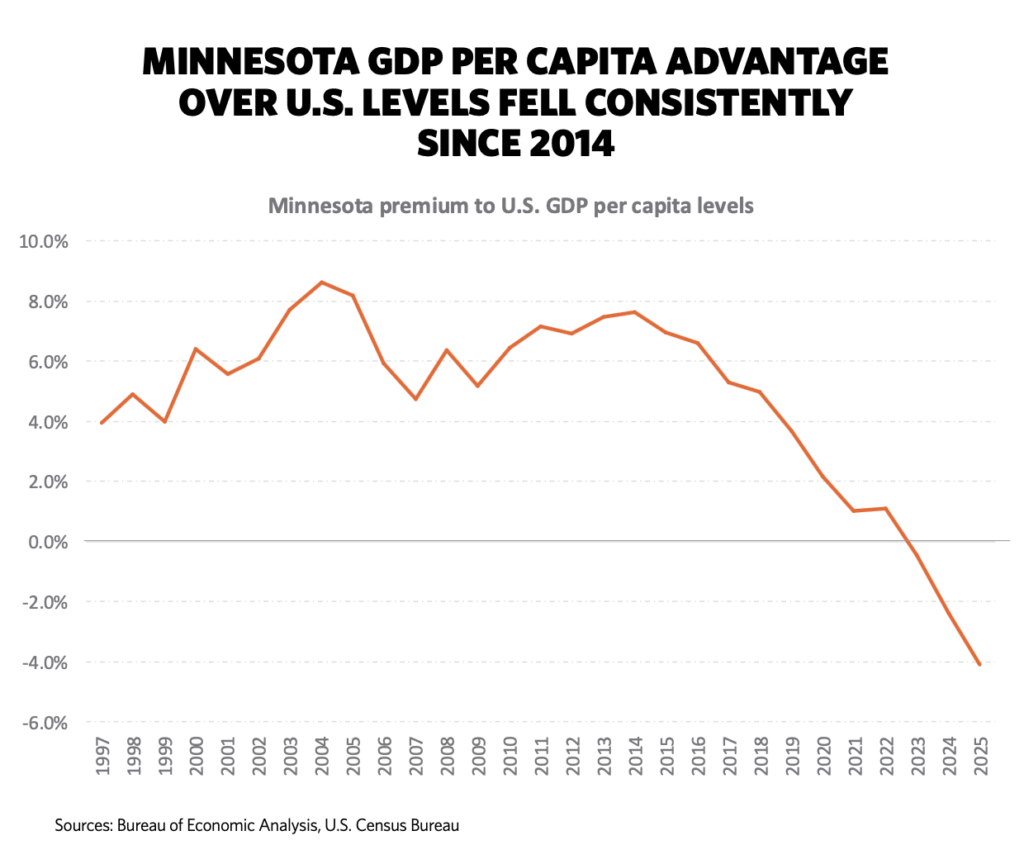
The main takeaway is that for many years, Minnesota was growing faster than the rest of the country. Now, it is not. Here’s what that looks like in chart form:
What happened, exactly?
You can pinpoint the moment growth began to slow on the chart above. In the mid-2010s, the rest of the country began to catch up to us. But up until 2022, we still had a growth rate that was tracking ahead of the rest of the country.
From 2023 until today, we have officially fallen behind. During that time, taxes have been raised, regulations have increased, and businesses increasingly feel like they are not being listened to. These numbers show that everything that’s passed out of the Capitol since 2023 should be on the table for examination, with an eye towards growth. The DFL trifecta is going to have to show whether or not it can correct the errors of its predecessors, which will be a major test for the new majority.
Outside of taxation and regulation, there is a widespread feeling that it is too hard to do business here, and that’s a solution that has as much to do with building a culture in our governments at every level that believes in listening to and working with people that are building businesses as it does with actual legislation.
Why you should care, right now
The massive property tax hikes people are seeing right now are directly connected to our sluggish growth. More business expansions would create a larger tax base, and more activity could drive higher valuations, both of which could make things easier for homeowners across the state.
That’s especially important on the heels of an election that was won with affordability concerns front and center. Some of the affordability solutions will need to come from the state. The easiest way to get more affordability in housing is to blow through the objections of stagnant local governments to build more homes. Some will come from looking at ways the state has actively made things more expensive, like a historic childcare investment that dramatically raised people’s costs.
Both GDP and migration numbers were made worse by a federal government that has been particularly hostile towards Minnesota, especially in two key areas – the trade war with Canada, which is far and away our biggest export partner, and Operation Metro Surge, which hammered our workforce. After seeing our first net migration increase in a decade in 2025, the report highlights a startling number from early 2026, a period that coincides with agents of the federal government descending on our state: “The state gained nearly 34,000 workers in 2025, then lost more than 55,000 between January and July 2026, falling below the size of its labor force at the start of the decade.”
While it would be convenient to use that as an excuse, it’s actually a perfect example of why growth really matters.
Growing places are resilient. They can survive a lot of things. Places that don’t grow are not. They are reliant on everything going right. When someone in Washington makes a decision that harms you, it leaves you on your knees. Growth matters because it protects you, it gives you options, and it gives you many possible successful outcomes instead of only a few.
Growing places also create many different opportunities for people to chase, making it easier to start a business, get a raise, switch careers, or make a living doing what you love.
The longer this sluggish growth persists, the more likely we are to consider desperate solutions. Are we there yet? That’s up to you. But I guarantee that if this continues much longer, we all will be.
As part of building a stronger pro-growth culture in our state, we need to do more to celebrate people that are building great companies here. We should all challenge ourselves to spend more time lifting up the people and companies that are driving new growth here than we do today. In some corners, there has been a reluctance to celebrate our wins because it could show people that things aren’t that bad, but that’s left a lot of great leaders out at sea without a sail. In this all-hands-on-deck moment, we need to redouble our efforts to tell the stories of the people that are paving the way forward.
The best time to reverse our growth trajectory was years ago, but the second best time is right now. We need to grow, and it is incumbent upon our new Governor (who seems to understand this) and new Legislature (who has yet to indicate the same) to make this priority number one when they take office in January.