

How Artist Adam Turman Became ‘the Minnesota Guy’
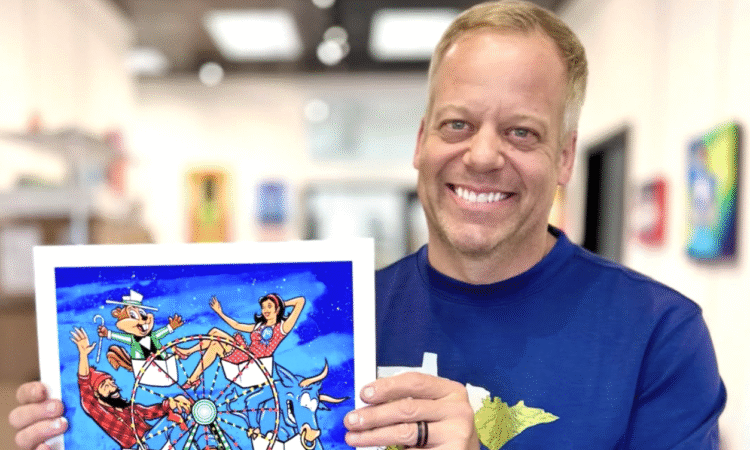
Artist Adam Turman wasn’t sure he wanted to be “the Minnesota guy”—or, the guy known for drawing and painting local icons: our landmarks (the Gold Medal Flour sign, the Grain Belt sign, Spoonbridge and Cherry) and our characters (Paul and Babe, Poppin’ Fresh, Hamm’s Bear).
Turman has painted murals of the Twin Cities—all brightly colored—for corporate clients like 3M, Surly Brewing, and Children’s Minnesota. His work is often unmistakeable, from the band posters he illustrated pro bono while getting started in the 2000s to his paintings and murals and screen prints. He taps 1980s influences: comic books, heavy metal album art, skateboard and BMX graphics. The people in Turman works have reminded me of cereal-box cartoons. His style has a purity of emotion to it.
And today, he’s embraced the Minnesota-nice niche. This comes to mind for him as he recalls a project he did for Indian Motorcycles, then owned by Medina-based Polaris: “a campaign for their FTR 1200, a motorcycle. … God, that project was awesome,” he says by phone. “I love working with local brands.”
Sometime between 2019 and 2021, he says, that Minnesota-guy identity crystallized: “This is who I am, and it’s hard for me to fake who I am.”
It’s led to considerable success. One metric is the size of Turman’s Minnesota State Fair booth, growing “exponentially” since his first setup in 2017—and bigger this year than ever. “We get tens of thousands of people coming to the booth,” he says, adding, “We’ve gone from tens of SKUs to hundreds of items.”
That seemed like a good excuse to learn how Turman’s style became one of the most recognizable in the state.
Pro bono to professional
In 1999, Turman graduated into the dot-com boom with a graphic design degree from the University of Minnesota. He worked in interactive/web design (“not my forte”) for agencies around town, then became an in-house graphic designer for his alma mater.
In 2003, Turman learned about Squad 19. A friend had organized a St. Paul art show entirely of gig posters. He joined Squad 19, this local collective producing posters for bands at no cost. Craving a return to illustration, he loved the work and eventually started making posters for Radio K, the station of the U of M’s College of Continuing Education (at which he was already employed in graphic design). He put URLs for his website on posters, and this began to bring in clients with budgets.
Gene Rebeck, TCB northern correspondent and former senior editor, wrote a 2012 article about the local poster economy. In that story, Turman is quoted as feeling “nervous and sweaty” after he started to make money this way, particularly after 2006, the year he had a booth at a Minneapolis arts-and-craft show: “I thought, ‘Oh, we’ll make between $500 and $1,000,’” he told Rebeck. “And it was a lot more than that.” Rebeck noted his big sellers were prints of Minneapolis landmarks like the Grain Belt sign and the Pilsbury “A” mill.
Turman committed to art full-time in 2012. He’d been earning more on the side than at his day job, and he’d had an LLC for about two years, he says.
“I realized in 2012, I could hit the ground running in the morning, answer emails up until, like, 3 o’clock in the afternoon, and then actually start my day,” he says. “After 3 o’clock, I was finally getting some artwork done, and by that time my kids were coming home from school.”
In 2017, he opened his first studio outside his home—the year of his State Fair debut. “We had so much merchandise and products left over [from the fair] that we had to put them somewhere.” As of this summer, his studio is in St. Louis Park, a move from Golden Valley.
“Obviously expenses went way through the roof,” he says, of his first studio, so he found ways to save. “I’m pretty conservative with how I run the business, low-risk. I try not to take on anything that’s going to sink the ship, so to speak. I try to be smart about what I’m getting myself into.”
All along, a snowball effect: people recognizing his work and becoming clients. “My brand has always been about making work that I hope makes other people happy,” he says, “and I know that sounds really cheesy, but it’s true.”
The team
Turman says someone called him one day, saying, “It seems like you’re busy. Can I answer emails for you?” He hired her for 15 hours a week. Kelly Palma is now his one full-time employee, a studio manager.
He also works with someone on merchandise—think: socks, drinkware, and lounge pants. Mike Barr, of Funatic, the Long Lake-based socks wholesaler, took over the merch side of the business from Turman in 2021, teaming up with Turman’s previous merch director, Julie Swenson. Working with Turman, they design and buy the merchandise; set up, staff, and run the State Fair booth; and divvy the earnings with Turman. It’s a year-long operation that begins the day after the fair ends each year.
“I wouldn’t be able to do what I’m doing if it weren’t for the people that I work with,” he says, noting he also hires contractors as needed.
And there’s no way he could sustain his business on merch sales, he adds. “That’s why my bread-and-butter is doing lots of client work.” He estimates commissions account for about two-thirds of his income.
The clients
Turman cold-called Omar Ansari, of Minneapolis-based Surly Brewing Company—in 2007, as Turman recalls: “If you guys give us beer for our art show,” he told Ansari, “I’ll make a free poster for you.” They ended up working together on Darkness Day, Surly’s annual imperial-stout fest, which they did again this year for the brewery’s 20th anniversary. “A lot of my clients turn into really great friends and practically family,” Turman says.
For Children’s Minnesota, a mural project came through an art sourcing company with which Turman had a relationship. After that, the Twin Cities-based hospital reached out privately, Turman says, requesting art for ambulances. (3M also came through an art sourcing company, he says.)
His goal is reliability: “excellent customer service, [trying] to get back to everybody as best we can, and [trying] to manage communications and expectations.”
Also, he says that, while he does possess a point of view, he likes to make art that appeals to many, and—“I don’t know if I’m a true artist in that sense.” He adds, “I kind of just like a lot of stuff, and I like a lot of people.”
That communal mindset is part of what he’s done right. “It’s trying to surround yourself with good people. It’s about trying new things that hopefully are relatively low-risk, with slow organic growth, and trying to stay unique and staying with the times, and hopefully making things that I like and that other people like.”