

First Take: Abby Poeske Oversees 10-Year ‘Master Plan’ for Minneapolis
In February, Meet Minneapolis—the city’s convention and visitors bureau—unveiled a 10-year master plan. “Destination Minneapolis” imagines the future in bold epithets: Minneapolis will become the nation’s No. 1 city for women’s sports. It will own its status as a “catalyst of the modern-day civil rights movement.”
Those are among six “big ideas” meant to “uniquely position Minneapolis as a premier destination.” The plan has five strategic goals, too: investing in the Minneapolis Convention Center, developing new festivals, establishing Minneapolis as a national leader in equity and reconciliation, and expanding mixed-use riverfront development, among other initiatives.
The overarching goal is to keep the city competitive in the meetings, events, and visitor market—relevant following the slow return of tourism post-pandemic. “These initiatives will help support economic growth, attract visitors and events, create new opportunities for local businesses, and enhance the quality of life for our residents,” Meet Minneapolis states on its website.
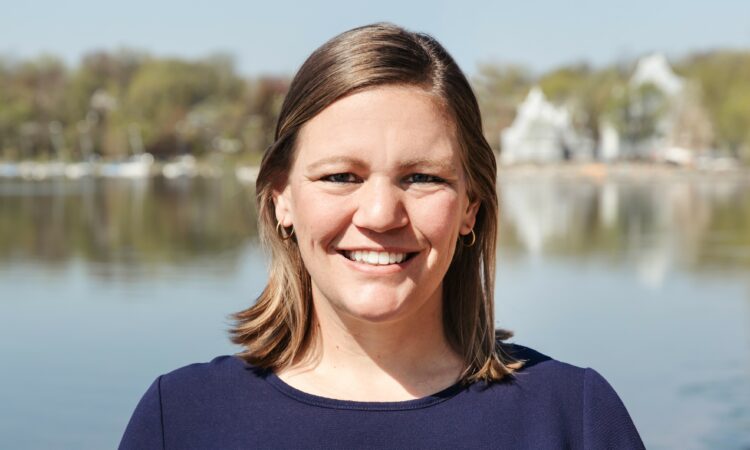
To oversee implementation of the 10-year vision, the nonprofit has named Abby Poeske vice president of destination development and public affairs.
Poeske joined the team in May, after more than two years as a senior advisor to Cleveland’s mayor. Bill Deef, her predecessor, has retired after 40 years with Meet Minneapolis.
But Poeske’s role differs from Deef’s slightly. “Destination development” is now in the title. “With [Deef’s] retirement and the launch of the new 10-year destination master plan, it was an appropriate time to make an adjustment,” Kathy McCarthy, senior director of public relations and communications, said in an email.
What’s different about the role? It folds in “creative placemaking,” Poeske says. “The ‘destination development’ work is shaping and enhancing places and experiences and assets that are really unique to Minneapolis,” she says, “to improve how visitors experience the city in ways that also benefit the people who live here and work here.” This means Poeske will focus on partnerships and city initiatives in addition to government relations and community engagement.
Partnership and community engagement also form the heart of the plan, which emerged from interviews, focus groups, and surveys of more than 900 city residents and stakeholders (with “stakeholders” including elected city officials, tourism and hospitality workers, and others working with Meet Minneapolis, per McCarthy).
Poeske’s appointment comes amid another evolution, as Meet Minneapolis assesses a recovering tourism landscape (with some post-pandemic highs for Minneapolis tourism noted last year).
In June, the local hospitality community, in partnership with Meet Minneapolis, established the Minneapolis Tourism Improvement District. Funded by a 2% charge to hotel room revenue, the initiative is managed by hotel leaders and set up to finance new tourism marketing, sales, and events. “Tourism funding [in Minneapolis] lags compared to the cities we compete against for meetings, conventions, sporting events, and more,” Meet Minneapolis states on its website.
This won’t be Poeske’s first time rallying municipal resources. In Cleveland, she oversaw the city’s 10-year strategic plan and the allocation of more than $500 million in American Rescue Plan Act funding. She has also led a nonprofit designed to revitalize a historic downtown district near Akron, Ohio.
“Abby brings a deep understanding of how destinations succeed when public, private, and community interests are aligned,” Meet Minneapolis president and CEO Melvin Tennant said in a news release.
“In this new role, we’re not just building infrastructure or improving vibrancy for people coming from out of town,” Poeske says. “We’re really celebrating our city, and we’re supporting more vibrant spaces and fun experiences and unique small businesses for everyone in Minneapolis.”
This interview has been condensed and edited for clarity.
How might we visualize enhancements to the Minneapolis Convention Center and the creation of a district around it? (This is one of the 10-year plan’s six ‘big ideas.’)
Some of that work is creative place making. This is something we would take the lead on [while working] closely with partners, like the council and the city. … One small example is helping visitors walk out that door [and] know how to get to the riverfront—and they know how to get to some of our special and unique small businesses and restaurants that are downtown. So, making it more navigable.
There’s also modernizing the Convention Center to make sure we are nationally competitive, as well as adding some hotel rooms within a certain radius of the Convention Center so folks can have easy access when they come to town for large meetings.
One of the strategic goals is to establish Minneapolis as a national leader in equity and reconciliation. What are some examples of this?
This acknowledges that the 2020 events really put us in the spotlight, and the murder of George Floyd is part of our story and always will be. This roadmap was built with input from stakeholders and from community, and so will be the initiatives that come out of it.
For different initiatives, we are going to have different roles. Some we lead, some we support. For some, we can advocate. This is one of the examples of work where we will be following the community and supporting their vision for what this really looks like. And we have some initiatives in there, [such as] building on the existing cultural district framework that we have and amplifying those cultural districts. And supporting Owámniyomni Okhódayapi, to promote and develop the Native American tourism presence on the river—things like that.
But this first year, we’re really going to be focusing on those two initiatives that have been identified as a priority: the capital for women’s sports and the modernization of the convention center district.
What would it look like for Minneapolis to be the capital for women’s sports?
This is a really fun and exciting one now. We believe that we truly are this capital of women’s sport, and we feel like we have the receipts or the data to back that up, when you think holistically about professional women’s teams, champion professional women’s teams, some of the athletes that have come out of here, [and] our universities.
We also know there are other cities that are looking to compete with this identity. There are our West Coast friends in Seattle and Portland, and Indianapolis is making some claims. So, we’re hoping to be a leader in this, and we are going to be working with MNSE—they have a women’s sports committee—as well as our professional sports teams and partners like Bar of Their Own, the women’s sports bar, to really identify what this means.
We also know there’s strong community support for women’s sports in Minneapolis, and we just want to continue to foster it. So, we are still defining, really, what this means. First and foremost, it’s storytelling, telling people what we already know and not being so humble about it. And we’re working on, now, what those ‘destination development’ aspects look like for it, too.
What insights did you gain from the planning process for Cleveland’s 10-year plan that inform your approach to Meet Minneapolis’ 10-year plan?
I had a committee of critics I invited to the table, staff members who I knew were constructive criticizers. I brought them into the room and said, ‘Tear this apart and tell me why these are bad ideas, and tell me how we can make them better.’
I think it’s really important to be open to that honest feedback from people who genuinely want to make the city better or, in this case, want to make Minneapolis better, so we can think through some of the risks or challenges or reasons why we should pursue something.
And then, [I’d say] just how important it is to go back to your underlying mission and goals. It’s really easy for plans like this to grow and grow and grow. There’s an endless number of initiatives you could do. But coming back and reminding yourself of what the strategic pillars are … is important so you can say no to some of the things that don’t align with those.
What’s your favorite visitor experience in Minneapolis?
I love the Grand Rounds. I love cycling, and I love how you can explore the city from protected scenic bikeways all around the whole city. I unfortunately hurt my ankle a little bit doing it the other week but had so much fun just going around the lakes and up to Victory Memorial Parkway. It’s a beautiful asset we need to continue to celebrate.