



Beth Ford Advocates for Immigrant Labor
President Trump has chosen the mass deportation of illegal immigrants as one of the hallmarks of his second term. Immigration and border security was one of the top two issues of his 2024 campaign, just behind the economy and cost of living.
“No one is exempted from striving to ensure respect for the dignity of every person,” Pope Leo XIV said in May. The first American pope, he noted that dignity should extend to “citizens and immigrants alike.” In appointing his first U.S. bishop, Pope Leo selected Michael Pham, a refugee from Vietnam, who has encouraged Catholic priests to accompany migrants to U.S. immigration court appointments.
Without question, political and moral considerations have been swirling around the Trump administration’s aggressive strategy to round up undocumented immigrants in the United States.
In this charged environment, Land O’Lakes CEO Beth Ford is arguing the case that U.S. businesses need immigrant employees to operate their companies.
She’s not simply speaking on behalf of the Fortune 500 agricultural cooperative that she’s led from Arden Hills since 2018. Ford chairs the Immigration Committee of the Business Roundtable, an organization comprised of CEOs of the nation’s largest businesses. Ford is the only Minnesota-based CEO who serves on the Business Roundtable’s board of directors, which includes the CEOs of General Motors, JPMorgan Chase, Apple, and United Airlines.
“We support investment in border security at the same time we support immigration reform,” Ford said in an interview with Twin Cities Business. “Immigration is central to the economic health and the growth of our economy and our businesses.”
The Business Roundtable has been advocating for those tenets in recent years. Ford, who served on the Immigration Committee when it was chaired by Apple CEO Tim Cook, became chair in January after she was asked to do so by Chuck Robbins, chair of the Business Roundtable and CEO of Cisco Systems, Inc.
When Ford talks to members of Congress and the Trump administration about immigration policy, she’s addressing the need for immigrant labor across the U.S. economy. But she acknowledges that immigrants have an outsized impact on agribusiness. The U.S. Department of Agriculture’s Economic Research Service has reported that more than half of U.S. crop farm workers are foreign-born.
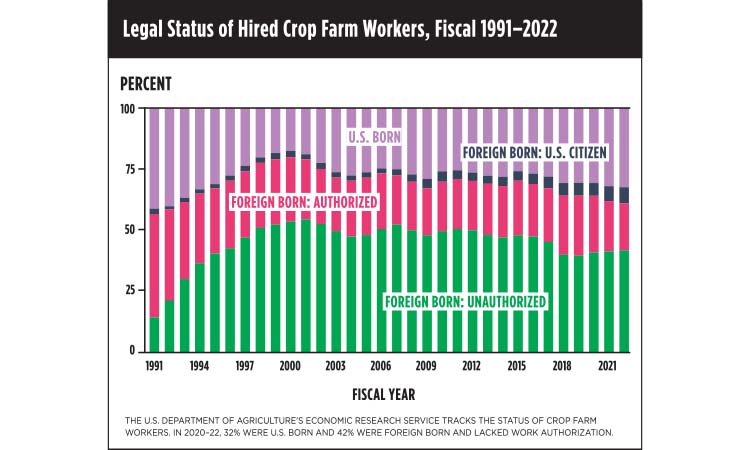
“Many are illegal,” Ford says. “The thing that’s very challenging is that most people acknowledge these are jobs that Americans don’t want to do.” Historically, many immigrants have used farm jobs as their entry into the U.S. economy, and others have stayed in the agriculture sector for decades.
“Let’s talk about the backbreaking work of picking produce in the Central Valley [of California],” Ford says. “Let’s talk about dairy farmers. That’s a 24/7, 365-day-a-year business. These are not jobs, writ large, that American citizens want to engage with.”
Achieving Elusive Immigration Reform
As someone who speaks on behalf of American businesses, Ford avoids inflammatory rhetoric from the left and right and focuses on facts and the realities of legal immigration, as well as industry-sector reliance on undocumented workers.
Her committee chair role is clearly defined. “It is about focusing on immigration and immigration reform and helping the administration and helping members of Congress understand what is critical, why it’s critical, and how it enables economic growth,” Ford says. The committee is updating a nationwide economic analysis, so it can have current data when discussing immigrant labor challenges and the implications of reform strategies.
Minnesota Immigration Facts
- In 2023, foreign-born Minnesotans made up 8.6% of the state’s population.
- International migration to Minnesota increased sharply between July 2023 and July 2024—reaching 29,540.
- In 2022, Minnesota’s undocumented population was about 95,000 people.
- From 2020 to 2024, international migration accounted for 94% of Minnesota’s net population gains. It overtook natural population change—births minus deaths—as the No. 1 growth driver.
Source: Minnesota Chamber Foundation 2025 report
“There needs to be a wholesale review of immigration and immigration policy,” Ford says, adding that many members of Congress recognize they need to move beyond the status quo.
Read more from this issue

By stating up front that the Business Roundtable favors secure borders and legal immigration, it places the emphasis on how businesses can employ more immigrants on a legal basis. “That is the framing of the Business Roundtable, and we believe that here at Land O’Lakes as well,” Ford says.
“It always comes down to the details,” she says, “We need a review of critical industries that demand more visa access.” For example, she says, a strong argument can be made for creating a new visa for high-demand industries, which could accommodate the need for year-round construction workers and year-round workers on dairy farms.
In Minnesota, over the past decade, employers have expanded their use of guest worker visa programs to overcome local labor shortages. “The number of visa approvals in Minnesota has doubled in categories such as H-1B, H-2B, and H-2A since 2015,” according to a February report published by the Minnesota Chamber Foundation.
H-1B visas are employer-sponsored and targeted to highly skilled professionals who work in fields that include information technology, engineering, and finance. These visa holders have bachelor’s degrees or more advanced education.
The H-2A is designated for seasonal or temporary agricultural workers, while the H-2B visa is used for temporary non-agricultural workers who work in industries such as hospitality, landscaping, and construction. For both types of visas, employers must prove that a shortage of U.S. workers exists.
The Minnesota Chamber of Commerce and its foundation have been studying immigration and issuing reports on the topic over the past 16 years.
“The economic realities remain unchanged: immigration is an essential ingredient of Minnesota’s long-term economic success,” the Minnesota Chamber Foundation said in its 2025 report. “New Americans contribute to the economy as entrepreneurs, consumers, taxpayers, and workers, often filling high-demand roles that businesses struggle to staff.”
From 2019 to 2023, almost 60% of Minnesota’s total labor force and employment growth came from foreign-born workers, according to the report.
“Temporary protected status” is another way in which immigrants can legally work in the United States, and it’s been granted to those affected by war or natural disasters. Ford noted how it had been given to many Venezuelans through a 2023 designation, but it was terminated this year by the federal government. The immigrants lost their status and work permits. In July, the Trump administration announced it was stripping the status from thousands of people from Nicaragua and Honduras. This form of protected status is among the multiple legal options being studied by Ford’s committee.
“Immigration is central to the economic health and the growth of our economy and our businesses.”
—Beth Ford, Land O’Lakes CEO
ICE Rounding up Immigrant Workers
Since she became the CEO of Land O’Lakes, Ford has worked with people inside and outside government to marshal and expand resources for farmers and small towns in rural America. Access to high-speed broadband and telehealth are among the needs she’s addressed.
Tina May, Ford’s chief of staff at Land O’Lakes, is working on the immigration issue, as are members of the cooperative’s government affairs team. Ford’s Land O’Lakes leaders are collaborating with staff of other CEOs, as well as the Business Roundtable staff. They are gathering extensive information to share with the Trump administration and the U.S. House and Senate so they’ll “get a picture of the economic implications for different things we see going on or different initiatives going on that relate to immigration,” Ford says.
Ford has been closely watching the roundups of large numbers of undocumented workers at business plants and in farm fields. The raids are being conducted by the U.S. Immigration and Customs Enforcement (ICE) agency, which has been charged with trying to arrest at least 3,000 illegal immigrants a day.
“The original view had been that [the Trump administration’s] focus would be on criminals or those with real legal issues,” Ford says. “This has now shifted. We’re seeing more raids in businesses.”
She cited raids on crop farms, dairy farms, and in meat processing plants. “If you are a dairy farmer and you don’t have labor, you don’t have a business,” she says.
Crop farmers who employed undocumented immigrants also find themselves in a predicament if a large portion of their workers have been arrested. Ford says she and others anticipate that some produce likely will be left to rot in farm fields. “I want to get an updated number for the amount of produce that will not be picked, that will be left on the ground, because farmers can’t access it,” she says.
“This is something that has been shared with the administration,” Ford says. “It’s the concern that the direct impact is whether the farmer has a [viable] business” after an ICE raid.
Agriculture Secretary Brooke Rollins raised this issue with President Trump, and she caught his attention. In a recent Fox News interview, Trump broached the possibility of allowing undocumented workers to remain with their long-term employers. “I’m on both sides of the thing,” Trump told Fox News. “I’m the strongest immigration guy that there’s ever been, but I’m also the strongest farmer guy that there’s ever been. And that includes also hotels and, you know, places where people work.”
At a news conference a few weeks later, Rollins said there would be “no amnesty under any circumstances, mass deportations continue, but in a strategic and intentional way, as we move our workforce towards more automation and towards a 100% American workforce.” Simultaneously, Axios reported, “the Trump administration is launching a program to streamline issuing visas for temporary, migrant workers to try to make sure fruits get picked, meat is packed, and lodgings are cleaned.”
In a Gallup poll of 1,402 U.S. adults, conducted from June 2 to 26, 79% said immigration is a good thing for the nation. The portion of Americans who indicated that “immigration should be reduced” has fallen from 55% in 2024 to 30% in the June poll. Only 38% of those polled favored “deporting all undocumented immigrants.”
Ford is thinking about options for a path forward. “I want to be constructive here and productive and say, ‘Let’s work together for solutions on behalf of the farmers and the food system.’ [We need to] remind ourselves that food security is national security,” she says.

Struggling With Low Commodity Prices
Agriculture economics are challenging for farmers in 2025. Beyond the farmers affected by immigration raids, Ford says that many farmers are dealing with low prices for their products and higher production costs for their produce or commodity crops.
“This is going to be the third year in a row with very low commodity prices,” Ford says.
“If you’re a corn grower or a bean grower especially, these are tough times,” she says. “You’re probably below your break-even [levels]. You’re not going to make money. And you’ve got trade pressures, and you’ve got increasing costs for materials like aluminum or steel to put [grain] bins up.”
She notes that the farm sector continues to consolidate, and many farmers survive because of their income from off-farm jobs. In 2024, there were about 1.9 million farms in the United States, which is down from the peak of 6.8 million farms in 1935, according to the U. S. Department of Agriculture.
In terms of farm income, the USDA reported in early 2025 that median farm income was a negative $651 in 2024, but median off-farm income was $82,777 that year.
“Add in the fact that interest rates are high and farmers are accessing operating loans and financing at a greater level than they have in the past,” Ford says.
“Their financial position is weakening,” she says. “Then you add the labor component. Without having labor on the farm, you could lose the farm.” Many farmers who lose their workers in ICE raids won’t be able to operate effectively because it’s difficult to find people who will do the physical labor that’s involved in many on-farm jobs, Ford says.
For every retail dollar spent on food, farmers receive only 14.5 to 15 cents of that dollar, Ford says. “We are massive advocates for the farmer, their families, and their communities,” Ford says, emphasizing “there’s a fragility [to a farmer’s financial viability] that people are not necessarily recognizing or really understand.”
“New Americans contribute to the economy as entrepreneurs, consumers, taxpayers, and workers, often filling high-demand roles that businesses struggle to staff.”
—Minnesota Chamber Foundation report
Land O’Lakes ‘War Room’ on Tariffs
President Trump’s decision to add tariffs on goods produced around the globe is another challenge facing U.S. farmers and agribusinesses.
“The volatility [in tariff levels] is significant,” Ford says. “What I said to my team is, ‘We can’t run around with our hair on fire every time there’s a new announcement. So we’ve got to have a war room.’ We set that up many months ago to talk at the ground level, at a detailed level, about the implications of different tariffs or potential constraints on the movement of goods.”
Dairy powders are among the items Land O’Lakes has tracked. “When China gets in the market to buy nonfat dairy powder, which is a commodity, they can drive demand and pricing for the global environment,” Ford says. She points out that many ingredients used in making animal vitamins come from China. She also notes long-standing trade between the U.S. and Canada to meet the crop fertilizer needs of farmers in both countries.
Ford says she and Land O’Lakes leaders have been analyzing the financial risks associated with tariffs as well as identifying alternative products.
“We believe our success starts with our [farmer] member success,” she says. In early 2025, she says, Land O’Lakes acted quickly to ensure that farmers had the seed they needed, crop protection, and other supplies. This year, she says, many farmers dodged most tariff effects because the goods they used for spring planting were purchased in the fall of 2024. But she views that scenario as a temporary reprieve.
“I have the most concern for what will happen next year,” Ford says. “All of these cost pressures that are now being added on will come into play then, against a commodity cycle that is going to have lower commodity prices.”