

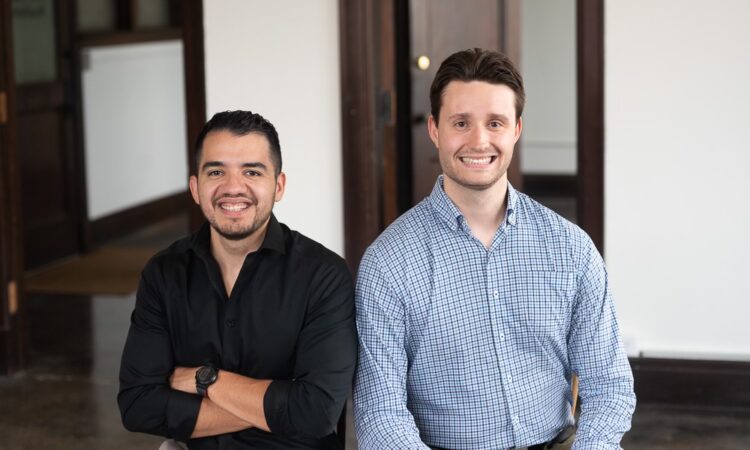
Adialante Turns to Silicon Valley to Scale Its University of Minnesota-Born MRI Innovation
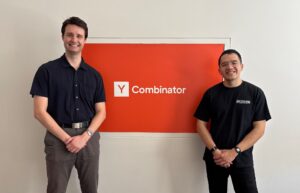
When Efrain Torres traveled to Silicon Valley this spring to be a part of Y Combinator (YC), a renowned startup accelerator that offers a three-month mentorship program for early-stage companies, he had no idea he’d fall in love with California as much as he did.
Torres’ Minneapolis-based medtech startup, Adialante, has created a mobile imaging clinic to scan for various cancers. It now has an office space in the Bay Area, and he plans to permanently move his medical device startup to the West Coast in the near future.
“We have raised factors more than we thought we could raise in two weeks, because [Y Combinator] basically gave us permission to be who we are,” he explains at an outside table at SK Coffee in St. Paul on a recent sunny morning.
YC gave Adialante guidance and pushed Torres and co-founder Parker Jenkins, whom he met in undergraduate school at Marquette University, to keep advancing development of their whole-body MRI scanner until it was fully operational.
As of this year, it is. This year, Adialante has received $19.5 million in letters of intent (LOIs) and has 11 clinics signed up. The co-founders assembled the scanner themselves for less than $1 million and still have the one manufactured.
Torres awaits FDA clearance so he and Jenkins can begin transporting their mobile, full-body MRI scanner to independent clinics, to meet patients directly.
Surviving ‘cockroach mode’
While enrolled at graduate school, Torres learned the art of making new MRIs is rarer than it was 40 years ago. “Not many institutes build MRIs,” he says. Also, current MRIs cost a lot to manufacture.
That has led to an issue of MRI accessibility. “I figured that was a really hard problem,” he says. “If the world could have an accessible MRI tool, then the world would be massively different.”
In the late 2010s, he considered pursuing a startup that could disrupt the MRI industry for the reasons above.
There have been multiple iterations of the scanner since the company’s founding in 2023. Torres primarily positioned Adialante as a head-only MRI system, but that fell apart quickly.
To build an MRI scanner, there’s heavy reliance on the metal neodymium, which is almost entirely outsourced from China. “The project essentially died because we couldn’t get neodymium” from China when the country suspended exports of rare earth minerals to the U.S., Torres says.
Adialante faced another obstacle last year when the federal government paused its $2 million in Small Business Innovation Research funding for nine months. Torres says Adialante couldn’t pay itself, forcing the company to go into what Torres calls “cockroach mode”—a company that refuses to die despite financial issues.

Looking elsewhere, Adialante turned into a consulting firm, essentially, for three months, working with other MRI vendors to generate revenue to survive.
As a self-proclaimed disruptor, Torres changed course again, evolving his startup to construct a full-body MRI scanner. The scanner Adialante eventually assembled doesn’t rely on liquid helium—an expensive chemical that traditional scanners use to cool its magnets.
Torres adds that Adialante’s full-body MRI scanner is 80% lighter than a traditional scanner and uses 60% less power. It also uses 50% less hardware.
The goal is to be able to allow a patient to get a full-body scan for cancer once a year for $250 at an independent clinic. Patients will pay for a scan if they have a high-deductible insurance plan.
Clinic referrals for renal imaging and prostate and breast cancers will go to Adialante. Then, the company will transport its mobile scanner to the clinic.
“We are going to operate at every single urology clinic and breast cancer clinic in the country,” Torres says.
The University of Minnesota’s role
The Venture Center, within the University of Minnesota Technology Commercialization, helped connect Torres to other entrepreneurial mentors. Torres entered the Venture Center pipeline in 2019. (The University of Minnesota’s Office of Discovery and Translation offered Torres grants for his startup.)

Angie Conley, director of the Venture Center, says the Venture Center plays a mentorship role early on for entrepreneurs. It finances the startup, builds strategies to get the business to market, and typically brings in executives from other companies to run the small startup, according to Chris Ghere, associate director of venture development at the Venture Center. “Rarely is it that a startup comes to us,” he says.
In the past few years, the Venture Center was able to connect Michelle Bellanca, now CEO of Claros Technologies, with the founder of the PFAS testing technology who was in the Venture Center’s pipeline.
“It is a unicorn if it’s the original founder,” Conley says, alluding to Torres leading Adialante himself without the Venture Center’s typical process of bringing in outside leadership. “It is very difficult for an academic lead to raise money. To go out and raise funding is a different skill set.”

In the Venture Center pipeline, startups go through various stages of funding. For medtech, startups generally start with non-diluted funding. The Venture Center does have a fund and has invested $13 million in 27 of its startups. The requirement is that they have outside financing.
About 70% of the startups launched in the U of M’s Venture Center are headquartered in Minnesota. The startups have created 1,500 jobs and $15 million of tax revenue. The U of M’s Venture Center also reached a milestone of 300 startups launched in April.
Torres’ take on investing in Minnesota
Although Torres is grateful for the relationships he has built with the Venture Center, he admits “you can’t build a $100 billion business [in Minnesota].”
He says investors here are too conservative.
“We struggled and were fought by investors in the ecosystem here,” Torres explains. “The second we moved to [California], it was like all those headwinds became tailwinds.”
Conley says that while the Bay Area provides approximately 50% of early-stage capital in the nation, that capital flows to where the best opportunities are, regardless of zip code. She adds, “investors are drawn to massive markets, strong teams, and capital-efficient operations—all of which define the Minnesota business ecosystem. Pivot Bio, a $2 billion company that recently relocated to Minnesota from Berkeley, is a great example of this.”
Torres mentions he’s never wanted to hire an external CEO, because they’re not going to be in the trenches and can’t pivot technologies.
Still, with a headquarters in the Twin Cities, Torres says he may keep a manufacturing facility in Minnesota or in the Midwest down the road, post-relocation.
Adialante will close its seed fund in a few weeks with a goal of raising $15–20 million.