


The Smaller Markets That Have Surpassed Minnesota’s Venture Capital Ecosystem
How does the Twin Cities stack up against other markets? Historically, we are well ahead of where we were at as a market a decade or two ago. But it also depends on where you’re looking.
“When my career started, there wasn’t much,” says Scott Litman, a serial entrepreneur, creator of nationally recognized startup competition Minnesota Cup, and investor with Traction Capital. He believes some of the startup founders who have become investors after their payday prove the Twin Cities has a pretty healthy ecosystem. “If you take Silicon Valley out, we’re actually pretty successful. There’s a diverse ecosystem of VCs and angels that have come out of successful startups.”
Compared to smaller Midwestern neighbors, the Twin Cities continues to lead the region. However, fast-growing markets like Detroit; Columbus, Ohio; Indianapolis; Cincinnati; and the Kansas City region are on its tail.
Compared to the big six high-growth markets like the Bay Area, New York City, Boston, Seattle, Los Angeles, and Austin, Texas, MSP remains a blip on the map. In the push to make Minnesota a better place to do business, efforts to increase access to growth capital have taken a back seat to targeting new entrepreneurs. The state’s tax climate also acts as a weight on growth companies. But more is possible, and there is clearly a desire in corners of the market to build faster.
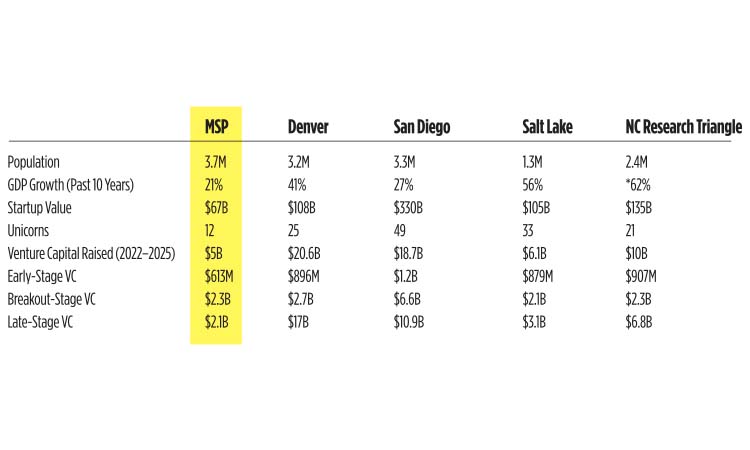
Which cities make a reasonable benchmark? A recent analysis prepared by economic development hub Greater MSP (see chart below) took a look. It focused on markets with smaller populations than the Twin Cities but that now have more capital investment for startups.
The Twin Cities does well on early capital. But as startups grow, gaps open between comparable markets and are especially large in later-stage funding that they really need to get big.
In a market like Salt Lake City, fundraising is quite competitive, but its ability to scale companies has far exceeded the Twin Cities, with nearly three times as many “unicorns” (companies worth $1 billion and up), which has resulted in nearly twice as much total startup value. Investors achieving liquidity that can be reinvested into the local startup ecosystem are critically important for building scale.
“If we could allocate even a small fraction of that wealth into venture as an asset class, it would transform things overnight.”
—Mary Grove, partner at Bread and Butter Ventures
About a third of the major local VCs have launched since 2020, and many of them need time to reach scale. Adialante, a startup founded at the University of Minnesota, recently announced it was departing for California—not exactly a place with business-friendly tax policies or regulation. The company makes a novel MRI technology. It is, in many ways, the quintessential Minnesota startup, emerging from our strong higher ed and medtech cultures.
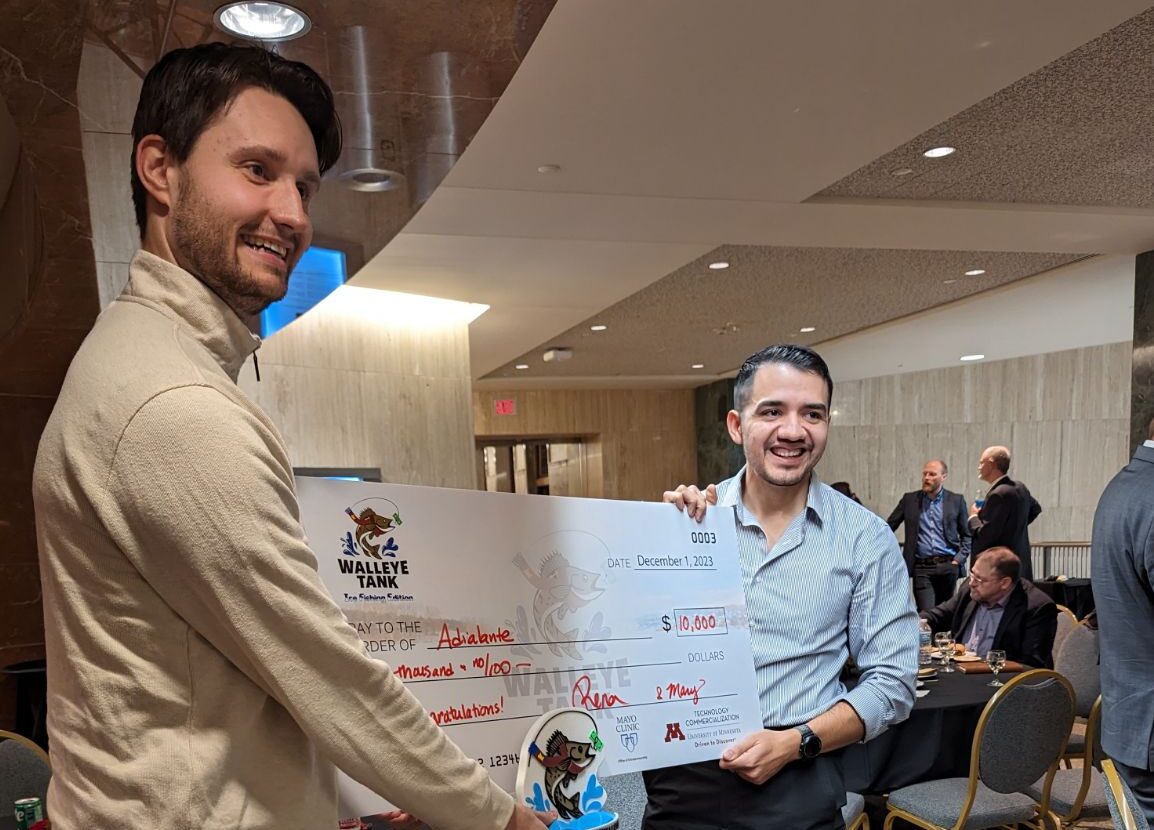
Why did it leave? Fundraising mindset. Once the company was accepted into prestigious startup accelerator Y Combinator in the Bay Area, the relocation made a lot of sense. “We struggled and were [frustrated] by investors in the ecosystem here. The second we moved to [California], it was like all those headwinds became tailwinds,” says Efraín Torres, Adialante’s co-founder. “The amount of due diligence that funds here put me through were five times more than Sequoia Capital, and [those funds were] offering money that’s 100x less. On 10x worse terms. The investors [in Minnesota] are too conservative.”
Notably, the underdeveloped nature of the VC universe here is not because of a lack of capital.
“The venture ecosystem is still early days, but the capital exists in Minnesota; it’s just currently sitting in real estate, private equity, or cash. If we could allocate even a small fraction of that wealth into venture as an asset class, it would transform things overnight,” says Mary Grove, partner at Bread and Butter Ventures, on The Twin Cities Business Show podcast.
For founders, that locked-up capital has a downstream impact. On a recent episode of the same podcast, Cora Leibig, CEO of Chromatic 3D Materials, says her biggest challenge as a CEO is capital availability, which has led to chasing investors in other markets, many of whom are skeptical of companies building in Minnesota. She would like to have more interested local investors, which would free her up to pitch the company and its plan rather than spend time selling the market itself. Leibig thinks the money is there, it’s just not being allocated.
“We actually have the wealth here, but the people who have it are not into investing in new technologies,” says Leibig. “I don’t want to fault anyone for deciding that they want to sit on their nest egg, but there is a lot of fun that comes out of investing in new businesses. It requires a little bit of a club mentality of, ‘Hey, let’s all help this company that’s trying to build something great.’ That is cyclical—the more everyone has success with one company, and that company brings an exit to everyone else, that allows more of it to happen. It’s a cascade.”
Local Venture Growth: How the MSP Ecosystem Stacks Up to Others
Six U.S. markets capture roughly 90% of venture capital activity and measure the value of their startup ecosystems in the trillions—Silicon Valley, New York, Boston, Los Angeles, Austin, and Seattle. Other regions, including Washington, D.C., Chicago, and Miami, are in a tier below. What might leveling up look like for Minneapolis-Saint Paul?
Read more from this issue

Here are four places smaller than MSP that are outperforming the Twin Cities: