

‘There Isn’t A Capital Problem’: A Reality Check on Minnesota’s Startup Scene
This commentary is part of an occasional series focused on practical, proven strategies that can drive new economic growth in Minnesota. Previous articles from the series can be found here, here, and here.
Each year, Twin Cities Startup Week brings together smart, hard-working founders that are fighting to grow their companies. This year, we decided to participate by hosting the Minnesota Capital Forum, which continued our focus on the investor community that we went deep on in our August print issue (more on that here).
We brought together some of the smartest people in the local venture capital community to help answer a big question: What does Minnesota need to take us to the next level? What we got was a set of very different answers and focus areas.
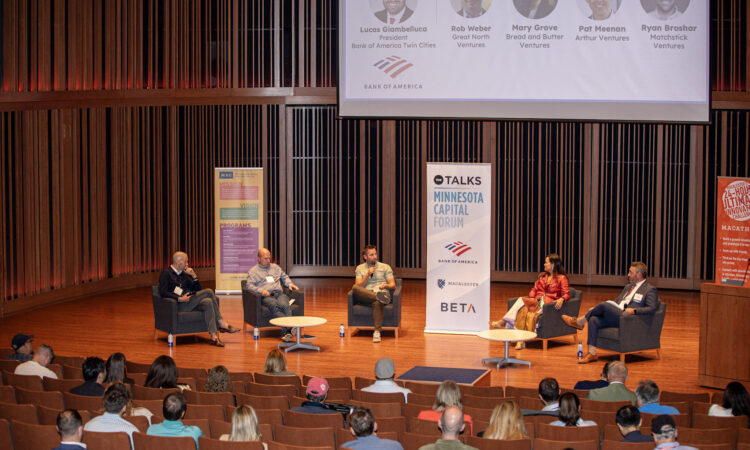
The event featured a founder showcase, a presentation from Matt Lewis of Greater MSP to ground us on where we stand, and a panel featuring Rob Weber of Great North Ventures, Mary Grove of Bread and Butter Ventures, Pat Meenan of Arthur Ventures, and Ryan Broshar of Matchstick Ventures, hosted by Lucas Giambelluca of Bank of America.
Do we have a capital problem?
According to this group, no.
Early in the panel, Meenan shared his feeling that “I don’t think there’s a capital problem whatsoever.” The statement was met with agreement from the other panel guests. There was broad consensus that Minnesota’s venture ecosystem, which has expanded rapidly in the past few years, has plenty of resources to fund big ideas. There was also a shared perspective that Minnesota’s corporate community has stepped up to the plate and is doing enough to be supportive of startups.
Talk to enough local founders and you will find a handful that say the biggest thing stopping them from getting bigger is a lack of access to local capital. But this group of VCs don’t agree.
The inherent implication is that if we want our startup community to catch up to the places that have passed us by, we need a combination of better ideas, better execution, and better policies (more on the last piece here).
Do we have a culture problem?
Weber pointed to Minnesota’s startup employees’ lack of willingness to bet on a company in the form of equity as part of their compensation package as a key driver of the problem. At one of his companies, 100% of the California-based employees maxed out their equity offering, while only two of the 300 employees in Minnesota did the same. He believes there’s a cultural issue of talent choosing higher salaries over betting on the upside of equity, which keeps more talent working for larger corporations instead of joining a fast-growing startup.
Weber also thinks people need to embrace “failing upwards”, or trying something that might not make it but provides valuable experience and resources that can be applied to another idea. The throughline of these two concepts is the need to have more of our local talent embrace risks that have the potential to generate outsized returns and the uncomfortability that comes with it.
Broshar thinks a critical part of getting our startups moving at a faster speed is to have them look at the competition. Capital is mobile, and being the best company in a category in Minnesota isn’t enough to scale if there’s a better company somewhere else. “Our founders need to know what they’re competing against,” Broshar added when suggesting people travel to places like San Francisco and New York to learn about the companies they’ll ultimately be competing against for capital and customers.
Grove believes that having more of a global lens can drive better long-term decision-making: “An urgent message is that we are all building with a global mindset, so it’s okay if it’s not here tomorrow.”
Weber suggested that the media landscape is holding some companies back. He cited the decline of national writers at places like Techcrunch combined with local media that he says doesn’t spend enough time covering the startup community as a reason that he thinks companies aren’t growing as fast as they could.
Do we have a policy problem?
Talent was a major focus of the event, with a consensus forming around the idea that we need more of it in the right places. Meenan pointed out a specific problem he’s noticed with a genre of fast-growing startups: “Companies are more distributed than ever, and there’s a trend forming of talented founders in their 30s and 40s leaving the state a few years before they exit.” When those people leave, talent sometimes leaves with them, and the capital that founders get from the company often doesn’t return in the form of future investments. “There are long term consequences on the recyclability of talent.”
While lamenting the fact that he was complaining about taxes after swearing to himself he never would, he did point at some of our state’s policies that make leaving Minnesota an easier decision than it should be as a culprit that needs an urgent solution. To fix the problem, fix the policies.
Where are we winning?
There were multiple people that mentioned pressing our advantages. Grove talked about Bread and Butter’s model, which focuses on working with our largest corporations to find good startup partners to help them solve problems. She believes that this is one of our biggest strengths, and should lead to us targeting companies that could build a “second headquarters” here to work with those companies.
Meenan, whose firm is older than many of the newcomers in town, talked about how much more mature our venture capital environment is today than at any point in recent history. “There isn’t a capital problem whatsoever,” Meenan shared. More firms, more deals, and more capital are all a positive sign.
He added that the personality traits of people in our state give us a natural advantage. “People here have a natural persistence of effort and humility,” he added, traits that are very valuable for entrepreneurial endeavors.
Weber thinks the diversity of our economy will help us navigate the uncertainty of the economic turmoil that the world is facing today. He mentioned that the sheer number of fields that our state has economic activity in will allow us to be more resilient as things change.
Where we are at and a few founders to watch
After Lewis’ presentation to start the day, he sat down with Sahil Sanghvi, Managing Director & Partner at BCG. They both shared memorable quotes that brought together a few themes from the event. Lewis talked about why focusing on going bigger should matter: “If we’re not here to create transformation, then what are we here for?” Sanghvi shared the sentiment, asking us all to think bigger: “We’re not incrementalists here.”
The founder showcase featured interviews with three VCs and their portfolio companies:
- Reed Robinson of Groove Capital and two founders their firm has invested in, Dori Jones of AcQumen Medical, which built a device to monitor the blood flow of pediatric patients and won the Minnesota Cup in 2025, and Wyatt Gustafson of Refr Sports, which launched a fast-growing platform for referees and sports officials.
- Scott Burns of Mairs & Power alongside Tim Herby of Cascaid Health, a health-tech company that allows you to build a personalized roadmap for health decisions by bringing together all of your health data in one place.
- Paul Campbell of Brown Venture Group with Chris Campbell of Simpli-Fi Automation, which has licensed a NASA technology to build a database of the sense of smell for use in AI applications.
No, there isn’t video of the event, because being in the room matters. If you want to make sure you don’t miss the next one, you should grab tickets to our Person of the Year & TCB 100 event now.
Meenan left us with one quote that summed up the energy in the room as well as anyone: “It will take a collective effort to build our next great company.” We should all take those words as a personal challenge if we want to help build what comes next.
Amanda Week contributed to the reporting of this story