

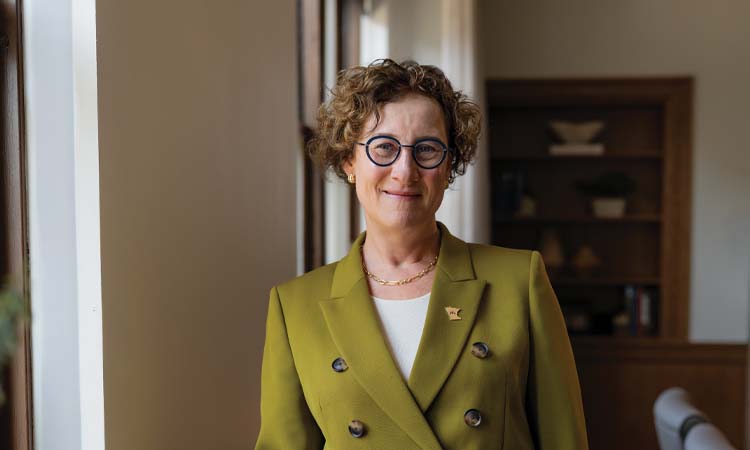
U of M President Rebecca Cunningham’s Defining Year
There are three default perspectives on Rebecca Cunningham and her first two years as president of the University of Minnesota. The most common is “Who?” because Cunningham has not yet made a broad impression beyond the institution. The second is that she fumbled the hospitals negotiations by relying on bad advice or poor instincts. The third is that she’s a visionary who attracts talent and has produced a widely admired road map for the university.
It’s conceivable that all three perspectives have merit.
“You can’t keep everybody happy and get anything done,” notes Robert Bruininks, who served as president from 2002-2011 after spending the bulk of his career at the university. “You have to use your capital while you have it.”
It’s also true that there’s no way to run the U without leaving some constituencies frustrated. “The U has so many stakeholders,” says David McMillan, a onetime Allete exec who served on the university’s board of regents for a decade and as interim chancellor of University of Minnesota Duluth. “To set priorities when every single thing is a priority to someone is tough.”
Pillsbury’s Choice
John Pillsbury, Minnesota governor from 1876-82, donated the land for the university on the predicate that the institution would include both the functions of a populist land grant university and the elite aspirations of a research institution—whereas many of the country’s top public institutions split them among two schools (see Michigan and Michigan State).
Cunningham, 56, relishes the complexity: “This is a really exciting ecosystem. Not many research universities live in such an ecosystem.”
Pillsbury did not obligate taxpayers to maintain the U or control it. Today, public funds provide for only 15% of the university’s needs, a historic low. “We still receive an impressive amount of state funding relative to our peers. We’re pleased with that and grateful,” Cunningham says. “We educated 70,000 students last year. Seventy percent stay in the state [after graduation]. We’re in all 87 counties with our extension program, research, touching communities.”
In an interview this summer in her spacious, spare office in Morrill Hall, Cunningham suggested the U’s challenges are both esoteric and practical: Trust in higher education seems to be at a modern low, an accelerant to a decades-long process of public disinvestment. Thus, her challenge: “How do we take the things we’re good at to come out of this time as a focused and more prioritized institution?” she asks.
Since 2000, “the U lost $200 million in state support through three recessions and a no-new-taxes pledge,” notes Bruininks. “People don’t understand the cost/value relationship. Economists have developed an ROI rate of 16:1 for the U, and a big part of it is what your graduates do after they leave.”
Dave Mona, Minnesota PR legend and lifelong U advocate, concurs. “There’s no longer a consensus [about the U]. As they’ve focused on becoming a more elite institution, some of the broad-scale pride has been lost.”
Pillsbury’s decision surely had its benefits, but it’s left Minnesota in a 50-year conversation about the U’s purpose, dating back to 1980s president Ken Keller’s “Commitment to Focus” initiative, which began the de-emphasis of the U as a birthright of every resident with a high school diploma. It’s the conversation that won’t end, often fed by politicians eager to justify ever-shrinking budget allocations.
Observers see the resolution of the Fairview relationship as Cunningham’s real starting point, free of a morass she inherited though was probably hired to solve.
“The next year may define her presidency,” Mona observes.
“A key job will be to build back relationships,” says McMillan. “I believe she can move on and forward. It’s remarkably hard to keep a set of priorities in front of you when everyone is trying to reset them. Healthcare was holding the strategic plan back.”
Opinions are mixed on the eggs that got broken. An insider with familiarity of the negotiations told TCB that Cunningham wanted to restructure the business relationships that govern health sciences at the U. In the end that didn’t happen.
“I’m grateful she knew the landscape and what it takes to run these institutions,” says regent Penny Wheeler, who ran Allina from 2015-2022. “I give her kudos. She entered negotiations at their most difficult time.”
Read more from this issue

The New Boss
Cunningham began her tenure July 1, 2024, having served most recently as the University of Michigan’s vice president of research. She is a medical doctor who spent 25 years based in an ER. Which, if nothing else, means she’s accustomed to making decisions under pressure.
“Her mindset is informed by a background in a high-stakes clinical setting,” says Kelly Sexton, now Michigan’s associate vice president for research, innovation partnerships, and economic impact. “She’s got this amazing ability to see [around] the corner.” Sexton worked under Cunningham in her most recent capacity at Michigan. “She led one of the largest research commercialization departments in the country. We positioned UM to be able to move at the speed of business.”
“At Michigan we had a $2 billion office [working] with industry,” Cunningham explains, “mostly the auto industry. Creating knowledge that impacts people’s lives, moving from research to business and jobs and economic impact.” Competition for research dollars and moving those solutions into the private sector is what many see as Cunningham’s most anticipated role.
“We’re at an inflection point in higher education—why we exist at all,” she continues. “Presidents have to look to the future and see that this is a moment of change. I’m good at helping see where a new future is and helping to move between here and there.”
Cunningham is on the board of Greater MSP and has impressed its CEO. “Today, leadership trumps management,” explains Peter Frosch. “We need more than a steward at the U.” Frosch sees the U’s 21st century role as developing the talent for the state’s corporate sector, research (solving problems the private sector can’t yet monetize), and helping the tech sector commercialize, all hallmarks of Cunningham’s tenure at Ann Arbor.
“The U is the engine of the state’s economic well-being,” notes Brighton Development co-founder Peggy Lucas, a former regent. “If we don’t do the research, no one else will do it.”
“I’ve seen a decisiveness that is not aloof to feedback. That’s an encouraging profile in leadership.”
—David McMillan, former regent
A Rough Start
The regents were forwarded three finalists for the president job. The local favorite was Laura Bloomberg, who had run the U’s Humphrey School of Public Affairs, leaving in 2022 for the presidency of Cleveland State University. (University of New Mexico provost James Holloway was the third candidate.) But the regents ultimately decided Bloomberg’s background didn’t align with the U’s most pressing needs.
Bruininks takes no issue with Cunningham’s selection, but he wishes the process Gov. Pillsbury set up was different. “Minnesota’s [selection] process is worse than most states because you’re meeting the expectations of a governing board appointed through a highly political process,” he says, noting that corporations strive for continuity, while the political nature of regent selection leads to candidates “who make a lot of promises about how [they] are going to do things differently.”
People close to the regents believe Cunningham was chosen, in part, due to her medical background and perceived ability to navigate through the Fairview troubles. Cunningham is said to have not liked the structure of the med school and hospital and felt that Fairview, mired in red ink, had been a poor partner and reneged on financial commitments. She reportedly believed having University of Minnesota Physicians (UMP)—the U doctors who staff Fairview’s hospitals—in the university’s employ would give the U leverage. But it required the assent of the doctors.
During the height of that conversation—with Minnesota attorney general Keith Ellison assigning mediators—a bomb dropped. Dr. Jakub Tolar, the respected dean of the medical school since 2017, announced his departure for Baylor College of Medicine, seemingly frustrated with Cunningham.
Related: U of M Medical School Dean to Leave for Texas Job
The health of the medical school has a direct bearing on the state’s most important economic sector, as 70% of the state’s doctors are educated at the U, and it has the only dental, pharmacy, and veterinary schools in the state.
Regent Ellen Luger notes it’s important not to overstate the significance of the now-concluded dispute or its after-effects, noting, “We hired [Cunningham] to run the U, not the medical school.”
The U sold its hospitals to Fairview in 1997, a light-year ago in healthcare. Those who remember the era say the university struggled with deficits and market share challenges. “There is much nuance in running these entities,” says Wheeler.
Healthcare is a dynamically evolving industry that often only produces returns for insurance companies. In 1997, most Twin Cities doctors were in private practice; today, most work for the big five local health systems or a centralized specialty conglomerate like Minnesota Oncology or MNGI. Thus, the U was at the end of a 30-year business relationship formed in another era, says McMillan. “She was in a tough spot.”
Moreover, hospitals are one of the few businesses that public universities operate and scale in the private sector. “Academic health exists in most metro cities. Most of our peer universities own and operate their hospitals,” says Cunningham, “because an integrated model creates efficiencies.”
She arrived with “a Michigan context,” says Bruininks. He notes that health sciences are the largest part of the U budget but nonetheless small, making up less than 5% of the Twin Cities healthcare marketplace.
A business needs customers, and it was unclear, without Fairview, who would feed them to the U. (Cunningham proposed a consortium with Duluth’s Essentia, but that never took off.) Cunningham apparently believed Fairview and UMP needed the U more, while Fairview believed the opposite. The story could occupy many pages in this magazine, but to oversimplify, the U ended up in a new 10-year deal with Fairview that is more similar than different.
Related: U of M, Fairview, M Physicians Solidify 10-Year Partnership In New Agreements
“I can see it from all sides,” says Wheeler, “but going it alone is a difficult maneuver. Healthcare economics are rough in the Midwest. Everybody had to swallow some changes on the governance side” in the deal.
“I’m pleased with where we ended up,” says Cunningham. “There was an open conversation on buying the hospitals before I arrived. We explored a number of different options, and we’ve landed in a place that makes sense for all the partners and good for the state to drive medtech and health research.
“These are complex relationships with more than three decades of history, so there were naturally highs and lows. We’ve achieved a solution that will strengthen and sustain our relationships and bring clarity to our roles.”
Cunningham notes that Tolar’s interim successor, Dr. Carol Bradford, “is a national leader, and it’s a new day. We have strong leadership in place to grow and be stronger in academic health.”
The New Reality
For decades the U and Fairview marketed the hospitals as run by the university, via the M Health brand. Cunningham has decided to make the boundaries plainer. They are Fairview’s hospitals, and they will operate under Fairview’s brand. M Health is to be sunset at year’s end.
As for UMP, “We have an excellent physician group,” Cunningham says. “They provide clinical care. We will partner with them. The medical school is different than the hospital. The med school brand will remain. Our faculty will continue to compete for federal grants and biomedical research dollars.” U.S. News ranks the medical school as Tier 1 in preparing students for medical careers and Tier 2 in the quality of its research. Research is driven by fundraising.
Minneapolis residents Lynne and Andrew Redleaf (he’s CEO of X3 Capital Management) say they have given (via their foundation) roughly $21 million to the medical school, largely because of their belief in Tolar and his work. “For now,” Lynne Redleaf says, “we’re on hold.” She said the foundation has turned away $13 million in proposals. She wishes Cunningham had kept peace with Tolar.
“Lots of places want money,” says Redleaf. “It’s foolish to give people a reason not to give. We try to practice trust-based philanthropy. You can’t micromanage it. So you give when you feel confidence. I’m worried about the ranking of the medical school being in jeopardy because key researchers have left, along with their NIH grants.”
In late June Tolar hired Drs. Jeffrey Chipman and Peter Crawford from the U. Chipman was the U’s senior associate dean for undergraduate medical education. He led accreditation, opened the St. Cloud campus, and implemented curriculum at the medical school. He also had run intensive care units across the M Health Fairview system. Crawford was the medical school’s chief of health transformation and entrepreneurship—an acclaimed physician-scientist and researcher.
Cunningham’s response: “Dr. Tolar’s selection to lead Baylor College of Medicine speaks to the exceptional talent we have at the University of Minnesota. We’re grateful for his leadership and contributions, and while leadership transitions are never easy, they are a normal part of academic medicine. His time at the University of Minnesota of nearly 10 years is standard for higher ed leadership. I remain very confident in the strength of our medical school, the exceptional talent and commitment of our faculty and staff, and the talent we will attract as we sustain and strengthen health education and research and healthcare in Minnesota.”
Though opinions are mixed, a majority of stakeholders TCB spoke to at the university shared Cunningham’s perspective of evolutionary change over a descent into chaos.
The Quiet Problem
Cunningham had been in office less than a year when the Trump administration took on a group of over 50 universities it considered too focused on diversity initiatives and ignoring antisemitism on campus. The U was on the list, but to date it has not seen the kind of federal threats most of its peers received.
Despite divisive faculty votes and rumblings of internal protest, Cunningham has kept the U out of the crossfire for the past 18 months, preserving its $660 million in federal research grants. (The U receives over half its research funding from federal sources.)
“The regents and president correctly told the faculty we’re not going to pick fights with the government,” says McMillan. “It was the wrong moment to exercise freedom of speech with reckless abandon.”
Beyond Trump’s blunt instruments, there is a debate happening within higher ed about the extent to which it remains an honest broker on divisive societal questions and academic research.
“It’s the hottest topic in higher education right now,” says Cunningham. “It’s important that there’s an opportunity for faculty and students to have a broad and wide range of opinion and not limit opinions. It’s also important that scholarship and hiring happens at the department level [as opposed to Morrill Hall]. We need to be a vessel for open and diverse thought.
“I do really believe we are the university for everyone. We are nonpartisan; we are here to educate people whatever their politics,” she continues. “Universities have gotten off track on that in recent years, but that is the course I believe in. We need to not be telling you what to think but showing you options for what to think. I believe deeply in academic freedom, faculty speaking on their expertise and scholarship. But when the institution takes a stance, that’s a different moment.”
Meeting the Moment
Cunningham has been working on things beyond hot button controversies, notably creating a strategic plan for the U, known as Elevate Extraordinary 2030.
“You have to have a vision in higher ed,” says Bruininks. “You have to focus on the most pivotal challenges. She’s done it quite well. We had two recent presidents who didn’t believe [strategic planning] was worth doing. She created a senior position to focus on it.”
Regent Ellen Luger calls EE2030 “a clear road map proving she’s the right leader for this time.”
The effort entailed 14 months and 100 town halls to develop priorities. “It’s important to focus, because resources are constrained,” Cunningham says. “We’re going to do that by building on our strengths.
“Students are a core theme, preparing the workforce of tomorrow. Another major theme is innovation,” she continues. “The world is hybrid; people don’t learn the same way. We need to lean into new ways of teaching, a comprehensive online strategy.”
There is the inevitable AI focus. “How will the state have a workforce that is AI-ready?” she asks. This is predicated on the idea, already deep-seated in the business community, that AI is going to change everything.
Cunningham is focused on the acute shortage of healthcare workers: “We’re leaning into expanding the Rochester and St. Cloud campuses to meet those needs.”
The Business President
Given her work in Ann Arbor and her stated priorities for the U, Cunningham may prove to be the university president the regional business community has long pined for. EE2030 calls for an online learning hub to meet the needs of CEOs who told Cunningham they have employees thirsting to “upskill,” but don’t have the means. “What we heard was education now is more than 18-22 [years of age]. It’s lifelong,” she says. “We seek to be that partner” to business.
“It’s incredibly important for the business community to have a top-tier research university in the state,” she continues. “With that, we attract hundreds of millions of federal dollars; we drive agricultural innovations [such as] creating Kernza [a promising sustainable grain pioneered at the U]. That allows us to attract top-tier faculty, which benefits students, overwhelmingly from the state of Minnesota. One of the reasons the state is a medtech hub is we have the university spinning out innovators.”
As examples, advocates like Frosch point to the U’s Bakken Medical Device Center, part of the region’s medtech 3.0 efforts; work on sustainable ag and aviation fuels; and the U’s Venture Center, which has launched hundreds of startups.
Post-Fairview, Cunningham “needs to be visible in the business community,” says McMillan. “I believe she will be.”
Thinking Beyond Fairview
It’s a given that the healthcare ecosystem will look different when the Fairview deal sunsets in a decade. Cunningham wants to anticipate those changes and begin to prepare for them: “In this next phase [we’re] looking at how we serve the whole state, particularly via rural health,” where entities like Mayo are disinvesting. “We have opportunities to see how our needs match up with other health systems and partnerships.” This includes ongoing efforts in St. Cloud (training local doctors), Duluth (rural healthcare), and Rochester.
“I’m super-impressed with her work at the Rochester [undergrad campus], its innovative healthcare focus,” Luger says.
There seems to be consensus that Fairview’s flagship hospital, the University of Minnesota Medical Center, is nearing the end of its useful life. “We have a commitment and partnership with Fairview,” Cunningham says. “They have agreed to invest a billion dollars in their building. It’s a new day for us to explore ‘What does the state need?’ and ‘How can the university serve healthcare and healthcare education?’ Fairview will do what is good for Fairview, and the U will do the same.”
The coming year will see Allina merge with California’s Sutter Health, plus South Dakota’s Sanford Health acquire North Memorial Health. “I think the universe will look different in 10 years,” Wheeler says. “There is enough time to evolve.” If the U does take on a new hospital, she adds, it should be rightsized for the unique specialty care the U leads in, given the prodigious development and operational costs.
As to the debate over access versus excellence, Cunningham carefully comes down on the side of both, noting, “We’re less expensive than a decade ago, adjusted for inflation. We have five campuses with different sorts of access and opportunities. But no university can educate every single [resident].”
She argues against a university that simply operates of, by, and for Minnesotans: “Attracting national and international talent gives our students a national and international exposure that is essential. It exposes them to people and ideas they would not experience in their hometown.”
“She’s got this amazing ability to see [around] the corner.”
—Kelly Sexton, University of Michigan associate vice president for research, innovation partnerships, and economic impact
Searching for Pancakes
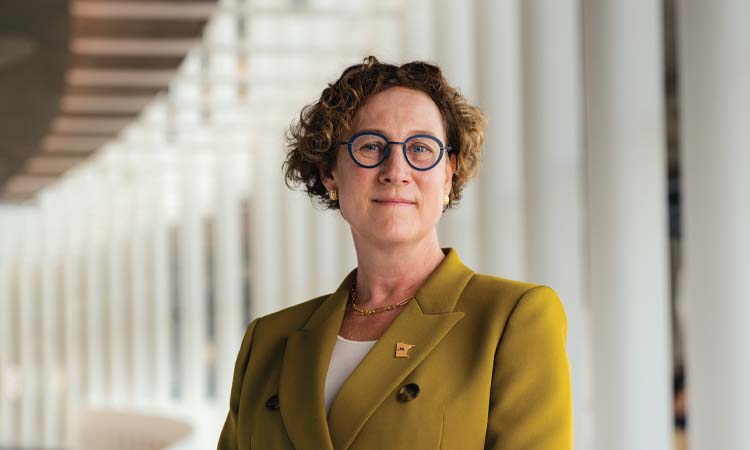
During our photo shoot for this story, a bicyclist passing Cunningham suggested she f— off. She wished him a nice day and noted he was expressing his free speech rights on campus, which she strongly supports.
It’s a tough job, and not all U presidents are beloved.
Dave Mona thinks Cunningham has a difficult task—connecting with Minnesota’s corporate elites and everyday folk to become a transformative leader.
“Times have changed,” Mona notes. “Ken Keller went to the Minneapolis Club and made his case to the Pillsburys, Daytons, and McMillans. Now you need a public strategy. CEOs don’t always live here.”
Mark Yudof ran the U only from 1997-2002, and though an introvert, is remembered for his bully pulpit advocacy of campus pride and his pancake breakfasts around campus and the state.
It’s not clear that Cunningham is the griddle type, but those who support her express a hope she can raise her profile. “She doesn’t get out as much as some presidents,” Lucas notes.
What observers seem to like best about Cunningham is the ER doc’s action orientation combined with a willingness to change her mind, on issues big and small. After all, she acceded to consensus on the hospitals and dropped a new slogan, “Leave a Future,” after it failed to generate buy-in.
“I’ve seen a decisiveness that is not aloof to feedback,” says McMillan. “That’s an encouraging profile in leadership, if you ask me.”