

The Price of Manufactured Winter
You don’t have to be a native Minnesotan to understand how unusual this winter has been. This winter season in the Twin Cities has been one of the warmest on record, with an average temperature of 29.9 degrees from December, January, and February, WCCO reported earlier this month. That’s more than 10 degrees above average.
For businesses that depend on winter weather, this season has also presented financial and logistical challenges. That recently led Gov. Tim Walz to “unlock” federal disaster funds to help out businesses impacted by the warmer winter and historical drought conditions. Under the federal Economic Injury Disaster Loan program, businesses can borrow up to $2 million to cover their actual losses, and they won’t pay interest for the first year, according to the governor’s office.
The loan program is open to any businesses operating in the 81 Minnesota counties that have received ongoing federal drought declarations.
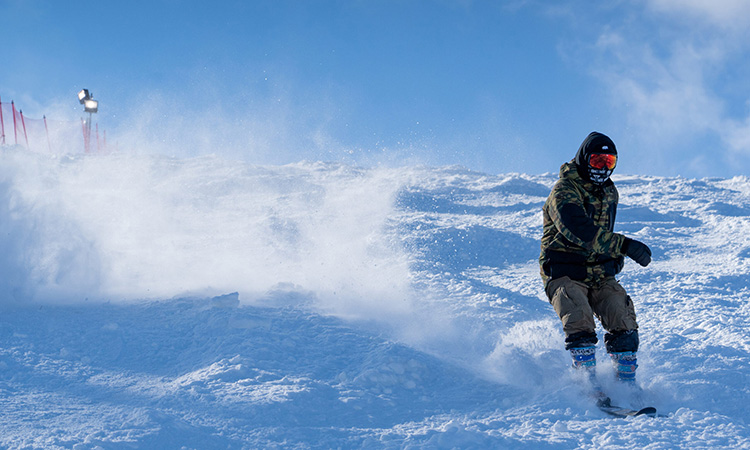
For many winter businesses, the program may offer some relief. Perhaps surprisingly, though, leaders at the Afton Alps ski hill in Hastings don’t have plans to apply for federal funding. Trevor Maring, the hill’s general manager, said he’s seen a fairly active season for skiing and snowboarding, though there’s obviously been a much higher need for manufactured snow this winter.
“We’ve maximized every opportunity that we can for snowmaking,” Maring said, noting that the most recent snowmaking happened at the end of February. He also shared that “snow farming” — putting snow in certain pockets of the hill and spreading snow out for an even surface — has been an integral part of maintenance.
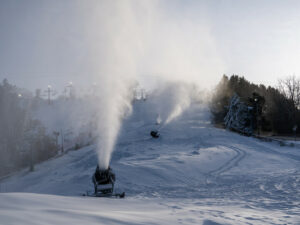
“It has not impacted necessarily our operations, but more just our ability to be upfront and use resources we have more effectively,” he said. “Shifting resources to our grooming teams has been a huge reason why we haven’t closed at all this year despite some of the weather variability.”
Maring also credits Vail Resorts, which owns a network of 42 resorts around the world including Afton Alps, for the stability. The ski hill has been open every day since Nov. 29.
Still, not every winter-oriented business has been so lucky. There are real costs to manufactured winter. The Minneapolis Parks Board, for example, reportedly spent as much as $750,000 for just one week of skate-worthy ice, according to a Star Tribune article published earlier this month.
Over at Hyland Hills in Bloomington, leaders are expecting changes in revenue. Jeff May, director of enterprise operations at Three Rivers Park District which owns Hyland, says there’s been a notable decline in organic, spontaneous skiers. May believes the decline in that group of spontaneous skiers will affect 25% of Hyland’s revenue for the year.
“People just aren’t thinking ski when they’re not shoveling,” said Jeff May. “We still had an OK year, but we just missed that part of our business.”
Season pass holders and regular events like races have helped provide some stability, though. But, unlike Afton Alps, Hyland had a delayed start to the year, having pushed back its usual start date from Black Friday to Dec. 1.
Meanwhile, snowmaking has increased labor costs for Hyland.
“You pretty much have to do it overnight, so you’re talking about a third shift,” May said. “When we close the ski hill, we like to groom the runs. But when you’re making snow, that is a lot of staff and a lot of labor.” By early March, Hyland had to manufacture snow twice due to a warm Christmas, which May said is irregular.
Despite overall visitations going down, May doesn’t think this will affect seasonal pass purchases for the next winter.
“We’ve had three great years in a row with plenty of cold weather and plenty of snow,” he said. “We just hope the next one goes back to what we’ve had before.”