

The Art of Climate Change Research
If Arctic thaw turns unpaved Alaskan roads into marshes, will the military need to invest in new types of vehicles capable of traversing the altered landscape? It’s an aspect of climate change not widely considered, but one of serious consequence to the U.S. Department of Defense. Among the research groups evaluating the threat is an unlikely partner: the Minneapolis College of Art and Design.
How did the arts college get tapped to work on a $17 million project funded by the U.S. Army Corps of Engineers Cold Regions Research and Engineering Lab? That’s thanks to MCAD professor and chair of creative entrepreneurship Olaf Kuhlke. With a Ph.D. in geography, Kuhlke has conducted Arctic research since 2018.
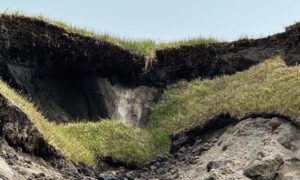
MCAD’s $1.8 million share of the four-year contract is the largest research grant in the school’s history. The team from MCAD collects spatial data using lidar (light detection and ranging) via remote sensing equipment utilized by Steve Rowell, an MCAD instructor and postgraduate research fellow hired specifically for the project. Two MCAD undergrads also work on the project; Anastasia Broman is a freshman in creative entrepreneurship, and Connor Johnson is a junior studying product design. The team uses newer technologies like the Apple Vision Pro and Meta’s virtual reality headset to monitor Alaska’s changing landscape and the impacts on infrastructure from afar, Rowell says.
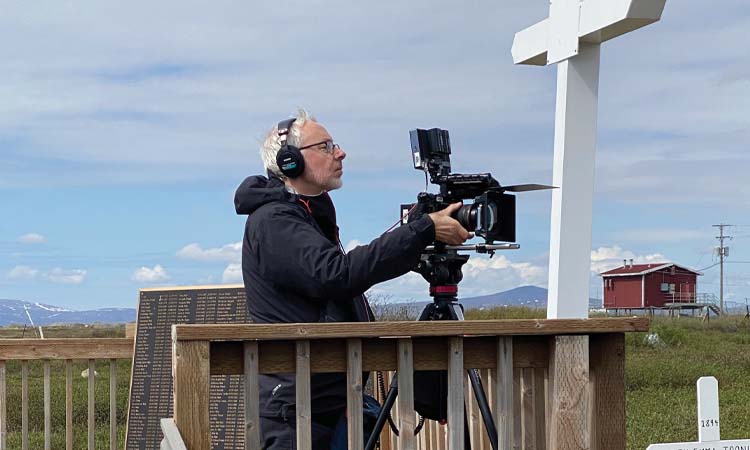
By measuring the land in remote areas of Alaska, the team can track and visualize the rate at which permafrost melts and to what degree it could destabilize roads, bridges, homes, and even a cemetery on Native land containing bodies preserved in ice who died during the 1918 flu pandemic. If the grave sites thaw and create puddles on the surface, Rowell says the virus could spread from wild animals to household pets to humans.
MCAD’s $1.8 million share of the four-year contract is the largest research grant in the school’s history. The team collects spatial data using light detection and ranging from remote sensing equipment.
“Climate change affects the living, and it affects the dead,” Kuhlke says. “There are engineering, cultural, and archaeological implications to this, and somehow this has to be mitigated.”
Kuhlke joined the faculty at MCAD in 2022 and rebranded its entrepreneurial studies program as creative entrepreneurship. The program considers photography, film, and other forms of digital visualization that can be applied outside of the art world. While the current project is strictly research, “there is huge potential for entrepreneurship in developing engineering and material science solutions to this problem.”
Researchers and engineers from Virginia Tech, Stony Brook University, University of North Dakota, and the University of Minnesota Duluth Medical School are also involved in the project.