

Sun Country Stays Course as Peers Struggle
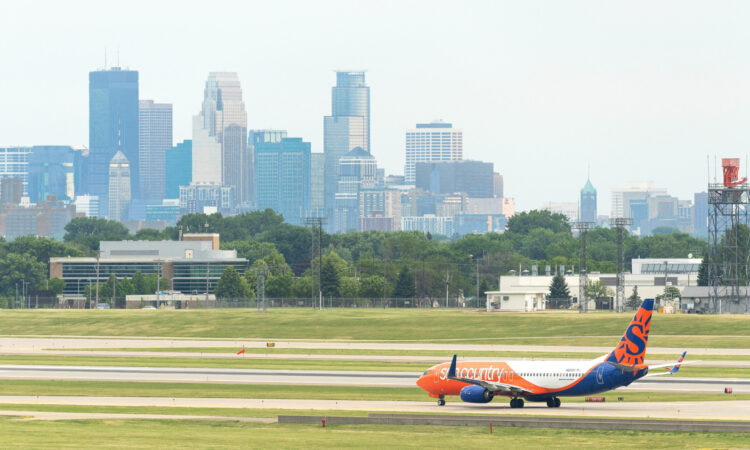
Sun Country, “the disciplined airline,” may not be a great marketing slogan, but the approach is working for the MSP-based carrier as its peers lose altitude. The recent disclosure that so-called ultra-low-cost carrier (ULCC) Spirit would leave the market Dec. 1—as part of an extended draw-down of operations post-bankruptcy—was not good news for consumers hoping to fly cheaply to Detroit or Atlanta. Yet it was a seeming vindication of the strategy Sun Country has maintained.
And it’s not just Spirit. Industry peer Frontier has dropped roughly 80% of its pre-Covid capacity at MSP, while struggling Southwest is down about 50% year over year. “We’ve won in Minnesota,” explains Sun Country president Jude Bricker. It’s won by doing less scheduled flying than it did last year, focusing on predictably strong travel days and opting out of marginal ones.
“In Minnesota, you have 150 great flying days, 150 terrible ones, and 100 in the middle,” Bricker notes. Sun Country flew many of those middle dates in the past but now leaves them to Spirit, Frontier, and Southwest, burdened with expensive new-aircraft leases that make it fiscally unwise to sit an airplane on days it can’t fly profitably.
It’s a fixed calculus that doesn’t offer more opportunity to Sun Country when carriers exit MSP routes and frequencies. Sun Country continues to look for opportunities in other markets with opposite seasonal flying patterns to MSP, but Spirit’s base in Detroit is not that either. So, Sun Country plans to stay its course, which of late has been beefing up its cargo business with Amazon.
The airline does plan to add seven additional aircraft to its passenger fleet over the next two years and by March 2026 plans to be back at the passenger capacities of a couple years ago. But rampant growth is not in the cards, for a number of reasons: Sun Country’s middle-income customer is not flush right now; availability of aircraft and parts remains constrained due to well-documented industry supply chain issues; and Sun Country’s labor costs are higher than ever. Bricker says the airline’s pilot wages are up 140% over 2019, a necessary correction in his mind, but material, nonetheless.
The airline’s growth plans mostly revolve around restarting markets it left during recent retrenchments, including Sacramento, Oakland, and Austin, Texas.
Bricker acknowledges that a variety of industry trends have left the ULCCs on their heels, including the impact of basic economy fares offered by network carriers (Delta, United, American) to compete with ULCCs, the growth of premium cabins and perk-laden bundles on the network carriers, and strong consumer demand for inter-continental travel, which the ULCCs don’t offer.
But Bricker nonetheless feels good about his airline’s position: “We have the highest load factors in the industry,” he says. And despite the sector’s struggles, “our opportunity here isn’t diminished.”