


2025 Entrepreneur of the Year Winners
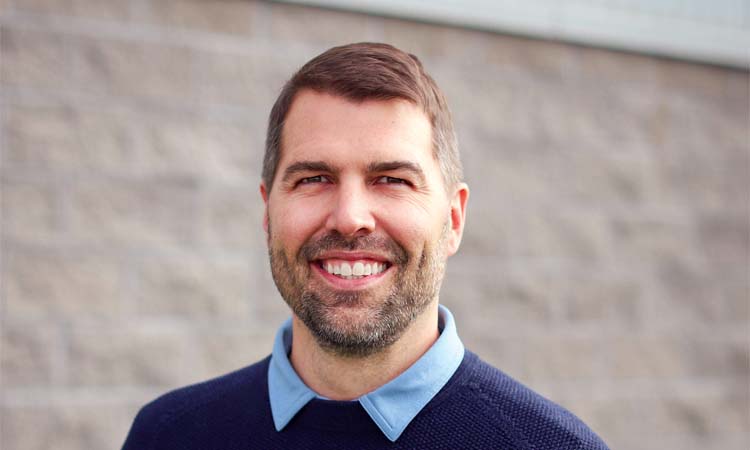

Thomas Barrett
Partner, co-managing director
Sarah Barrett Reiner
Partner, co-managing director, Barrett Petfood, Brainerd
Farmer Mike Barrett bought an extruder for fertilizer only to learn it was intended to churn out pet food. That struck Sarah and Tom, his children, as more fun. They started experimenting with it and, almost 20 years later, are running a successful pet food business.
Experimentation is still key to the work. Barrett Petfood’s differentiator, the siblings say, is that they refuse to say no. Wild and unusual customer requests come in. Maybe it’s for an exotic protein, such as kangaroo (they’re like the deer of Australia). Or for a lesser-seen format, such as a category called “kibble plus”—with dried fruits mixed in, for example. The Barretts do the research to make it happen.
At first, it was naivety, Sarah says. But, she adds, their always-game ethos ended up placing the Barretts ahead of current trends by about a decade. It means they’re often building out capabilities and buffing a reputation for custom orders.
They’ve secured a niche in a market Tom describes as “fat and happy.” Pet food production has climbed since the pandemic evidently spurred pet adoptions. Most competitors, by the Barretts’ estimation, haven’t felt compelled to push boundaries.
Barrett Petfood is seeing results: Headquartered in Brainerd, the company in 2020 opened a second manufacturing plant, in Little Falls, doubling production and adding more than 140 jobs. They employ about 400, with two more facilities also in central Minnesota.
Back when they were playing around with an extruder, they wondered if a pet-food operation could save the family farm. To get Barrett Petfood off the ground in 2006, their father secured a loan with the farm as collateral, Sarah says. They got refinanced by the U.S. Small Business Administration, became profitable, and have grown without reliance on outside capital. “We basically reinvested everything we were making back into the business,” Sarah says. —Erik Tormoen
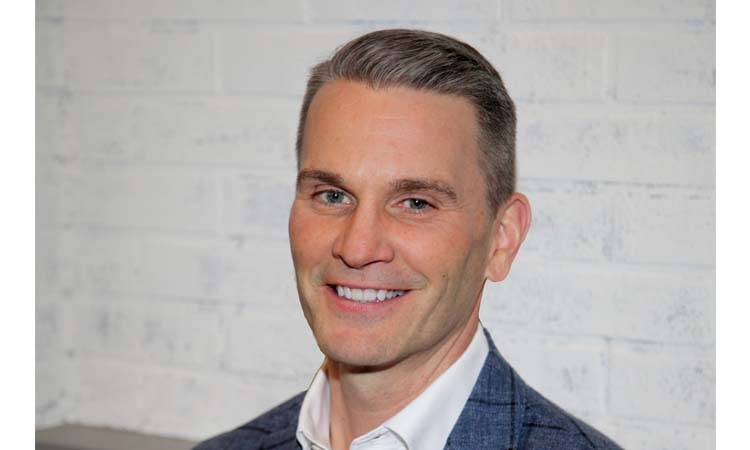
Michael Blue
President and CEO, HistoSonics, Plymouth
“I fell in love with the opportunity to start something as early-stage as possible and get the chance to build it,” says Mike Blue. As president and CEO of Plymouth-based med-tech company HistoSonics, he has taken an innovation that was still in a research lab and built a team that would design a product and take it to market.
That product is the Edison system, which harnesses an advanced ultrasound technology called histotripsy to noninvasively and robotically destroy cancer tissue at a subcellular level. This approach is intended to sidestep the side effects of traditional treatments such as surgery, radiation, and thermal ablation. In addition, it can allow patients to return home the same day.
A team of University of Michigan engineers and researchers founded HistoSonics in 2009 to build a histotripsy platform. In 2017, it hired Blue to be its top executive. He brought with him extensive executive expertise in sales and marketing roles for med-tech companies both large (Johnson & Johnson, Boston Scientific) and small (NeuWave, superDimension).
Under Blue’s leadership, HistoSonics has developed a product to deliver histotripsy safely and effectively in hospitals and in-patient settings. His work has included creating a clinical plan and setting in motion the regulatory and reimbursement approval processes. Of course, he has been raising money—more than $300 million over the last five years.
Now HistoSonics, which currently employs more than 230, is getting into high gear. In October 2023, the U.S. Food and Drug Administration (FDA) approved the commercial sale of the Edison platform to hospitals and medical professionals for liver applications. The company has established histotripsy programs in eight of the top 10 U.S. cancer centers as well as more than 50 additional U.S. and global institutes, treating approximately 1,500 patients.
The company now plans to expand commercialization and continue to conduct trials on other organs, particularly the kidney, the pancreas, and the prostate. “The milestones,” Blue says, “will be coming fast and furious.” —Gene Rebeck
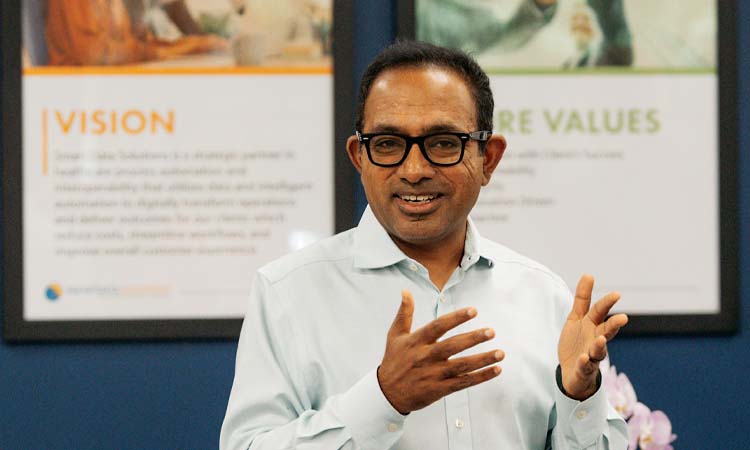
Shashi Yadiki
CEO, Smart Data Solutions, Eagan
Not long after becoming CEO of Smart Data Solutions in late 2022, Shashi Yadiki faced doubt. The Eagan-based health care technology company, founded in 2000, had an opportunity arise with a client far bigger than its traditional base.
Yadiki, who is based at the Texas office and spends a week each month in Minnesota, recalls his team demurring: Were they ready for such a leap? But he knew they had the capability to build a best-in-class AI-first platform. To him, it sounded like a chance to bring the team together.
Through the process, he “found the core DNA of the company,” Yadiki says. Some on the team deeply understood workflows. Others grasped the nuances of health care. For comparison, he points to Hanuman, a character in an Indian epic—“a god with immense power, but he doesn’t know he has that power. That was what we had on the team.”
Smart Data Solutions specializes in AI and process automation. It helps streamline workflows and enhance data integration in support of more than 500 health care organizations. Its team includes more than 700 professionals across the United States, India, Nepal, and China.
Yadiki’s gambit appears to have paid off: The team won over the big client, and the company today reports remarkable growth under Yadiki.
He says his leadership philosophy—focused on “results over ego or titles,” reinforcing that every team member can shape the company’s success—traces back to his maternal grandmother, a farmer in the Indian village where he grew up.
She hadn’t learned to read, but she was curious, seeking out, by herself, how to do yoga, new ways to cook, how to speak the language in a new state. “If she believed somebody had an idea to teach her, she would go and learn from anybody,” he says. —Erik Tormoen
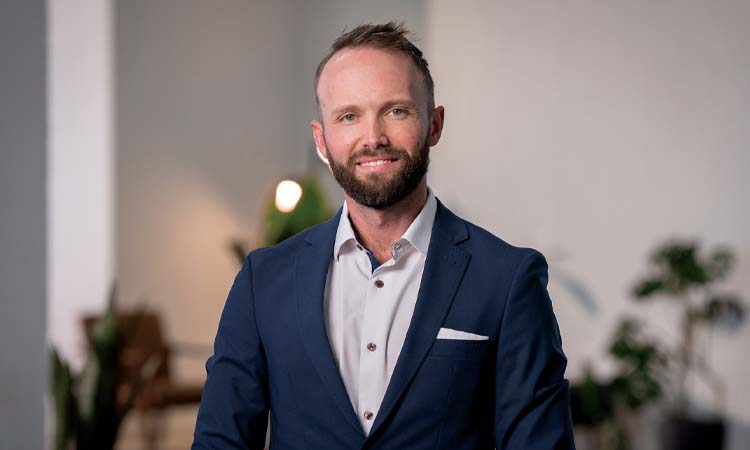
Michael Jordan
Founder and CEO, UNRL, St. Paul
Michael Jordan’s entrepreneurial drive surfaced when he was a young caddy at the Dellwood Country Club. The golf patrons turned into clients. As a teen, Jordan designed logos and websites from his White Bear Lake home for people he met on the golf course.
While still a college student at Minnesota State University, Mankato, he founded UNRL (pronounced unreal), an athleisure apparel business. Launched in 2013, UNRL has been profitable every year, despite being in an intensely competitive retail space.
“I was maybe naïve enough to go all in on this and think that I had a chance of winning,” Jordan says. “There’s been no shortage of blood, sweat, and tears on the journey here.”
But Jordan, sole owner of the business, has succeeded by adhering to a few key core principles. “We didn’t try to cut a corner—even if it took 10 times as long to do it right,” he says. “What we’re doing and trying to create are the best athleisure garments in the world and to raise the standard in the licensed apparel world and sportswear world.”
By 2019, he says, the company was focused on producing the best men’s hoodie and jogger pants and making products around those flagship items. The garments are cut and sewn in the Shanghai region of China. UNRL employees, based in St. Paul, do the finishing work on the garments, which can include trims, embroidery and sports patches. Another St. Paul company, Superior 3rd Party Logistics, handles warehousing and distribution for UNRL.
UNRL employs just over 50 employees. Scheels is a major retailer that sells UNRL products, and they also are carried by Von Maur, an upscale department store. UNRL products are sold in sports shops operated by the Minnesota Wild and other professional teams.
Jordan has a well-defined price niche for his UNRL apparel. “It’s higher than a Nike or an Under Armour, and it’s a little bit lower than a Lululemon,” he says. Jordan, 32, who wants to make a positive impact on the world, donates 10% of pre-tax profits to charitable causes. —Liz Fedor
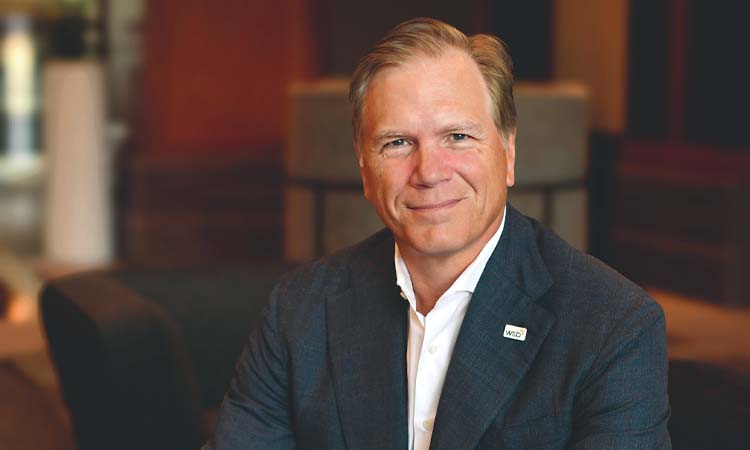
Bret Weiss
President and CEO, WSB, Golden Valley
Bret Weiss and his four partners didn’t necessarily think of themselves as entrepreneurs when they launched their own civil engineering firm in 1995. Very simply, “we didn’t like the place that we were working,” Weiss recalls. Still, he adds, “we couldn’t look exactly like the firm that we had left. Otherwise, we weren’t going to get any business. We had to look different than our competitors.”
That’s how Weiss and WSB became true innovators in their space. “We saw that technology was going to play a huge role in our industry, and so we really leaned into that,” says Weiss, who’s now WSB’s president and CEO. The firm decided to “go after those clients that are early adopters and want to do something different.” Those clients fall into three categories: government (mostly state and municipal), energy (particularly renewable projects), and commercial development.
A notable example of WSB’s approach in action is “Redefine Elk River 169,” a three-year, $124 million project that transformed a three-mile stretch of U.S. Highway 169 in Elk River into a freeway. With this project—completed last year—WSB became the first engineering firm in the U.S. to deliver fully modeled 3D plans, which combine the 3D models and the construction management software used in a project into one. This allowed WSB to proactively see conflicts, increase efficiency in project planning, and better manage resources. By using the fully modeled approach, WSB cut nearly $15 million from the budgeted construction costs.
WSB now employs more than 1,500 people across 52 offices, and over the past two years has posted 20% revenue growth year over year. Looking ahead, Weiss and his firm plan to continue a national expansion and focus on technological innovation. WSB is collaborating with software developers to create a digital construction management product for billion-dollar engineering projects. —Gene Rebeck