


Editor’s Note: Must Even the Biggest Booms Go Bust?
My introduction to beer was at Macalester College, back when they allowed kegs in the dorm because the drinking age was 19. (I was 18, but whatever.) Warm Hamm’s in a sweaty lobby was my introduction to Minnesota beer, and it tasted so foul I didn’t drink enough to get drunk, depriving me of the point of warm Hamm’s and ending my relationship with beer before it began.
I would watch my friends guzzling Hamm’s, then puking their guts out a few hours later, and wonder what about this endeavor I was failing to understand. (Much, actually.)
Minnesota ceased being a center of commodity brewing not long after. The dominant names, Schmidt, Hamm’s, Grain Belt, became subsumed by national brands…but people decided to make better beer again, including here.
I don’t need to review the craft beer boom and its diversification into a host of local microbreweries, nor the likes of Surly and Summit. But the news that Summit Brewing’s lender wants to push it into receivership was alarming. Even if it doesn’t happen, the threat, combined with the dire picture Surly’s Omar Ansari painted in our last issue, is sobering.
Usually when a business goes splat, it’s doing something wrong. That doesn’t seem to be the case here. What it looks like to me is hard generational change.
I’m still not a beer drinker, and I’ll be honest and say the taproom revolution left me cold. Those cavernous, undecorated spaces, their hard seating, sound bouncing, dogs slobbering, little if any appetizing food, and little else to drink but canned pop left me at a loss.
But now that the business is in free fall, I can’t understand quite what happened. I remember when the millennials on our staff wanted TCB to cover every tiny iteration of the movement. There was no one of that generation who was not absolutely obsessed. Nonetheless, there was the sense a bubble was building that would eventually pop.
Usually when a business goes splat, it’s doing something wrong. That doesn’t seem to be the case here. What it looks like to me is hard generational change. Gen Z doesn’t want its parents’ watering holes (or their beer), just like I didn’t want the seedy old-man taverns of my parents’ era.
Read more from this issue

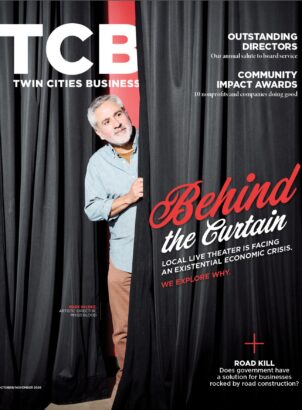
Another industry in the generational vise is regional theater. Associate editor Erik Tormoen ventures into the fun house that is art vs. commerce to examine the ills of the local live theater scene, and the excellent piece is disturbing reading on several levels.
Theater has always presented topical and moral questions as entertainment. Such is art. But what a group of local theaters are advocating for is a hard turn away from the art part—proposing an existence as wards of philanthropy whose function is to heal disadvantaged communities.
It raises fascinating questions about how people in the arts view their role and influence, and also the value of traditional artistic forms themselves.
Also in the latest issue: Our new columnist Dave Kansas. Dave’s paid his dues in business journalism around the globe. Each issue, he’ll share his take on the stories we’re all scratching our heads over. In his inaugural entry, he casts an appropriately intrigued eye on sports owners, notably the transition at the top of the fast-appreciating Timberwolves. No mention of a bubble there.
Every business in Minnesota wants to trumpet its good works. God knows, I get all the press releases. Some really are worth trumpeting, and our annual Community Impact Awards has the details. Liz Fedor leads this excellent package annually and doesn’t even mind the emails.
Finally, please join us Oct. 20 for our annual salute to board service (Outstanding Directors), and at Orchestra Hall on Dec. 7 when we honor our Person of the Year, Christophe Beck of Ecolab, plus each and every one of the TCB 100. Might you be one of them?