

Could Hickory Oil Be Minnesota’s Next Agricultural Breakthrough?
On an unusually warm day in late February at the University of Minnesota Landscape Arboretum, the snow beneath the oak and nut trees is littered with squirrel and wild turkey tracks. It’s quiet evidence of a seasonal feast.
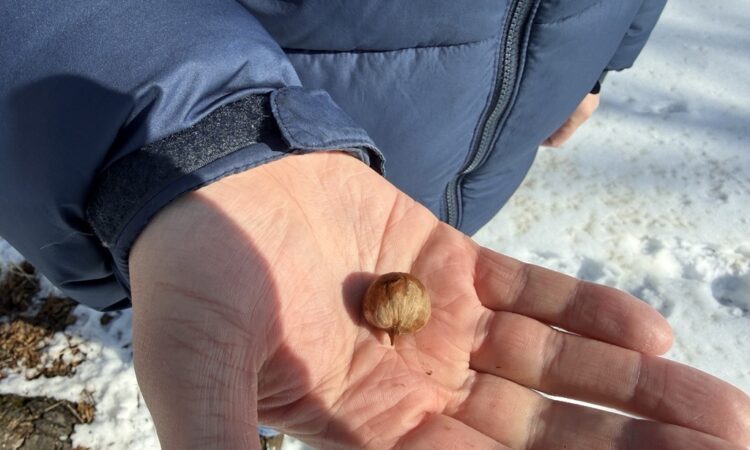
By late fall, most of the acorns are gone. What’s left scattered on the ground are the bitternut hickories.
“[The animals] don’t come and get them until the spring,” says Brandon Miller, an assistant professor in the university’s Department of Horticultural Science, “when they’ve already exhausted everything else.”
For generations, a bitter taste has defined the yellowbud, or bitternut, hickory. The heart-shaped nuts are high in tannins, compounds that make the raw nut so astringent, Miller says, “if you were to eat it, you’d spit it out.”
That’s one reason bitternut hickories haven’t been a part of our global food system for more than 200 years. Historical references suggest Native Americans made hickory nut oil for thousands of years. European settlers used it, too—as lamp oil, potentially.
But Miller believes the nut could position Minnesota at the forefront of a new specialty oil industry, one that offers small farmers a niche market, builds resilience into the food system, and complements olive oil.
Growing an Industry from a Native Tree
Miller grew up with hickories in suburban Chicago, before he began his postsecondary education studying bitternut hickories at Cornell and Iowa State universities. In 2021, he joined the U of M as an assistant professor.
Minnesota also has many pecan trees, Miller says, which are from the same genus as bitternut hickories. That means they’re “like sisters.”
While pecans anchor a multimillion-dollar industry in the South, bitternut hickories aren’t even sold at most garden centers. They are commercially inconvenient, taking a long time to develop from a seed—just a few inches a year at first.
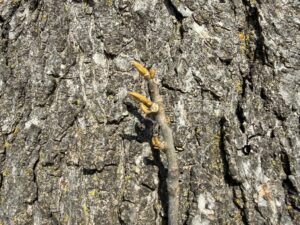
But, amid global supply pressures, the bitternut hickory may have an opening in the cooking-oil market.
The global olive oil industry has suffered through some of its worst harvests so far this decade as extreme heat and drought gripped the Mediterranean. Production declines have rippled through global markets, exposing how dependent consumers are on a handful of regions for cooking oils.
The bitternut hickory, by contrast, is native to Minnesota and found across a wide swath of the United States, all the way down to northern Florida. In the wild, it favors upland, drier sites, like at the Arboretum’s oak and nut tree collection. Miller’s past research found the species to be highly drought tolerant—and likely tolerant of flooding, as well.
RELATED: Houston We Have a Corn Problem. How Do We Solve It?
“In Minnesota, that’s a big deal,” he adds. “Getting oil from this crop means we’re creating more stability in our food system, that we’re not so much at the whims of Mother Nature.” What has taken years for Miller and his peers to discover is that the key to unlocking the bitternut hickory’s commercial potential lies inside.
While the nut meat is intensely bitter, the tannins that cause that bitterness are not fat soluble. So, when a producer extracts the oil and separates it from the solids, that harshness disappears.
“That’s where this opens up a whole new opportunity,” Miller says.
Bitternut hickory’s similarities to the pecan provide a nice benefit for oil extraction, as well. Unlike many other hickories, the bitternut has a thin, leathery husk and a relatively thin shell, making it easier to press.
Producers collect fallen nuts, grind them, and run the mash through a screw press. Oils can be hot-pressed or cold-pressed, though hot pressing generally yields more oil.
Early data suggest hickory nut oil is high in unsaturated fats and may contain tocopherols, a class of antioxidants commonly known as Vitamin E, though Miller says more research is needed to document health benefits.
The University of Minnesota has multiple grants under review to study the oil’s composition and to begin breeding efforts aimed at increasing annual yields—essentially domesticating a wild tree for commercial production, much as the state’s pecans were improved over generations.
A Wisconsinite’s Discovery, 24 Years Later
On a farm in northern Wisconsin, Samuel Thayer grew up picking hickory nuts, mainly shagbark and yellowbud. “There’s so much oil in these,” he recalls thinking. “And they smelled so good.”
Thayer began reading about olive pressing and realized the same principle applied to hickory nuts: Tannins are not fat soluble. If he could separate the oil from the solids, the bitterness might not matter—just as Miller discovered years later.
Thayer modified a meat grinder and drew out small amounts of oil. “Oh, my goodness, that’s good,” he remembers thinking. The flavor was rich and buttery, “like a liquid pecan.”
It changed how Thayer thought about commodity vegetable oils. “It’s impossible to find fresh canola oil,” he says, criticizing industrial oils that are processed for shelf stability and often stored at room temperature for long periods.
After two years of research, Thayer invested $9,000 in a screw press to produce the same hickory oil he’s been making for 15 years.
“Think about all the people who have bought ATVs [for that same amount of money],” he says. “Those are toys. I make all the hickory nut oil for my whole family for a whole year for that same price.”
Today, Thayer harvests from about 30 productive trees on his land and gathers additional nuts from 15 to 20 farms across Wisconsin and Iowa. The season stretches from mid-September to February, peaking in mid-October. By July, he can usually predict the size of the hickory nut crop.
Some years are abundant, others are sparse. The hickory oil industry remains tiny. Four producers currently sell the product, according to Thayer. An Iowa producer pressed 74 gallons last year in their second year of operation.
Still, Thayer is bullish. If yellowbud hickory orchards were planted at scale, he believes per-acre oil yields could eventually exceed canola.
The appeal isn’t just agronomic (less need for herbicides and less soil erosion). It’s also culinary.
“No one wants to dip a cracker in canola oil,” Thayer laughs. “It’s gross.” Hickory oil, by contrast, is aromatic and sweet. One of his customers recently drank a 5-ounce bottle in a day and immediately called to order another. Thayer adds that he’s already sold out of this year’s hickory oil supply.
“It’s weird I stumbled on this, and people are taking notice,” he admits. “Maybe my grandkids will say, ‘My grandpa discovered this.’”