


How Damaging Are Minnesota’s Image Problems?
WCCO Radio’s Jason DeRusha was on TV in January, talking about our latest local, er, national controversy. Minnesotans, he told CNN, wanted off the national news and back to being flyover country. It’s a striking turnaround for a region that long craved national recognition and respect but is now known as a place of political killings, violent activism, federal retribution, and scandal.
Even before federal immigration raids began in mid-winter—which put the chaos in Minneapolis on national TV day after day for weeks—people were suggesting Minnesota was not viewed as a stable market for investment.
“We were one of the strongest apartment markets in the nation. We were stable, growing, a good place to invest.” That’s Stu Ackerberg. The development company he founded built much of modern Uptown. Today, his signature buildings are in foreclosure, the neighborhood he loves still struggling six years after the riots.
“We went under the microscope: the City Council’s lack of interest in business and growth, an inability to deal with crime, rent control in St. Paul. Everyone knows [what’s happening] everyplace now,” Ackerberg says.
The Twin Cities cannot sustain growth and reinvention without outside capital. No one argues that. “But if I were on an investment committee pitching a deal to a board, with opportunities in Minneapolis, Boston, or Denver, where am I going to invest?” says Ackerberg. “Remember, you can only get fired for a bad choice. It’s not an industry of risk takers.”
The problems afflict even the most successful parts of town. The TractorWorks office complex on Washington Avenue in the North Loop just sold for less than half its 2014 price.
Then there’s the West Hotel historic redevelopment, also in the North Loop. David Wilson co-developed the still-unfinished project. After Covid and the George Floyd riots, it lost its lender and he could not attract capital to replace it. The project reverted to its mortgage holder, Onward Investors, in November, and Wilson, the former head of Accenture’s local office and a neophyte developer, lost his investment.
“Our reputation is in the hands of the media and politicians,” Wilson learned. “[Gov.] Tim Walz’s [vice-presidential] run was counterproductive and drew more negative attention. It’s seeped into how investors view us, and there’s no counter-narrative.
“I was surprised how much gut and emotion is involved in these [lending] decisions,” Wilson continues. “You bring [prospective investors] downtown, and they are surprised when they see it’s not a hellscape.”
He sees a region living on a reputation built in another era. “We’ve been surviving on wealth generated 25 to 50 years ago,” Wilson says. “I’m not reading about new companies hiring lots of people.”
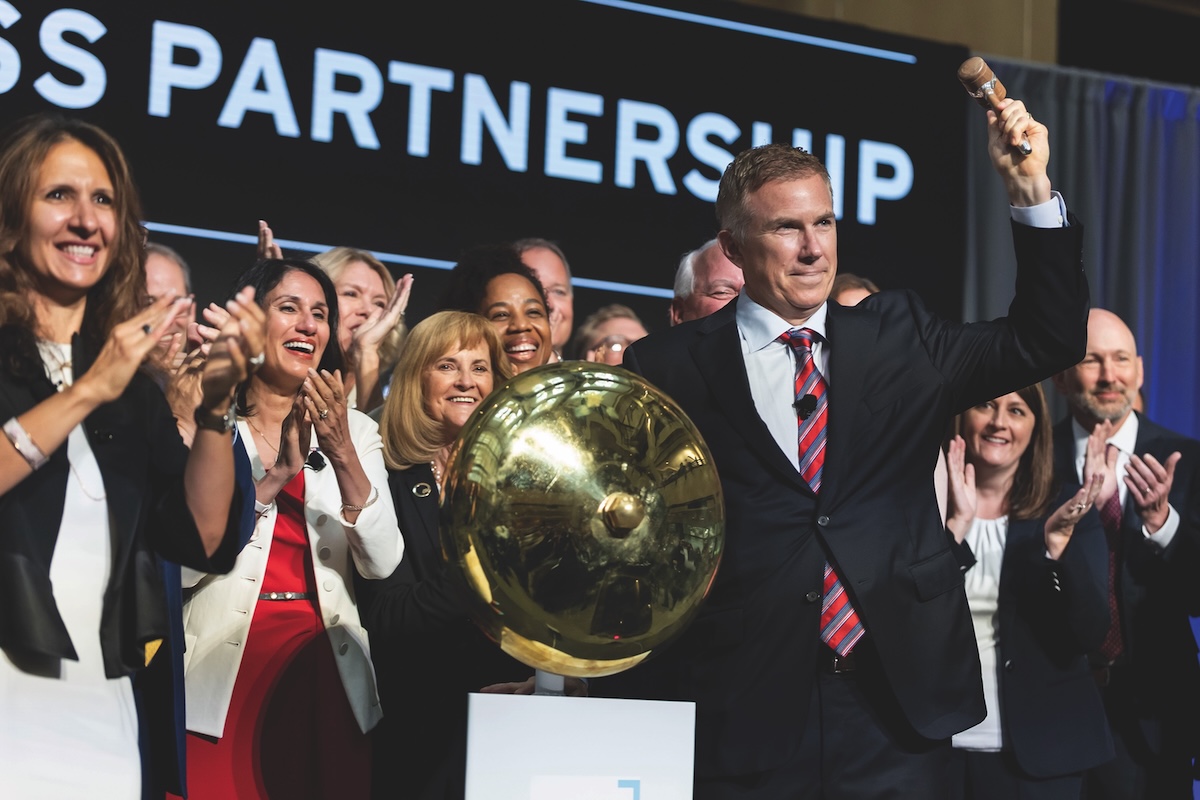
The Minnesota Business Partnership is trying to create a counter-narrative. It brought the New York Stock Exchange to the Medtronic Fridley campus in July so that Medtronic CEO Geoff Martha could ring the opening bell flanked by CEOs of major Minnesota companies. Martha is chairman of the partnership, which is targeting communications to a national business audience. The message: Minnesota is a place where companies should expand and entrepreneurs should start businesses.
In a Nov. 13 LinkedIn article, “Innovation and Quality of Life: The Minnesota Advantage,” Martha highlighted Fortune 500 companies in the state as well as other assets. But he also wrote: “Like any ecosystem, Minnesota’s business community faces challenges. Views of our cost of living, economic strength, and public safety have declined in recent years.”
Minnesota can’t revert to flyover country, notes Jen Hellman, CEO and president of the St. Paul-based Goff Public PR/public affairs firm. “I’m not worried about the fact that we are having some high-profile crises,” Hellman says. “What I’m concerned about is how we respond to them, because the world is watching.”
When the state is in the spotlight, she says, Minnesota leaders need to demonstrate they can find solutions. “If we let the pressure of these incidents separate us, that’s when we’re going to get in trouble. Businesses need to see stability and be able to feel like they’re entering a state where they’re going to have influence on policies that are going to impact their businesses.”
Ackerberg is impressed with the rapid turnaround San Francisco Mayor Daniel Lurie engineered in a city rocked by homelessness and abandoned by tech employers. Lurie’s roots are in business. “We need to take a group to San Francisco and learn what they’ve done,” Ackerberg says. “We need Jacob [Frey] with us. We need that kind of boldness from the mayor.”