


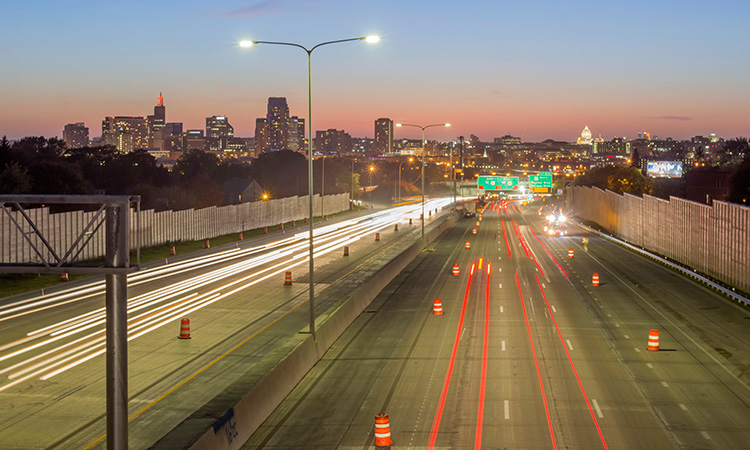
Rethinking I-94: Don’t Fill the Trench
To: Commissioner Nancy Daubenberger
Minnesota Department of Transportation
395 John Ireland Boulevard
St. Paul, Minnesota 55155
Dear Commissioner Daubenberger:
When you are sitting in the long parking lot that I-94 between St. Paul and Minneapolis often becomes, do you think: If we only had fewer lanes? Bike paths? Trees? Yet that is exactly what some transit groups want the Minnesota Department of Transportation to do with the 7.5-mile section of I-94 between St. Paul and Minneapolis.
You read that right! Transportation advocacy group Our Streets has issued a report advocating filling in the I-94 “trench” with a boulevard, bike paths, and affordable housing.
MnDOT has a series of reports and proposed alternatives to the existing I-94, occasioned by the need to reconstruct the underlying pavement and bridges along the stretch of I-94 between Marion Street on the east and Hiawatha Avenue on the west. These alternatives are titled “Rethinking I-94.” Taxpayers, businesspeople, and those who travel between St. Paul and Minneapolis should review them.
Let’s deconstruct these plans. I-94 between St. Paul and Minneapolis has 130 express bus stops and 38 limited bus stops; 114,000–167,000 vehicles use it each day, emergency vehicles included. Filling in the trench so the roadbed would include trees, bike paths, and affordable housing would displace much of this traffic. Where would all of this traffic go?
Fill-in-the-trench advocates have an answer: to the neighborhood streets. This is not a joke—read their website. It is, however, an alternative reality. Few of these “abolish I-94” advocates are old enough to have even driven between the cities before I-94. The undersigned has, and did, on a regular basis. Marshall Avenue/Lake Street was a mess, and University Avenue even worse. Driving University Avenue when the U was in session during winter, dodging streetcars, was a long trek. This trek has not improved now because you have to take care of our modern streetcars (now called light rail). If you want to go from the Minneapolis City Hall to, oh, say, the Department of Transportation office now, you would have to negotiate 49 stoplights. Efforts to make this easier by synchronizing stoplights would be made impossible by light rail crossings.
The problems don’t stop there, although traffic might. Many advocates of “filling the trench” argue that the I-94 trench is a source of serious air pollution. Spoiler alert: Assuming the same number of vehicle trips, and forcing those vehicles to stop and start frequently at stoplights, increases, not decreases, air pollution in the immediate area. The real goal here, though unstated by fill-the-trench advocates, is to make car travel so inconvenient that the number of trips, would, in the words of the MnDOT website—“evaporate.”
Today’s actual use of I-94 provides increased access to neighborhoods like Cedar Riverside, Prospect Park, and Seward. It is no secret that I-94 is a major thoroughfare taking people to events at the Xcel Energy Center, Allianz Field, and Viking football games. Emergency vehicle access to all of these areas is easier and quicker than attempting to navigate neighborhood streets.
There are better alternatives than filling the trench if you want to reduce pollution and increase convenient access to the places people wish to go. The Twin Cities used to have one of the most developed light rail networks in the nation (we called them streetcars), which you can revisit by going to the website of the Minnesota Streetcar Museum (trolleyride.org); but the system was phased out by 1954.
Today’s light rail system has not lived up to its potential—local news sources are replete with reports and studies about the homelessness and crime problems. According to Metro Transit general manager Lesley Kandaras, ridership on the light rail system is less than two-thirds of what it was before the pandemic.
Metro Transit has a very difficult time hiring police and community service officers and is currently down 172 officers. Fixing the crime problem on light rail would go a long way to providing alternatives to I-94. By the same token, converting Metro Transit buses to electric propulsion instead of diesel fuel would also reduce pollution. Herein may lie a government structure problem: I-94 is governed by federal regulations administered by the Minnesota Department of Transportation, whereas Metro Transit light rail and buses are owned and governed by the Metropolitan Council. These are bureaucratic barriers to holistic solutions.
The plan to rethink I-94 may become a bureaucratic zombie ready to come back to life when jolted by federal infrastructure funding. That is why I would urge readers who commute between the cities in the real world to become involved in this issue. We should work to make light rail and the metropolitan bus system true and useful alternatives to our I-94 traffic, while at the same time supporting electrification of the transportation grid.
Sincerely yours,
Vance K. Opperman
Frequent I-94 commuter