


More Flight to Quality, Fewer Vacancies: Checking In on the Office Market
The Twin Cities’ pattern of high office vacancies stopped expanding and even shrank a little in this year’s second quarter. It signals some progress in a post-Covid mission: to transform forsaken offices into—for the most part—apartments, warehouses, or their component parts.
The metro office vacancy sits at 20%, a dip from first quarter’s 20.1%, according to the second-quarter report from Newmark, a commercial real estate firm headquartered in New York. Newmark defines the metro as north to Andover, east to Hudson, south to Apple Valley, and west to Mound.
It may seem negligible, but a 0.1 percentage-point drop equates to nearly 112,000 square feet removed from the market—leased, converted, or demolished. That’s a bright spot for local commercial real estate (CRE) when the vacancy rate has mostly risen since 2020, with work-from-home adaptations setting in and companies letting leases gradually expire, as TCB editor Adam Platt reported in his article about the CRE market’s “slow-moving crisis” last summer.
Related: What’s Behind the Commercial Real Estate Mess in Minneapolis?
Removal is the goal, for the sake of property values and the metro’s tax base. The vacancy rate’s second-quarter dip is “significant,” says Maura Carland, research director behind the report. “It’s leveling off and going down.”
But if a pre-pandemic vacancy rate is the goal, we have many demolitions and conversions ahead of us. Office vacancies in 2019 hovered around 10%.
Where are we seeing wins, to explain the leveling off? The suburbs continue to fare better. Nearly all regions around the metro, as measured by Newmark, have lower office vacancies than they had a year ago, by an average of about 2.7 percentage points. Of the Twin Cities’ major CRE hubs, the two in the west and southwest (roughly around I-394 and I-494, respectively) saw positive net absorption—or, more vacancies removed than added—this past quarter. So did downtown Minneapolis, which sits at 30.3% vacancy, down from 30.4% the prior quarter but up from 29% this time last year. Downtown St. Paul vacancy also continues to rise, now at 37.6% versus 37.3% the prior quarter and 36.2% this time last year.
“We have, not a vacancy problem, but a demolition problem,” quips Newmark vice chairman Jim Damiani, whose team at the Twin Cities office helps would-be tenants find space.
Related: Is It Time to Tear Down Empty Skyscrapers?
New office leases—and, much more rarely, new office construction—depend on location and whether landlords have the capital for upgrades. The “flight to quality” continues, with employers shrinking company footprints, fleeing outdated buildings, and seeking modern amenities, the better to cajole workers from home: “It’s totally an arms race to provide the best possible employee experience,” says Steve Shepherd, a Newmark senior managing director who works with landlords.
Two years ago, Shepherd noted that greater demand for the upscale as his team began redeveloping Richfield’s Meridian Crossings office complex for longtime owner Piedmont Realty Trust. “We benchmarked [the office] more to Four Seasons hotels than we did to competing office buildings in the market,” he says, “down even to scent technology,” with Piedmont using scent machines in common areas. Redevelopment cost about $12 million.
U.S. Bank had occupied Meridian Crossings for more than a decade before the company downsized a few years ago. Today, the 400,000-square-foot building has rebounded and is 98% leased, Shepherd says. “If you [property owners] don’t have money and you’re just limping along, you’re not going to win deals,” Damiani adds.
Because they need less space, tenants are generally willing to pay higher rents per square foot. The average asking rent per square foot has risen after 2024—by about 3% since the end of last year, to $30.71 per square foot—following a considerable drop in 2023.
Unproductive landlords, particularly downtown, Shepherd says, “are likely riding the existing rent roll into a new day and a new use for that real estate. Any sort of pre-pandemic recovery, numbers-wise, involves losing some of that lower-quality office space out of the [central business district] environment.”
Based on second-quarter reporting, here’s a look at owners making gains across the downtowns and suburbs, plus a look at corporate campuses.
By the numbers*
The Twin Cities metro** has seen 7.8 million square feet of office space removed from the market since 2020.
5.1 million square feet have been demolished—that’s 55 properties.
A little more than half that, 2.7 million square feet, have been converted (19 properties).
Notably, data centers have made up about 500,000 square feet of office conversions.
The Twin Cities have 570,000 square feet proposed for removal.
There are 7.2 million square feet of “wild card” real estate, or offices tapped for potential redevelopment.
*Numbers reflect Newmark’s second-quarter report on the Twin Cities office market
**North to Andover, east to Hudson, south to Apple Valley, and west to Mound
Downtowns
Downtown Minneapolis’ office vacancy of around 30% is expected to climb through 2028, possibly to exceed 31% as company space reductions outpace conversions and modest new development, per Newmark.
But the region lately secured a win. The Wells Fargo Center skyscraper sold in late 2024 for a reported $85 million, a more than 70% drop in value from 2019—but the building recently leased several big law firms, including Cozen O’Connor, Faegre Drinker Biddle, Saul Ewing.
Damiani notes the tower’s steeply discounted sale reset its tax basis. “Now they have tons of money for amenities, upgrades,” he says. “That’s why they’re getting a lot of these [law firm] deals downtown.”
The skyscraper’s smaller floor plates (mid-20,000 square feet, per Damiani) must have helped. The iconic nature of the building surely does, too, plus the Bellecour restaurant from celebrated local chef Gavin Kaysen, is expected to open on the ground floor this fall.
“The tenant class that seems to be doing best are the law firms,” Shepherd adds. Along with financial services, engineering, and accounting firms, they lean heavily on collaboration. “We need activity from other trades, as well.” (Newmark notes continued tightening of hybrid policies: Target in April ordered about 150 remote workers to relocate to Minneapolis or accept severance; Best Buy in May established a four-day in-office policy for corporate workers.)
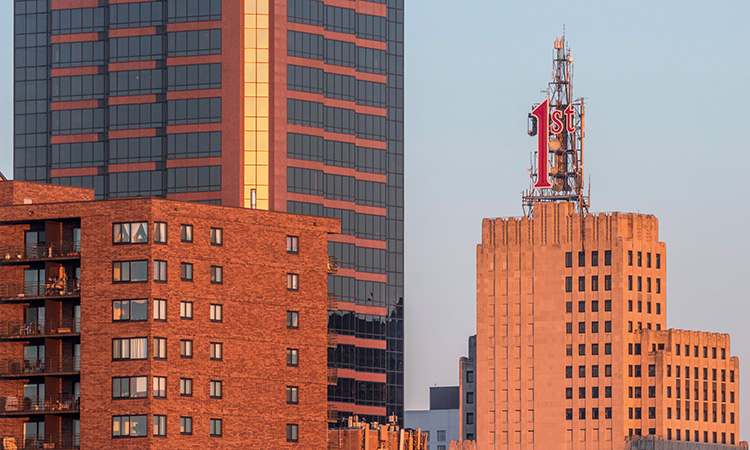
Across the river, the St. Paul Downtown Development Corporation keeps on with its mission to buy and convert undesirable downtown properties, completing its purchase of the U.S. Bank Center in June. And the Downtown Revival Trust, a recently created investment entity in Florida, bought two steeply discounted St. Paul skyscrapers—the First National Bank Building and Great Northern Building—this past spring. (The former had its rooftop “1st” sign illuminated earlier this month, a sort of beacon of hope.)
The suburbs
The west metro has upheld its reputation for quality real estate that’s conveniently located. “The west has never been overbuilt,” Shepherd says, and that CRE hub, around I-394, “continues to tighten to the point now where you know there really aren’t any quality, large plots of space remaining.”
Along with modern amenities, employers generally want bustling locales, which Shepherd describes as “live-work-play environments.” The appeal for employees: “I can live near my office, I can step outside and there’s restaurants, there’s bars, there’s retail.”
A notable western project is Real Capital Solutions’ purchase of St. Louis Park’s 309,000-square-foot former Target West office building. The West End shopping and lifestyle center is a five-minute drive away, off I-394. Newmark describes it as 99% leased and amenitized, with its $34 million price 54% higher than its 2018 sale, “illustrating that well-leased, amenity-rich office properties can command premium valuations despite broader market softness.”
Farther southwest, in the I-494 corridor, Edina stands out as a metro city with new office construction underway—more than 268,000 square feet of it. That includes the Arcadia project, the Opus Group’s 115,000-square-foot build-to-suit headquarters expected late this year, as well as the Craftsman on France, Orion Investments’ mixed-use development anchored by Charles Schwab and Adolfson & Peterson, also expected late this year.
Swervo Development, too, has sights on Edina: The Minneapolis-based developer bought the 131,000-square-foot France Commons office building for nearly $9.5 million, to renovate while building three 5,000-square-foot buildings for service-retail and office use.
A small office project in Shakopee has delivered more than 28,000 square feet to the market, as noted by Transwestern, the Texas-based commercial real estate firm, in its own second-quarter report. Danny’s Construction occupies about 85% of the property.
In the east metro, meanwhile, construction continues of office space that’s part of the notably delayed United Village development in St. Paul’s Midway neighborhood.
Corporate campuses
Corporate campuses have comprised a huge chunk—more than 28%—of office space removed from the market since 2020. That’s thanks largely to Thomson Reuters.
The Canada-based AI and tech company has removed or renovated more than 1.4 million square feet of its Eagan campus “to make way for warehouse space, a data center, and multifamily residential,” per Newmark. That amounts to about 63% of 2.2 million square feet of Twin Cities corporate campus conversions total since 2020.
Other notable examples include the Prudential campus in Plymouth (450,000 square feet—“There’s a Summit Orthopedics facility there, there’s a grocery store, there’s a bank, there’s residential apartments,” Damiani notes) and Deluxe in Shoreview (314,000 square feet converted for industrial use).
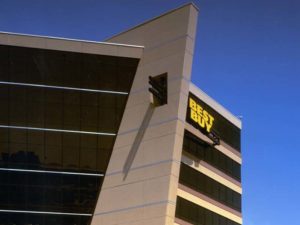
In many ways, the format of the corporate campus has become outdated. “We’ve got such a strong concentration of large companies, Fortune 500 companies,” Carland says. “More than 20 years ago, there were quite a few corporate campuses built”—like the Best Buy campus in 2003. They had “open spaces, to keep the employees on campus the whole week … big parking lots, that type of thing. And that just isn’t what’s modern now.”
Damiani adds, “They don’t have the walkability, or they only have one cafeteria in the building, whereas, if it gets converted into a mixed-use development, now you’ve got multiple restaurants, you’ve got shopping.”
They’re often in desirable locations, Carland adds—“in an inner-ring suburb, close to a lot of housing,” which makes them attractive to higher-demand uses.
Slated for conversion are the long-vacant Wells Fargo Home Mortgage campus in southeast Minneapolis and the Blue Cross Blue Shield campus in Eagan.
Novarum Development Partners in June bought the 25-acre former Wells Fargo Home Mortgage campus for $15 million, per Newmark. The plan is a mixed-use redevelopment of about 1,000 housing units, with portions for retail, healthcare, school, and tech.
Regarding the 442,000-square-foot Blue Cross Blue Shield campus, Opus Group and Capital Partners last month withdrew their multi-use development application following community opposition based on concerns over traffic impacts and housing density, as reported by the Pioneer Press.
The campus concept isn’t entirely demoded: In the northwest metro, Boston Scientific has opened its 400,000-square-foot, $170 million campus in Maple Grove, consolidating operations, R&D, and offices. Boston Scientific’s 225,000-square-foot building in Minnetonka, meanwhile, faces demolition and replacement by the new Maple Grove campus’s 273,000-square-foot industrial facility.
Tale of Two Offices
To parse this market of “haves and have-nots,” Newmark’s Steve Shepherd uses two office properties in the southeast metro’s Richfield: the Meridian Crossings complex and the Best Buy headquarters. Across Interstate 35W from the Meridian Crossings, Best Buy owns its 1.5 million-square-foot campus and began leasing portions of it in 2023.
“Anybody can sit at the top floor in Meridian and look across the street, like, ‘Geez, we’re going to compete against sublease-type rates over there at the Best Buy campus?’ And it’s like, well, no, not really, because they can’t deliver that [quality] experience,” Shepherd says. He points to the Best Buy campus’s large floor plates, which tend to make multitenant leasing difficult, and its ownership group, which he says has lacked interest in tenant improvements.
A Best Buy representative told TCB that the company “continue[s] to invest in shared campus spaces and amenities available to tenants, including expanded food service, updated vending and beverage options, and improvements to the look and feel of common areas.” The Best Buy campus made headlines in June for the county assessor reducing its property value by half, per Best Buy’s request—a change that would free up dollars for tenant improvements.
Externalities
Minneapolis may be a year or two behind comparably sized downtown office markets, Shepherd says. “We have a lot of national clients who have been kind of frank with us that Minneapolis lags some of the other downtowns out there,” he says.
He points to perception issues. (TCB delved into this topic in a story early this year.) “Sometimes, in our business, perception is the reality,” he says.
Lately, he says, Operation Metro Surge may have frightened prospective investors and property owner-users. “I know restaurant volumes and businesses downtown were hurt in January and February, which are already slow months,” he says, noting good restaurants are important for showing off a city.
He continues, “We heard stories of conferences getting shut down or canceled or postponed. Certainly, that has a spillover effect on our hotels. Our whole ecosystem in the downtown is really dependent on each other.”
Shepherd says he’d feel remiss to end the conversation without a note of uplift.
“The fundamentals of this market remain, in my mind, unchanged,” he says, and they will matter for office recovery. “We’ve got a highly educated employee base with a lot of good universities here. We have a really good quality of life, and that’s demonstrated by our park system. We always rank as one of the healthiest metro areas to live in. We’re still relatively affordable for a large [metropolitan statistical area], with an economy supported by a really diverse ecosystem of companies in a lot of different industries.”