



Arthur Ventures Just Keeps Growing
When Arthur Ventures general partners Patrick Meenan and Ryan Kruizenga need to make a decision, good luck finding them in the office. The pair, who make up the investment committee for the firm’s funds, aren’t ones for formal presentations or hour-long meetings; they usually take a walk to separate the wheat from the chaff. (“A lot of ideas get killed in the Minneapolis skyways,” Meenan observes.)
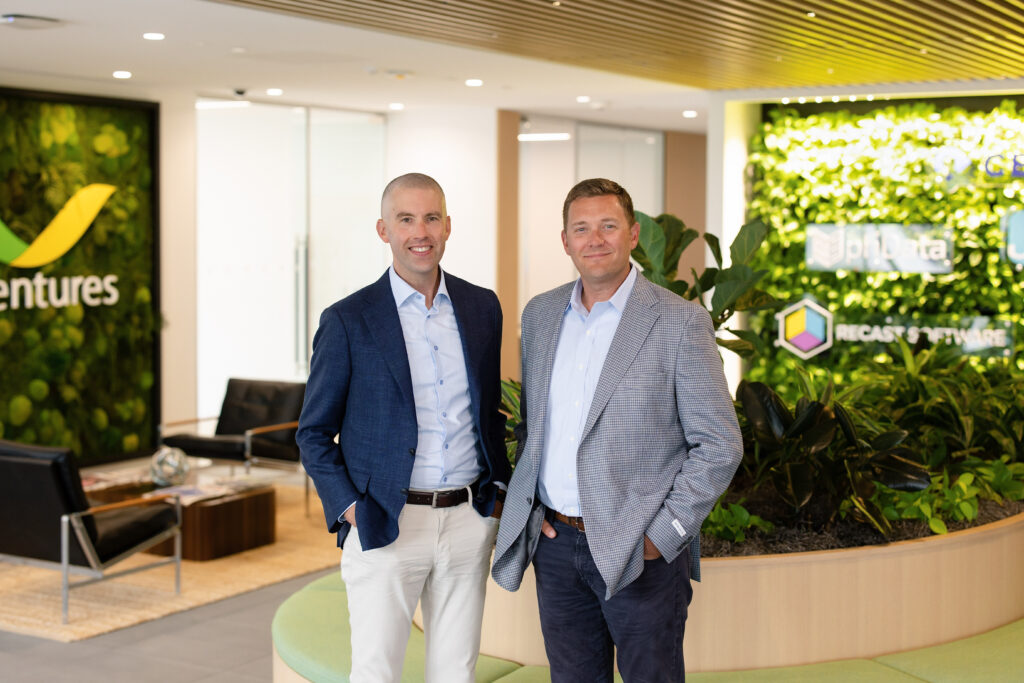
In their tasteful RBC Gateway office, the walls are studded with logos of the company’s biggest investment successes. By the time Meenan and Kruizenga bring a surviving idea to the rest of their team—a skeleton crew of 18—there’s little doubt in their minds.
That certainty has enabled Arthur to grow into the largest venture capital firm in Minnesota by a significant margin. As of July, the firm has nearly $2 billion in assets under management—over twice that of the state’s second-largest VC—and it’s raised $1.8 billion since 2019 alone. It has helped to kick-start several companies across the country, and five separate investments in individual companies have each returned more capital to investors than the value of the fund from which it was investing.
Becoming Arthur Ventures
Meenan, who worked at Microsoft before he joined Arthur in 2012, became a partner two years later, and Kruizenga came aboard in 2016. The pair had met a few years earlier when Kruizenga, who was working at Piper Jaffray, interviewed Meenan for an analyst position.
Arthur Ventures traces its roots to Arthur Cos., a multigenerational North Dakota agribusiness that was founded in 2008 by Doug Burgum, now secretary of the interior, and his nephew James Burgum. Before Doug Burgum became North Dakota’s governor, he built Fargo-based Great Plains Software, which Microsoft acquired in 2001.
The Burgums wanted to involve software executive Dave O’Hara in their new VC offshoot, Arthur Ventures. O’Hara supervised Meenan at Microsoft, and they hired Meenan on O’Hara’s recommendation. In 2020, Meenan and Kruizenga became owners. They credit the Burgums for much of the firm’s early fundraising success but presently have no connection with the larger company.
“[The purchase] was more of a reality of raising institutional capital,” Meenan says of the decision to buy Arthur Ventures. “We could have created our own firm, but we’re really proud of the Arthur Ventures legacy. We wanted to build on that.” They realized there was no sizable local investment firm focused on software, so they went all-in on the sector.
Meenan hopes to play the long game to build a Minnesota institution that lasts beyond the partners’ careers. “Most firms, irrespective of region, might grow and get big, and then the people retire and the firm goes away,” he says. “Our goal is to make this an enduring firm so when we’re done, there’s other people running it and it can continue to exist as the largest investment firm between the coasts focused on technology companies.”
“We need to figure out anything we can to keep entrepreneurs and talent here, because capital will flow to the right opportunities.”
—Patrick Meenan, Arthur Ventures
The Seabiscuit Effect
Arthur also stands out because it essentially invented the “early growth equity” investment category. Many local VC firms are less than a decade old; Meenan and Kruizenga attribute some of their success to having the right strategy before anyone else and compounding their wins over time. As Arthur evolved, the strategy remained: earn the right to be a partner.
“[Our team] is on the phone cold-calling CEOs with data that we have,” Kruizenga says, “trying to assess the quality of the business while selling them on the Arthur product and approach.” Employees have learned to be relentless when founders aren’t necessarily looking to cut a deal.
“You need to have incredible hustle and drive to find a company and convince that entrepreneur to give up part of their company because, with Arthur, the opportunity set will be bigger,” says Aram Verdiyan at Accolade Partners, Arthur’s largest limited partner, which has been invested in the firm since 2019.
Meenan and Kruizenga aren’t interested in companies that are burning cash or waiting for someone to come in and course-correct for them. Rather, they want to boost startups with a record of success by letting the companies take the lead and show them where they can go.
“I always talk about it as the Seabiscuit effect,” Kruizenga says, referring to the underdog-turned-champion racehorse. “At this point in our careers, we’ve had some really exciting, fast-growing, successful companies. To put those case studies in front of companies and introduce [their founders] to these younger companies we’ve invested in helps them realize they can run even faster.”
Arthur’s suite of Minnesota investments, in order of greatest ROI, are enterprise endpoint management platform Recast Software, cloud data engineering consultants PhData, and employee scheduling developer WhenIWork.
Read more from this issue

Will Teevan, CEO of Recast Software in the west metro, connected with Meenan in 2018 to grow his company to $1 million in revenue in the ensuing year. Now his business is approaching $50 million in revenue, with offices in the Netherlands and Finland.
“They were instrumental in the early days—I made two acquisitions within the first couple years,” Teevan says. “They always do what they say they’re going to do, [and] they’ve always been fair.”
About a year after Arthur made an initial investment of $2.5 million in Minneapolis-based PhData, the company realized it needed to overhaul its entire business strategy, CEO Ryan Bosshart says. The way Arthur worked through those changes with the firm showed Bosshart what it means to be a good coach.
“We threw around the idea of selling the business at that point … but they didn’t really waver ever,” Bosshart says. “[Kruizenga] asked some questions, but he wanted to invest more and showed a lot of belief in us.”
Like many venture capital firms, Arthur has built several funds, dating back to 2013. Each fund invests in a package of different companies, with a disciplined approach focusing on fast-growing companies that are actually producing revenue and have built a sales pipeline from the ground up (and are usually located outside of major tech hubs like Silicon Valley).
“They created a virtuous cycle of people who want to invest in [the firm],” says Scott Burns, partner at St. Paul-based Mairs & Power Venture Capital, which has invested with Arthur. “It turns one dollar into many more dollars. To overcomplicate it is to miss what the work is about.”
Investing in Minnesota
Of Arthur’s 56 active investments, only four are based in the state, and after 13 years, it still doesn’t have a Minnesota-based institutional investor in any of its funds—but that’s not because it doesn’t believe in the region. New possibilities are on the horizon with the rise of AI. While the revolution initially seemed like an existential challenge, Arthur now sees an opportunity; the five companies in its newest fund so far have average growth rates of over 450% and revenue of more than $4 million. Staying outside Silicon Valley has also helped Arthur avoid damaging coastal hype cycles.
“Continuing to have a business climate that makes people want to build here is the most critical thing,” Meenan says. “I’ve seen plenty of companies start here and then move somewhere else. … We need to figure out anything we can to keep entrepreneurs and talent here, because capital will flow to the right opportunities.”
Conversely, the pair also say that people in Minnesota can be too timid when giving companies feedback. What they need most is someone to push them toward execution, they believe.
“Ideas are the cheapest thing in the world,” Kruizenga says. “If you’re in the tech space and the only thing keeping you from being successful is capital, that’s bulls–t. It’s hard work and grit and getting those first two customers.”