

Wild Owner Envisions Championship Runs Led by Superstar Kaprizov
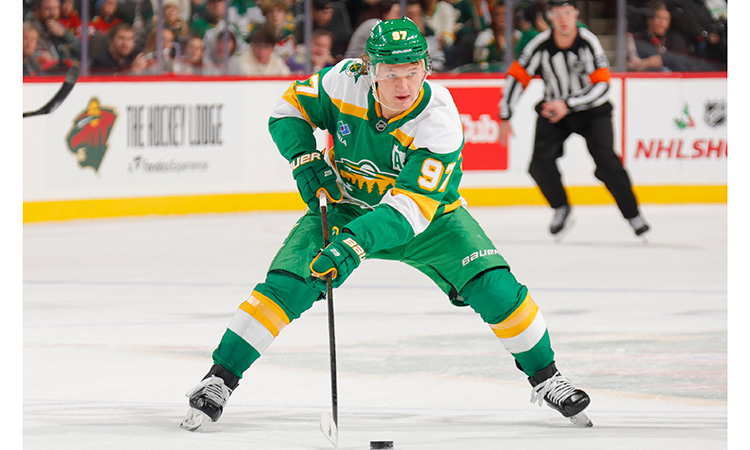
When the Minnesota Wild discovered Kirill Kaprizov in Russia, he was a teenager who had caught the attention of fans and coaches in his native country.
But Kaprizov’s potential within the National Hockey League wasn’t widely known, which allowed the Wild to sign him in the fifth round of the 2015 NHL draft. Kaprizov played his first game for the Wild on Jan. 14, 2021, and he immediately demonstrated his value by scoring an overtime goal to beat the Los Angeles Kings.
Signing Kaprizov to a long-term contract is at the top of owner Craig Leipold’s priority list. In a recent interview in his Minnesota Wild office in St. Paul, Leipold talked about how the Wild want to build a championship team around Kaprizov.
“We have never had a player as good as Kirill as a Minnesota Wild player,” Leipold said. “He wants to win. So our challenge is that he needs to see the path that we’re taking to win a Stanley Cup.”
The earliest that Kaprizov could sign a new contract is July 1. Under Leipold’s ideal scenario, the Wild and Kaprizov would agree to new contract terms sometime between July 1 and the start of the 2025-26 season. Kaprizov is in the fourth year of a five-year $45 million contract.
“I need to be a little careful in what I say, because we are negotiating with his agent right now,” Leipold said.
The last contract the Wild signed with Kaprizov was in September 2021. For a given time frame, the Wild can exclusively bargain with Kaprizov, and their strong desire is to get him signed before he gets enticing offers from other NHL clubs.
“He is very aware of his value in the market and how he has done so well in the NHL,” Leipold said. In his first season, Kaprizov won the NHL’s rookie of the year award. He began the 2024-25 season with an impressive offensive display, scoring 23 goals and getting 29 assists in 37 games. In the early months of the season, Kaprizov was considered a contender for the Hart Trophy, which is the league’s MVP award.
In recent months Kaprizov has been sidelined with an injury that required surgery. Wild leaders hope he’ll get some playing time before the team closes out the regular season on April 15.
Among the elite players in the NHL, Kaprizov will make news across the league when he signs a new contract. “For him, it’s going to be a big payday, no question,” Leipold said.
Kaprizov, 27, is an assistant captain who is popular with teammates and fans. “He has a smile on his face all the time,” Leipold said. “He is fantastic in the locker room. People love playing with him. He’s the smartest guy on the ice. He has vision. He can see people that are open, and he makes our team so much better.”
Leipold notes that Kaprizov will assess multiple factors before settling on a contract—a team’s ability to win a Stanley Cup championship, compensation in the contract, how he views teammates and management, and the community where he wants to live.
“It’s not just the money,” Leipold emphasized. However, he added, “I will only say that we will do everything we can to sign him.”
Leipold and the Wild intend to maximize their upfront ability to bargain exclusively with Kaprizov as well as offer him a longer contract than other teams could provide.
“We will be competitive on money, and nobody can offer him eight years [in duration] but us,” Leipold said. “When you are re-signing a player, you can do it for eight years. If you go to the open market, [a team] can only do seven years.”
Much more payroll money in 2025-26
The NHL is among the professional sports leagues that operates with a payroll salary cap. In theory, that puts teams on an equal financial footing to compete with their peers.
But certain strategic moves can leave teams with less money to spend over a particular season or seasons. That’s what happened to the Wild when management decided to buy out the contracts of forward Zach Parise and defenseman Ryan Suter.
The Minnesota Wild shook the hockey world on July 4, 2012, when they signed the talented free agents to $98 million contracts that spanned 13 years.
Nine years later, Wild management bought out those labor agreements. That decision reduced the money available to pay players on current rosters. That salary cap restriction has been a burden for Wild management and aggravated fans for multiple years.
But the picture will change dramatically for the 2025-26 season, and Leipold anticipates making moves that will strengthen the Wild for the Stanley Cup playoffs.
Wild Photo by Bruce Kluckhohn
For the 2025-26 season, Leipold said that Wild general manager Bill Guerin will have at least $12 million to $15 million more to spend on player salaries. “We’re making the assumption of what the [NHL] cap will be. Now it could be higher,” Leipold said.
“We know where our needs are,” he said. “We need a good centerman. We need a centerman who can win faceoffs [about] 55% to 57% of the time. [Joel] Eriksson Ek is that kind of guy. So we need another Eriksson Ek.” This season, injuries have limited Eriksson Ek’s playing time to 42 games. The Wild are still competing for a spot in the 2025 playoffs, and management would like Eriksson Ek and Kaprizov to log some playing time before the first round of the playoffs begin.
“Big defensemen are always important, but we need another scorer,” Leipold said.
“There are people who will be available who are unrestricted free agents,” he said. “We’ll target the right people, and we’ll go after them.”
Moving beyond Parise, Suter
Since he bought the Minnesota Wild franchise in early 2008, the signings of Parise and Suter in 2012 and the decision to cut them loose in 2021 are among the most dramatic moves in Leipold’s tenure.
The recommendation to part ways with Parise and Suter came from Guerin. Leipold acknowledged in the TCB interview that it took him “months” before he could sign off on it.
“I was not ready for it. It’s like ‘Wow,’ ‘’ he said, as he recalled his surprise when Guerin first broached the idea.
“It’s his responsibility to put the team together,” Leipold said, but he viewed it as his responsibility to examine the wide-ranging effects of such a decision.
“So I challenged him,” Leipold said. He asked Guerin: “Are you sure? If we do this, what are the ramifications?” Leipold wanted to know why he thought he needed to do it.
“I won’t get into the specifics of all that, because it’s just not appropriate to air all of our laundry,” he said. “But [Guerin] stayed pretty strong to his position and wanted to change the culture of the team.”
The pair discussed the issue while meeting in each other’s offices. “It was never, ever in anger,” Leipold said. He wanted to think through the fan reaction and the financial implications of such a decision. Ultimately, he gave Guerin the green light to move forward. “You live and die on this hill,” he remembers thinking of Guerin’s decision to buy out Parise and Suter.
Leipold, who owned the Nashville Predators NHL franchise prior to buying the Wild, hired Guerin in August 2019 to become the Wild’s fourth general manager. Having worked with multiple general managers, he views Guerin as having distinctive characteristics.
Guerin played for several teams during his 18-year career in the NHL. “He’s very open and inclusive with me in his thought process,” Leipold said. “He won’t come to me and say, ‘This is what we’re going to do.’ He will always come and say, ‘Hey, this is what we’re thinking about doing. What do you think?’ ‘’
It’s a dynamic that’s endured. “Billy knows at the end of the day, it is his decision. My role is merely to play devil’s advocate, to cause him to think about some of the issues that could be affected by it.”
Leipold has embraced Guerin’s desire to learn more about many aspects of the business of hockey.
“I have never experienced or heard of a general manager who is as willing to make the players available to the public through social media and cameras in the locker room,” he said. “He recognizes the value of a player,” Leipold said, adding that Guerin drew on his experience as a player for multiple teams to assess what works and doesn’t work for players.
“Ultimately, I respect his opinion,” Leipold said.
From sales to team ownership
Leipold didn’t play high school or college hockey but ended up owning two NHL franchises. He grew up in Neenah, Wisconsin, a small regional center southwest of Green Bay.
He played football, basketball, and baseball in high school. As a child, he learned to skate on an outdoor rink and took part in pick-up hockey games.
Leipold’s parents met on an airplane, when his mother was a flight attendant, and his father was working for Kimberly-Clark. Leipold was born in Memphis and moved with his family when he was a young boy to Neenah, where Kimberly-Clark was headquartered.
When it came time to choose a college, he took his older brother Lance’s advice to live in the South for a completely different experience. Leipold went to the University of Arkansas, joined a fraternity, and graduated in 1974 with a degree in political science. “I was likely going to go to law school,” Leipold said.
Instead, he accepted a sales position with Kimberly-Clark and has been in business ever since. “There was one salesman for the entire state of Arkansas,” he recalled. The existing salesman took the southern half of the state, because it was a great duck hunting region.
Leipold took the northern half of Arkansas, which included Fayetteville where he went to college. As the rookie sales guy, he started knocking on doors of various businesses. One of the visits paid off in a big way. “It was a little customer called Walmart, and at the time they had less than 100 stores,” Leipold said. “After a couple of years, Walmart was the largest Kimberly-Clark customer in the United States.”
Leipold caught the attention of his company’s leadership because of the Walmart account. “Timing and luck are everything in life,” Leipold said. “I do believe that. You’ve just got to keep your eyes open for when the opportunities present themselves.”
His sales success in Arkansas earned him a promotion to Kimberly-Clark’s headquarters in Wisconsin. By 1982, Leipold and a coworker decided to leave Kimberly-Clark and start their own telemarketing company. Leipold took the entrepreneurial leap just as he turned 30.
“Kimberly-Clark had a telemarketing department, and they would sell Kimberly-Clark products to small retailers around the country that just didn’t warrant or support a salesman to go knock on their doors,” he said. The program was incredibly successful, and Leipold and his business partner thought they could replicate the model and serve other consumer packaged goods companies.
Leipold and his co-CEO, Jim Bere, secured several Fortune 50 customers for their new Ameritel Corp. After three years, they sold their business to American Express. It was around the time that Leipold met his future wife, Helen Johnson, who currently chairs Johnson Financial Group and is a board director for S.C. Johnson & Son, her family’s consumer household products business.
Leipold got his start in sales, has always been involved in business, and has invested in a variety of startups. “I love sports. I love competition, and I love business,” he said, and he wanted to buy a sports franchise since the 1990s. His first season as owner of the Nashville Predators was in 1998. He bought the Wild in 2008 just a few months after selling the Predators.
Leipold’s TCB interview was conducted the morning after the Wild defeated the Washington Capitals 4-2. The Capitals have the best record among the 16 teams in the NHL’s Eastern Conference.
Leipold said the best part of being an NHL owner is winning. “I love it, what it feels like,” he said, noting that his wife refers to his reaction to winning as “Craig’s cocaine.”
For the Capitals game, Xcel Energy Center was filled and some fans bought standing-room only tickets. “It was awesome,” Leipold said. “It’s just the adrenaline that goes through you on a win. And big wins are even better.”
But the salesman trait also remains present in Leipold. He likes to have direct contact with Wild customers. “I never take for granted the amount of money that people are willing to commit to buying tickets, and parking their car, and bringing their family and buying all the food,” he said. “It is a substantial family commitment.”
He said he personally responds to emails and phone calls he gets from fans. “People want to be heard” and deserve a response, he said. “They have other options. But they have chosen to come to our games and be part of what we’ve got going on here.”