


Road Work Apocalypse
To the naked eye, it would seem to be one of the most expansive road construction seasons in anyone’s memory. Every week another route or street goes under the knife and getting where you’re going gets harder. Does anyone recall daily seven block backups on Franklin west from Hennepin to cross the intersection? The Franklin Avenue bridge over the Mississippi backed up for blocks as a matter of course?
Yet in media reports and public pronouncements, it’s a “normal” construction season. To drivers it’s not. Focusing on Minneapolis, the seeming epicenter of it all, TCB attempted to get to the bottom of what’s happening. It’s not easy.
There are multiple local agencies commissioning road construction, most of it executed by private contractors. There’s city construction, county construction, state construction, Metro Transit construction, plus public utility construction (gas, sewer, water, electric) which doesn’t always wait for planned roadwork.
Freeway construction is a summer constant, but what’s extraordinary is the number of major trunk routes and intersections totally or partially impacted. Focusing on Franklin again, a key alternate to I-94 construction, TCB counted five separate construction sites between Hennepin and Chicago Avenue, a stretch of 1.4 miles.
The city says it’s a “typical” construction season, noting 1.6 miles of street reconstruction and 10.8 miles of resurfacing, with a $225 million budget. But a look at the handy local map that tracks roadwork, whatever its source or purpose, lays the problems bare.
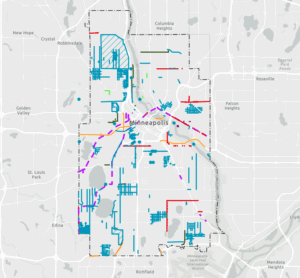
The county has projects up and down Franklin, while MnDOT has I-94 under the knife, while Metro Transit and the county have separate projects on University. These constitute all the primary east west roads in the city north of Lake Street. East Hennepin, the next thoroughfare to the north, is also constricted by county work.
Recently I-394 went under construction (though currently only the reversible lanes), parallel Hwy. 55 is also impacted by constructions and closures, while nearby Glenwood Avenue to the south is closed eastbound in Golden Valley, while Minnetonka Boulevard, the next route to the south, is fully closed for the entire construction season.
Earlier this summer Xerxes and France Avenues, the only two through north/south routes west of I-35 between Lake/Excelsior and Hwy. 62, were completely closed at key intersections. Xerxes for a water main project and France for a mix of county road work and Metro Transit bus rapid transit (BRT) work. The BRT implementation work is oddly disruptive because each upgraded bus stop requires an adjacent lane of traffic to be closed for the weeks or months it takes to construct the canopy and install utilities. They are tiny construction sites, but close lanes every quarter mile or so, and it begets congestion.
Minneapolis has also put orange barrels and miscellaneous bits of construction signage along alternate routes to “calm” traffic looking for an alternative. They appear like construction sites but are merely a mirage designed to force drivers back on the constricted roadway.
Minneapolis public works principal engineer Adam Hayow, responsible for the Hennepin Avenue reconstruction, poured water on the supposition that we’re in a construction apocalypse. He notes that local agencies do coordinate to avoid “too many impacts,” and that it takes years of planning before a road project can be started, but this summer that sounds a tad like unwitting gaslighting. MnDOT quotes a less than 10% increase in the number of active projects this summer. But a highly placed Minneapolis official told TCB, “there’s simply too much money around for it to be a normal construction season.”
They were referencing the Biden-era infrastructure bills and monies allocated by the state of Minnesota during its surge of spending over the last four years.
The impact on businesses is often beyond mere inconvenience. Red Cow, the burger restaurant at 27th and Hennepin in Minneapolis, has been affected by Hennepin construction two summers in a row. Last year the work was in front of its building, and this year it’s the full closure of the street to the north from I-94. Owner Luke Shimp notes that location has lost 40% to 50% of its business both seasons (the construction season lasts eight months), while his 50th Street location was down 10%-15% last year due to construction near 50th and France.
This summer, “France was closed, Xerxes was closed, 50th and Hwy 100 was closed,” he says. “You could not get to the restaurant.” He notes that even devoted customers grow weary and choose a path of less resistance. On Hennepin, when he became concerned about loss of access to his parking lot and spaces on the street, he said the city told him there were 1000 parking spaces nearby, but most were private lots for residents or other businesses, not available to area businesses. “The contractors were very communicative but with the city,” he says, “it often feels like they don’t care.”
Minneapolis offers four-figure grant programs for impacted businesses, but Red Cow is too large to qualify and that’s a fraction of the losses it’s incurred. “If we were a single entity without other locations to soften the blow, we’d have been forced to close,” Shimp explains. “We’ve done the same math we did in Covid—are your monthly losses greater than your rent. It’s really close, we’ve been teetering.” (Shimp has no plans to close, and expects business to rebound next year, after Hennepin reopens.)
Things may be better in the burbs. Yum! Kitchen on Minnetonka Blvd. (a county road), just west of the St. Louis Park border with Minneapolis, is also in the second year of a disruptive construction project that has completely closed Minnetonka east of Hwy. 100. The work is designed to force commuter traffic off the street and onto nearby Hwy. 7, while SLP is using the disruption to replace old sewer lines. For months last year the only access to Yum! was via residential streets to its north.
Yum! co-owner Robbie Soskin echoes Shimp in noting that “construction depresses business less due to the reality of reduced access than the perception of reduced access.” Yum! was coming off its best year ever in SLP in 2023.
Soskin told TCB that the suburb and county began soliciting community input five years ago and the restaurant was engaged from the beginning. “It was a thoughtful process,” he notes. Soskin worked not only to mitigate the worst impacts but refine the plan in a way that got the strip of adjacent businesses additional parking and Yum! greater outdoor dining space. Finally, rather than forcing westbound diners onto Highway 7 and a circuitous loop-around to reach the restaurant, engineers added a Hwy. 7 turn-off for the strip of local businesses.
“It was a combination of good luck, good people, and good timing,” Soskin says. His is a rare win in a construction season of pain for drivers and businesses.