


Music Tech Startup Reached New Heights at NAMM TEC
A tiny, Minneapolis-based tech startup found itself in rarefied air last week, as an award finalist alongside Apple, Fender, and Steinberg.
Those are multinational powerhouses, whereas Caedence was built by “five dudes in a basement,” says co-founder Anton Friant.
Caedence is a music-making program like Ableton or GarageBand. On Jan. 22, it competed in a five-product lineup for what many regard as the sound-recording industry’s highest honor: a NAMM TEC Award.
Its two co-founders left the ceremony, held in Anaheim, California, feeling buoyed. “If you’re going to lose to a company, lose to Apple,” says Jeff Bernett, the other co-founder.
To get here, the two friends have spent years self-funding (up to a figure with “a handful of zeroes,” Friant asides) an idea they discussed pre-pandemic. Bernett, playing in a cover band, had felt frustrated by rehearsal interruptions. He wanted a solution to the regular flurry of “Where do we start?”, “What key are we in?”, “What’s the tempo?” It would work like “a Guitar Hero for real bands,” as Friant puts it, referring to the video game.
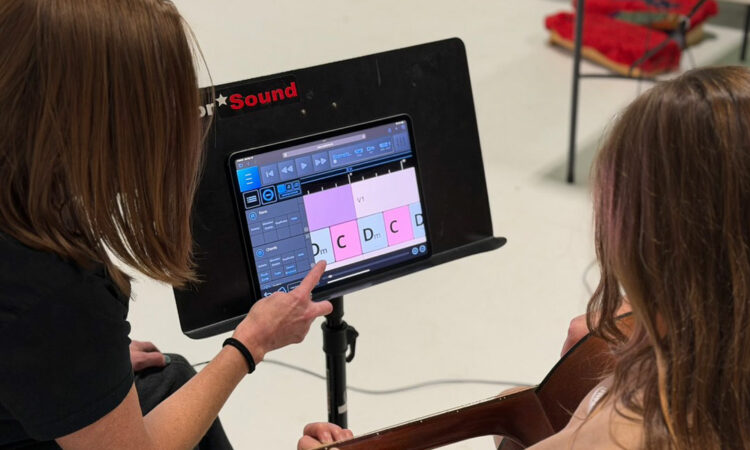
Caedence looks like a grid, similar to GarageBand. All parts of a song appear in stacked blocks. A cursor triggers them as it glides left to right. Patented technologies have made the platform easier to sync and customize among musicians, they say.
And, uniquely, Caedence is browser based. That means band members can share a link, no software necessary. “It’s like Google Docs,” Friant says. “Anybody in the world can log into your Caedence session and play along, or sing along, or clap their hands.”
They developed Caedence under a Minneapolis-based LLC called Stageware, working with three other tech developers: Terrance Schubring, Demetri Dillard, and Jon Voth. The platform launched as a subscription service last year.
Moments have stood out to them as proof of concept: A friend used Caedence to play at Paisley Park. Two musicians used it to whip out a couple recordings in one afternoon. “We just 4X’d the time it would otherwise take to get to the end result,” Friant remembers thinking.
In an enthusiastic YouTube review, Harry Younger, who makes videos about drum technology, described Caedence as equal to or better than Ableton, the (much pricier) industry-standard music-making program. “I didn’t realize how powerful you can essentially make a website,” he said.
Pandemic, Patents, and Pixels
Bernett and Friant met as college-age musicians in the early 2000s, with Friant at the University of St. Thomas and Bernett at the University of Minnesota. In the mid- to late 2010s, they reconnected while jamming at a mutual friend’s warehouse and discussed the Guitar Hero idea.
Bernett hired someone to make a prototype. Friant couldn’t get involved because of an NDA. Fender, the guitar manufacturer, had employed him to work on an app, he says. In his day job today, Friant runs Antigravity, a consultancy that designs and builds websites and apps. Bernett works as a marketing automation manager, teaches guitar lessons, and gigs around town.
Friant’s NDA expired as the pandemic took hold. Realizing there was little else to do, “that’s when we hit the ground running,” he says.
Their first new technology, Timelock, patented in 2020, can sync “an indefinite number of devices,” according to Friant. “Our ‘light bulb’ came when we started working with cloud computing and thinking about how we could essentially create a virtual click—a BPM up in the cloud,” he says, “that would inform every connected device.”
The second patent, Flexview, came a few years later. It lets users click on and expand parts of a song. “I know that no two musicians like to see the exact same information,” Bernett says.
During live performances, Caedence can trigger a smoke machine or a dance of laser lights. Friant says they’ve spoken with the Guthrie Theater about how the platform could handle stage control. At a NAMM show several years ago, schoolteachers kept approaching Friant.
“We were able to have these amazing conversations about, you know, ‘Every one of my students has a Chromebook,’” he recalls.
They’ve adapted the technology so it can detect the device in use and deliver the appropriate pixel density and frame rate to keep it from overheating. “There are hundreds or thousands of those little checkers that are constantly, 60 times a second, trying to optimize the experience,” Friant says.
Bernett notes Caedence is part of the MIDI in Music Education Special Interest Group, a coalition of educators, manufacturers, and retailers. “We are trying to get curriculum out to teachers—open source, free,” he says.
Caedence earns revenue from a subscription model, with pricing adjustments available to educators. A one-person subscription goes for $4.99 per month. The monthly rate is $17.99 at an “ensemble” tier (for band leaders, private lesson instructors, and gigging musicians) and $29.99 at an “organizational” tier (for touring artists, studio producers, venue directors, and worship leaders). Friant says the Minneapolis Public School District has a discounted subscription.
He estimates the company is bringing in 5-10% of the money it would need to break even.
They haven’t raised funds but are “never not considering that route,” Friant adds, noting their legal counsel has introduced them to funding information.
For now, they’re still high off NAMM, where Bernett watched Riverside City College students cue audio and visuals over a live performance using Caedence.
“That was such a great pat on the back from the industry,” Friant says, “and the folks we talked to last week out there are telling us we’re pointed in the right direction.”