


Long Live the Food Hall
Keg & Case Food Hall in St. Paul opened to great fanfare in September 2018. Situated in the historic Schmidt Brewery building on West Seventh in St. Paul, the hall was once home to two dozen tenants. Not long after it opened, USA Today readers picked it as the best new food hall in the nation.
Today, though, aside from retro arcade Starcade, pretty much all vendors have departed from the property. Its website is non-operational while the owner works through bankruptcy and another party explores a sale.
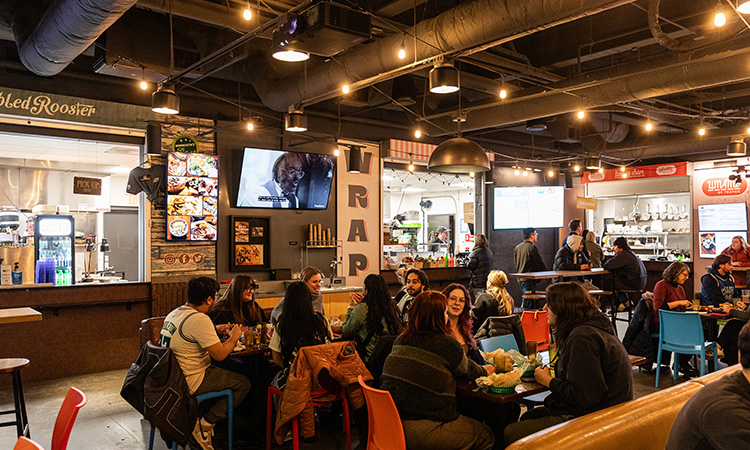
The fate of Keg & Case may look like a cautionary tale for any enterprising minds looking to dive into food halls. But other food hall operators in town say that, despite the perennial challenges facing the hospitality industry, they have plenty of reason for optimism. A couple of them are even looking to expand operations and open new locations.
Nationwide, observers note that food halls tend to be more resilient than traditional restaurants.
Out at the upcoming Ate Ate Ate Food Hall at the Burnsville Center, Jay Mawas of local real estate firm Wyn Group says all stalls are booked, and he has a waitlist of upwards of 60 potential tenants interested in leasing space.
“The food hall is a concept that promotes more than just eating,” Mawas says.
Mawas says that, pending final city approvals, the Burnsville hall is set to open sometime in the second quarter this year.
Ate Ate Ate will be the second food hall for Mawas and business partner Marshall Nguyen, CEO and founder of the Wyn Group; Mawas and Nguyen also help run the six-vendor Eat Street Crossing food hall in Minneapolis with a group of private partners.
That’s not to say there haven’t been bumps along the way over at Eat Street Crossing. The hall’s two original founding partners – Bebe Zito’s founders and the chefs behind Zen Box Izakaya – have both departed within recent months to focus on other endeavors. But Mawas says he’s feeling positive about the future direction of the hall, which has begun hosting more events.
And though events aren’t Eat Street Crossing’s main focus, they’ve helped draw new customers and interest, he says.
“Our food hall is pretty unique,” says Nguyen. “We’ve been doing a lot of events–it’s a food hall by day and by night on the weekends it turns into a music venue. … Is it an entertainment venue? Is it a food hall? It’s basically a hybrid of everything.”
Trip Schneck, a consultant who’s been watching food halls for the last decade, says that’s a formula that tends to work well. “What separates a good food hall from a great food hall,” he says, “is taking advantage of the daytime and nighttime populations.”
Schneck, who’s the co-founder and managing partner of hospitality consulting group Colicchio Consulting, tracks food halls across the country. As of today, he says there are 437 in operation across the country, and 138 under development.
“Food halls are not a panacea for every landlord or owner looking to backfill traditional retailer vacancies in their shopping centers with more current, culturally relevant concepts that drive foot traffic. But food halls can be hugely successful, if executed properly,” according to a 2023 report issued by Colicchio Consulting and Cushman & Wakefield.
Keg & Case is not, of course, the only food hall to shutter – Schneck says there’s been about 81 closures since he began tracking them around 2015. But, in general, food halls tend to be more resilient than traditional restaurants, and have a “significantly lower closure rate than the restaurant industry” as a whole, he says.
“Food halls are seen as a real estate hedge,” Schneck explains. “In a food hall, if one or two vendors do not perform well, they can be replaced fairly easily. As can an operator.”
Many vendors tend to operate under short-term licensing agreements instead of leases, he notes. That gives owners and landlords more flexibility to switch up their lineup.
The idea to house multiple different food sellers in one place, of course, is hardly a new idea. Consider the Midtown Global Market on Lake Street in Minneapolis, open for nearly two decades. There’s also the standard food court in shopping centers across America. What makes a food hall different from any of these, says Schneck, is a focus on “non-chain, fast-casual, chef-driven food and beverage concepts.”
“If you see a Subway, a Shake Shack, and a Sbarro, you’re in a food court,” he says.
Schneck also notes that food halls tend to have a broader purpose beyond just food and tend to serve as “community centers” with regular programming.
Waiting lists
Like Mawas and Nguyen, Patty Wall of the Market at Malcolm Yards food hall in Minneapolis also keeps a long list of potential vendors who’ve asked to join her hall. But it wasn’t always that way.
When she first started cold-calling restaurateurs and chefs about the idea a decade ago, many thought her plans were pie-in-the-sky.
“Most people thought I was nuts,” Wall recalls with a laugh. “A lot of people didn’t know what a food hall was.”
Now, many of those same people are calling her back. “We generally always have a list of people that want to be in here,” Wall says.
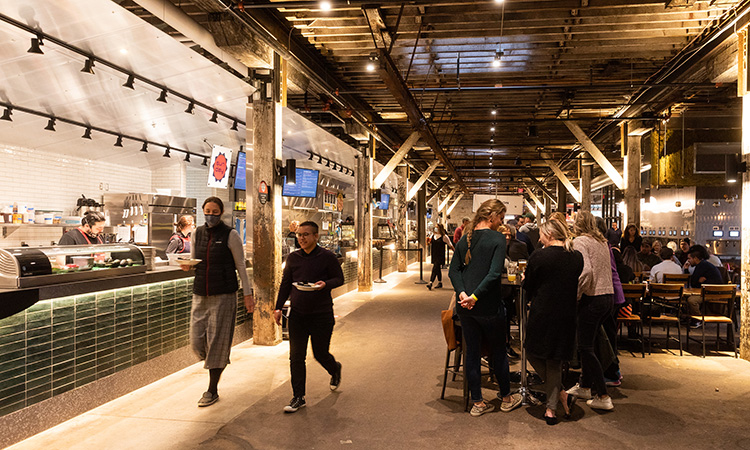
Looking back, of course, it might be a little easier to understand the skepticism. The Market at Malcolm Yards sits in the once-dilapidated Harris Machinery Building, a more than 130-year-old structure. Less than a year after Wall purchased the property, it was significantly damaged by a fire. At a time when the concept of a food hall was still novel in the Twin Cities, the prospect of a bustling, multi-chef establishment may indeed have seemed improbable.
Yet Wall made it happen, developing the market into a nine-kitchen hall with a bar. The place officially opened in August 2021.
Given the hall’s proximity to Huntington Bank Stadium, Wall says she continues to see steady traffic both on and off game days.
She’s now determined to do again. Last month, Wall told TCB about her initial plans to bring a second food hall to St. Louis Park with the help of local real estate group Hempel Real Estate.
She hasn’t yet unveiled a specific location for the second hall, but the Shops at West End outdoor shopping center, which is owned by Hempel, might be one viable option.
“I’ve learned, from traveling around the country and being an owner-operator, that there are certain things that will make a food hall successful and certain things that will make it tank,” Wall says. “You need dedicated parking, you need event space, and you need density.”
Travail’s food hall bid
Over in the North Loop, the trio behind the Travail Kitchen and Amusements restaurant group has recently entered the game with the purchase of Graze Food Hall in fall. Travail’s owners have shaken up the lineup at Graze, which first opened back in September 2019.
The team, which continues to expand in multiple directions at once, evidently sees plenty of opportunity in the food hall.
And taking over another establishment may seem like a bit of a departure for Travail, which, in the past, has primarily opened its own restaurant concepts. But chef and co-owner Mike Brown says his company has long sought out collaborations with other restaurateurs in town.
At Graze, he’s brought in James Beard Award-nominated chefs Kate and Gustavo Romero – the duo behind Nixta in northeast Minneapolis – among others. But Brown says he sees opportunity beyond the big names in town. Food halls also can serve as a business incubator of sorts for newer restaurateurs.
Brown says that could mean “taking on a little more of that mentoring role” for some vendors.
More than anything, though, Brown’s biggest goal is to make Graze a central gathering place for the North Loop. Graze benefits from proximity to Target Field, and Brown foresees big traffic bumps when the Twins start playing this season.
Like other local operators, he sees a clear opportunity to build a “third space” for neighbors and visitors – a place outside of home and work.
“We’re trying to give people a whole bunch of reasons to be here,” says Brown.