

How the Pop-Up Stole—or, Sold—the Holiday Season
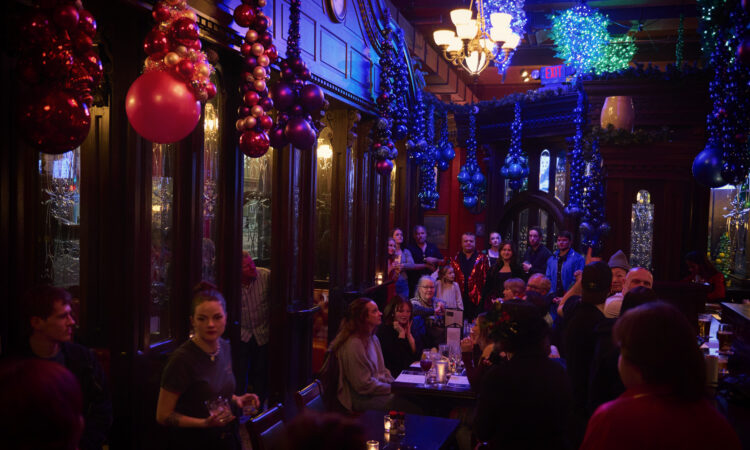
The Local long made do with standard holiday decor, but this year it’s hung Christmas trees from the ceiling like chandeliers.
The nearly 30-year-old Irish pub in downtown Minneapolis is part of the latest wave of holiday pop-ups, which comprise a growing, glimmering trend among Twin Cities bars and restaurants. The Local’s version is the “Gaelic Glow,” with special menu items, weekly events, and half the space drenched in jewel-toned twinkle lights. Why only half? “We want to see how it goes, operationally,” says Valid Serhan, president of Cara Irish Pubs, which owns the Local. “We expect it’s going to be good and busy.”
He’s right to expect it. The Local has joined at least 20 Twin Cities restaurants and bars this year in outfitting its space for immersive festivities, which must involve over-the-top decor and tend to include kitschy cocktails and seasonal menu items—along with, in this case, sing-alongs. In short, these experiences appear to be in high demand.
“The audiences out there are really asking for experiential events,” says Kelly McManus, owner of the Twin Cities-based McManus Creative agency, who worked with the Local to devise the Gaelic Glow. “The millennial audience is looking for a third space, and I’m seeing that across the board.” (Of course, she adds, the other generations partake, too.)
Holiday pop-ups gained traction post-pandemic, around 2023, but can be traced back about eight years to the festive embellishments and menus that took over Lawless Distilling (called Miracle at Lawless, 2017–2023) and Betty Danger’s and Psycho Suzi’s (Mary’s Christmas Palace, hosted at the former, then the latter, 2018–2023). The pandemic took out all three spots.
Without them, the trend carries on, growing even as consumers report caginess in an uncertain economy.
“As soon as we opened the doors a year ago, it was madness,” says Nick Kosevich, co-owner and CEO of Earl Giles, the Northeast distillery, restaurant, and shop for mixers and garnishes.
Earl Giles’ holiday takeover, Jingle Giles, made use of the restaurant’s high-ceilinged, 19,000-square-foot space with curtains of gold lights and a huge Christmas tree. Its success last year caught staff off-guard. “It was like Game of Thrones,” Kosevich says, “like, ‘hold the door.’”
This year’s Jingle Giles opened Nov. 17. By the end of the first week, Kosevich was reporting “double revenue numbers.” He has counted 800-plus Saturday reservations, about 300 more than usual. His team added a 50-square-foot heated tent out front, to contain crowds. They also bulked up staff by about 20% (servers, bartenders, runners). About $20,000 has gone into the menus, glassware, and garnishments, Kosevich says, noting, “All the glassware we bring in we also sell in our market, as a way to try to offset those costs.”
The success has been the challenge. That means, in this case: ensuring there’s enough room and enough staff to keep the “sea of Christmas zombies” placid.
So, business has been good, even though Kosevich guesses competition in this “holiday pop-up” market has doubled this year over the last. His estimate tracks with Mpls.St.Paul Magazine’s reporting that “Christmas pop-up bar inflation is at an all-time high”: 10 holiday pop-ups made its list last year, and 20 did this year.
Customers “want to collect them all,” Kosevich says. “They’re like, ‘I want to go to seven of these pop-up bars. I want to check them all out.’”
Different Impacts, Same Spirit
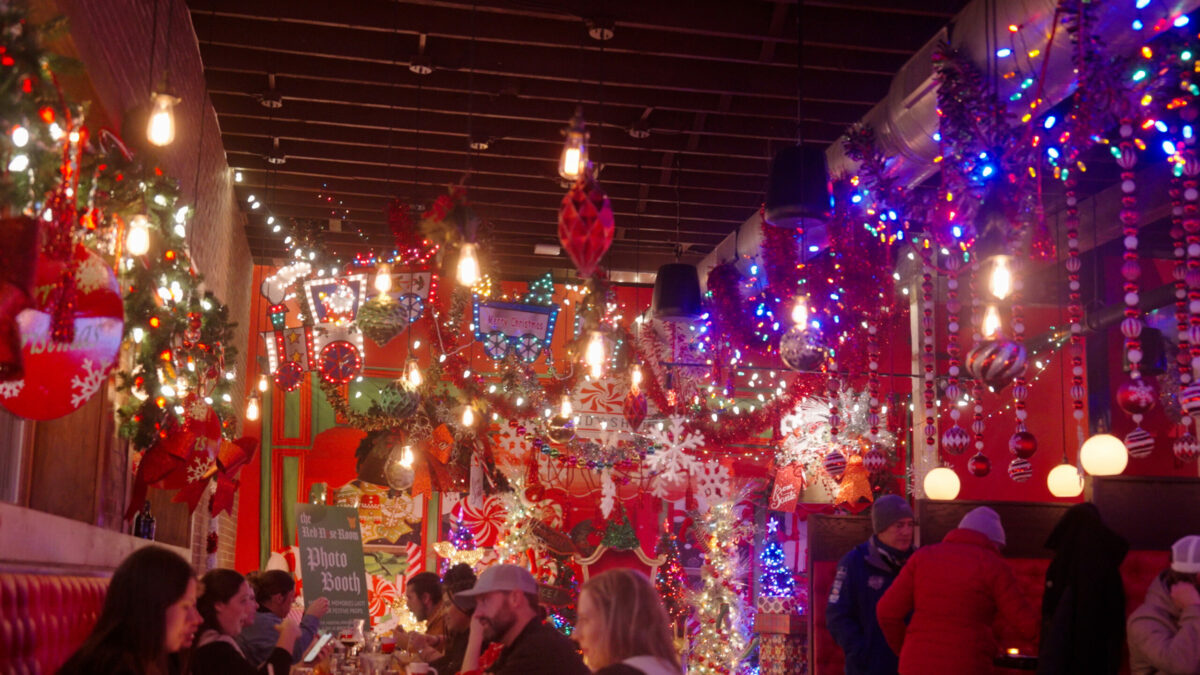
At Red Cow, it’s essentially the same outlook. The upper-scale burger tavern’s Uptown location has hosted the incandescent Red Nose Room since 2023. Owner Luke Shimp says that, over last year, at least twice the number of metro bars and restaurants appear to be hosting immersive holiday experiences.
“If it becomes ultra-competitive—and next year there’s 100 of them—then [Red Cow’s] competitive advantage may wane,” he says. “We’ll see how this year is.”
That first year, Red Cow spent about $12,000 on materials and setup, TCB reported at the time. It paid off, with the restaurant describing a 75-100% spike in traffic over the year prior. “We spend tens of thousands decorating all the stores for the holidays,” Shimp says, crediting local decorator Richard Anderson.
This season, consumer sentiment appears mixed, according to PwC in its Nov. 25 “holiday update.” Although consumers report economic wariness, they’re also “spending more than they planned to just a few months ago.” The update finds holiday-season optimism in a late-October U.S. survey: “People are willing to stretch their budgets, even if it means cutting back in January.”
It’s not just consumers dealing with uncertainty; restaurants face a tough year, too, Kosevich notes, largely from rising costs. “This is one of those opportunities to throw a Hail Mary and see what comes of it.”
For the Red Nose Room, Shimp took inspiration from Psycho Suzi’s. When that fabled Northeast tiki bar and restaurant closed in 2023, “that was the impetus for me,” he says. “I was like, ‘Oh, man, that place was so busy.’”
Red Cow’s Uptown location expanded the holiday takeover last year with an enclosed patio styled like a chalet. This year, its Wayzata location is done up, too: The Snowglobe Social (see: snowflakes, twinkle lights, a raclette-cheese “Alpine Burger”) was inspired by a pop-up that Shimp experienced in London.
The Red Nose Room saw roughly the same turnout in 2024 as in 2023: about 75-100% over a normal season. To be fair, Shimp says, the bar for growth was low. The restaurant desperately needed a traffic driver.
Covid-19, plus the uprisings following George Floyd’s murder, “just decimated Uptown,” he explains, “and it was still on the comeback, but it wasn’t coming back as fast as other neighborhoods were.” Two years of construction on Hennepin Avenue also proved “devastating.” Red Cow survived in Uptown only because Shimp owns multiple restaurants. “If one of them is having a bad year, there are others to help out.”
Red Nose has worked as a “shot in the arm,” he says. The past two years, it hasn’t made up for losses, “but it certainly helps, hence why we keep doing it.”
For Jingle Giles, Kosevich harkens back to Miracle at Lawless. Back then, he actually helped run it. Kosevich co-owned the Milwaukee-based Bittercube Bitters, which provided beverage consulting to Miracle. “It was wildly successful for that tiny bit,” from 2017 to 2023, he says.
Jingle Giles has been wildly successful, too, with Kosevich describing it as a game changer for Earl Giles’ business.
“The hard part about what we do at Earl Giles is that we’re a many-headed monster,” he says, noting the company oversees multi-sector operations. Open since 2022, Earl Giles is a restaurant, a distillery, and a producer of non-alcohol cocktail mixes, which go out to bars, restaurants, and hotels nationwide, Kosevich says. “So, we have all these different avenues of production.”
On the restaurant side, Jingle Giles is becoming the “crown jewel.” It’s on the level of its summertime “Earl-A-Whirl” event, an 80-vendor takeover that absorbs some of the crowds churning through Northeast for Art-A-Whirl, the huge open-studio tour.
Together, these yearly events help “level-set the rest of the insecurity that you have, running a restaurant in this market,” Kosevich says.
For the Local, Serhan also considers civic importance. Last year, he says his team thought, “Why don’t we do something extra to bring people downtown, let them know the city’s safe?” With the loss of downtown corporate workers, McManus says, “they’re really looking for different ways to bring people downtown and make it a destination.”
Serhan points to the Gaelic Glow’s weekly events—including Santa visits and live-music “Sparkle Sessions”—when discussing return on investments: “We have tickets for about 70 or 80 seats,” he says. “The ticket is going to be arranged between $10 for brunch per person to about $17.17 to $20, based on the events of the night.” If they sell each event well, he says, “I feel that we are in a good place.”
Put another way, if consumers are as hungry for holiday vibes as they appear to be, it’s likely all of the Local—rather than half of it—will be dripping in Christmas trees next year.