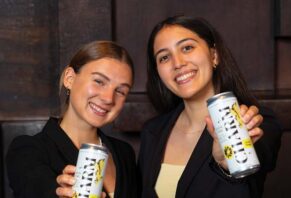



MN Cup 2025: The Commons
Walk into any school, and you’d be hard-pressed to find a classroom uninterrupted by the pings and buzzes of text messages and social media notifications. Even with administrators cracking down and implementing no-phone policies in schools across the country, these devices are still sneaking into schools, disrupting class.
Division Judges
Paul Louis Acito, Lyftbridge Innovation
Takara Archer, Minnesota Department of Employment and Economic Development
Jim Delaney, Satschel
Kasey Devine, ADP
Rob Garcia-Gradoville Jr., Cargill
Grant Gibson, Great North Ventures
Brian Gustafson, Tonkawa
Erik Halaas, Macalester College
Jonathan Hanson, Skyhawks Sports Minnesota
Wendy Hanson, MobileAxept
Melissa Kjolsing, AscendRural
Matt Ladhoff, Carlson School of Management
Tony Lloyd, Culture Shift Cos.
Sean Lundy, City of Bloomington
Sarah Miller, MNDEED
Katie Piehl, Bloomwise Partners
Demi Radeva, Akros Advisory Services
Kathy Roland, Oak Investment Partners
Connie Rutledge, FINNOVATION Institute
Karen Scott, AFCC
Tiffany Serbus-Gustaveson, BWG Connect
La Juana Whitmore, La Juana Whitmore Consulting
Kate Winter, Medica
“We founded The Commons after seeing this struggle firsthand and asking the question: What if technology could help solve technology?” says Julia Gustafson, who co-founded The Commons in 2025 with Shannon Godfrey. “Schools are tired of locking phones in pouches and boxes. It’s clunky, hard to manage, and leaves parents uneasy about being cut off from their kids. Most importantly, these solutions don’t help students build healthy, lasting habits they need to be successful beyond the walls of the school.”
That inspired The Commons, a privacy-first app built on the principles of behavioral economics. It manages distractions from students’ phones during the school day while keeping academic, medical, and essential communication functional. “We’re proud to be the first behaviorally informed, tech-powered solution built for schools—not adapted from another industry—and we’re already seeing how it transforms classrooms into spaces where real connection and growth thrive,” says Godfrey.
The Commons app activates automatically when a student arrives at school, blocking distracting apps during school hours. Calls and texts can get through in case of an emergency, but if a student disables the app, school staff are notified. When school ends, the app deactivates.
While the team sees a natural path into homes and workplaces in the future, schools and students are The Commons app’s primary area of focus, to help combat teacher burnout, academic decline, and growing rates of disengaged kids. The app recently launched in 10 schools across five states, serving 7,700 students. The Commons’ initial market, U.S. secondary schools, is 30 million students and 52,000 school leaders strong. Globally, that number grows to 1.8 billion students who wrestle with the same distractions.
“The ripple effects extend to families, workplaces, and communities,” says Gustafson. “The opportunity isn’t just about market size—it’s about reshaping how an entire generation relates to technology.”
In the months ahead, The Commons team plans to roll out to more schools, refine onboarding, and build partnerships that add value beyond the app, such as with the Digital Childhood Alliance, which advocates for safer app store standards, and the John Fontaine Jr. Foundation, an organization that works to educate young people about high-risk behaviors.
Funding is also imperative; to date, The Commons team has secured more than $600,000 in early investments, enough to finish its tech build, launch its pilots, and prove traction.
“The startup ecosystem here is small but mighty—a place where Fortune 500 experience meets a scrappy, collaborative spirit,” says Gustafson of The Commons’ St. Paul, Minnesota, headquarters. “We have found that connections happen quickly, support is practical and generous, and unlike bigger hubs where founders can get lost in the crowd, here the energy still feels fresh and personal.”