

Increase Access to Affordable Housing: Andersen Corp.
The windows and doors manufactured by Andersen Corp. can be found in homes across the United States.
But the company founded in 1903 doesn’t simply sell products it makes to people who can afford them. It’s carved out a philanthropic niche in which it donates money, products, and employee time to make housing a reality for people with limited incomes.

“Every day we get to see the impact that homes have on people’s lives, on communities, on economic opportunity,” says Eliza Chlebeck, Andersen’s vice president of communications and community. It’s why Andersen emphasizes “the need to create more opportunities for individuals and families to have access to housing that is affordable to them,” she says.
In 2025, Andersen contributed about $1.5 million to housing-related initiatives. Total charitable giving by Andersen reached about $5.2 million last year.
The Andersen Corporate Foundation makes grants twice a year. For the spring 2026 grant round, it awarded $1.2 million to 86 nonprofit organizations.
Among the grants was $100,000 to the Burnsville-based 360 Communities. This grant was allocated to the capital campaign for the Lewis House shelter, which serves individuals fleeing domestic and sexual violence.
Andersen also funds grants to nonprofits with workforce development programs, which train people to work in trade occupations that support housing construction. Summit Academy OIC, based in Minneapolis, was among the grantees.
Beyond making financial grants, Andersen also shares its talent with community organizations. “We have a lot of leaders who serve on nonprofit boards, many of them housing organizations,” Chlebeck says. For example, she cited, Brandon Berg, Andersen senior vice president and head of research, development, and innovation. He serves on the board of Twin Cities Habitat for Humanity.
“He is incredibly active on Habitat’s board and with Habitat’s team,” she says. “He’s really plugged into their work around innovation in housing and thinking about, ‘How do we continue to create more opportunities for housing to be affordable?’ and to include sustainable and durable products.”
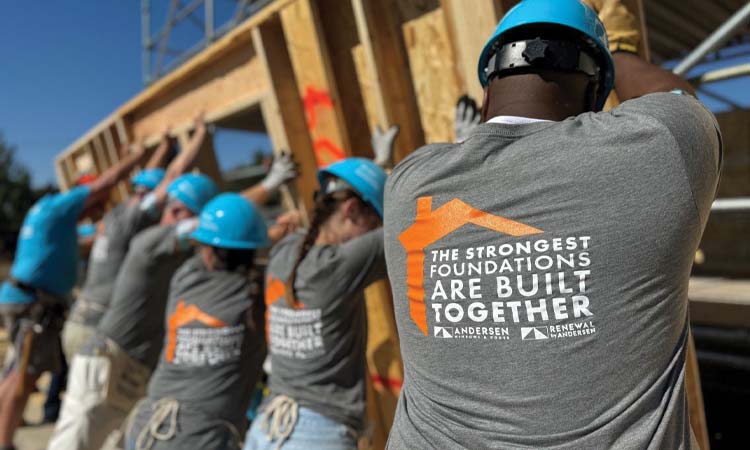
In various capacities, Andersen has been collaborating with Habitat for Humanity since 1995. One of the key chapters in that relationship occurred in 2024 when Andersen was heavily involved in a Twin Cities Habitat build in The Heights neighborhood on the East Side of St. Paul.
The Heights is a major redevelopment project on the former Hillcrest Golf Course. Housing construction on that site was designated as the national 2024 Jimmy & Rosalynn Carter Work Project.
“It shone a spotlight on the importance of affordable housing, of sustainable building, and of creating community,” Chlebeck says. “Our team loved it. We had people on site every single day volunteering, and even installing windows.”
Volunteering is a strong element of the Andersen company culture. In 2025, Andersen employees contributed more than 21,000 hours to a variety of community projects.
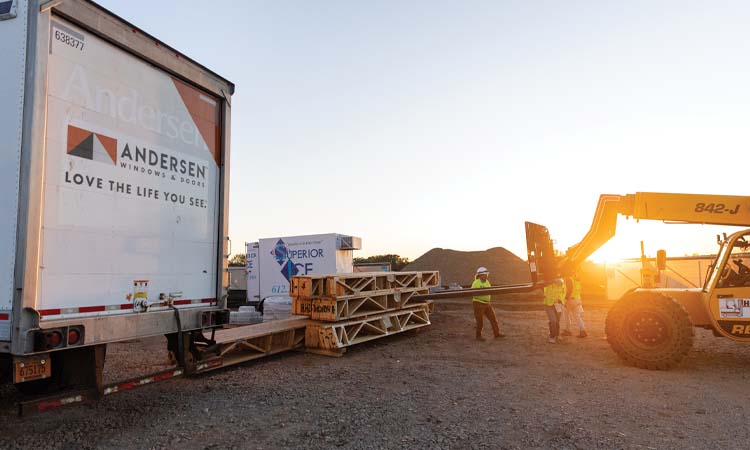
“We donated all the windows for the houses being built during that Carter Work Project,” Chlebeck says.
Energy efficiency is a priority at Andersen. “Most of the windows that we donate to Habitat projects here in the Twin Cities are our 100 Series windows,” she says. “They’re made out of our Fibrex composite material.”
Andersen is headquartered in Bayport in Washington County. Most of its philanthropy involves grantmaking, product donations, and volunteerism in the Twin Cities metro area and western Wisconsin.
Chlebeck says that Andersen leaders believe it’s important to provide financial support to nonprofits that are working along the entire continuum of housing services. “Some of the organizations that we provide grants to are supporting unhoused populations,” she says. “Other organizations do more transitional housing and help get people into more stable housing, and then we support organizations that create affordable housing opportunities.”