



The New Health Care Arms Race: Minnesota Hospitals Bulk Up
The Minnesota Hospital Association says we have a problem. More than 30 nonprofit hospitals in the state are out of cash to make payroll.
Hennepin County Medical Center (HCMC) was trending toward that scary position recently. Leadership had claimed all of this year that the state’s flagship safety-net hospital would close in June if it did not receive financial assistance from the Minnesota Legislature.
That began to change when the state approved a bill allocating $205 million in direct stabilization funding to HCMC. The legislation would include a new reserve account of up to $500 million that HCMC, and possibly other hospitals, could draw from until 2031. The deal awaits Gov. Tim Walz’s signature.

HCMC was running out of money for several reasons, but spotty insurance reimbursements and the hospital’s mission to accept all patients regardless of their ability to pay especially set it back in recent years.
RELATED: Hennepin Healthcare CEO John Cumming Discusses What’s Next
Other hospital systems, including North Memorial Health, have also admitted rising costs make it harder to protect access to care on its own.
“We really have an inflexibility to raise prices,” says Trevor Sawallish, North Memorial Health’s CEO. “Three-fourths of the patients who walk in the door are paid for by government. When you layer on the inflation pressure and labor shortages, raised wages, the reality is that it continues to raise the cost of care. The mismatch of those costs and inability to raise costs [at hospitals] raise pressure.”
Last month, North Memorial Health announced it would merge with Sioux Falls, South Dakota-based hospital system Sanford Health.
The Role Labor Costs Play
Labor costs are the No. 1 cost for any health system. According to the American Hospital Association (AHA), employee wages, benefits, and contract labor typically account for 50–60% of a hospital’s total operating expenses. “It’s a people-intensive industry,” says Tim Sielaff, executive fellow at the University of St. Thomas Opus College of Business. Sielaff previously served as chief medical officer of Allina Health for five years.
During the Covid-19 pandemic, hospital labor costs inflated, as did costs generally.
“The inflation in the cost of doing business was not supported by the insurance reimbursement structure,” Sielaff explains. “That is a substantial challenge. A safety-net hospital has a different set of challenges than other health systems.” Namely, safety-net hospitals such as HCMC tend to rely heavily on Medicaid and Medicare.

A hospital system generally loses money on Medicaid patients, according to the AHA. Meanwhile, a health system typically breaks even or makes minimal profit on Medicare. Private commercial insurance—health coverage obtained through the likes of UnitedHealthcare, Cigna, or Blue Cross Blue Shield—is what reliably provides hospitals with profit.
In 2025, about 40% of Hennepin Healthcare’s (HCMC’s) payers used a Medicaid system, 29% relied on Medicare, and 18% used commercial insurance.
The Insurance Fiasco
In 2025, President Trump’s “One Big Beautiful Bill Act” brought sweeping changes to Medicaid, including additional program eligibility requirements. The first changes won’t take effect until the fall.
Even before then, Minnesota had seen a reduction in Medicaid enrollment across the state because Congress had mandated states return to pre-pandemic eligibility processing. In 2024, 1.2 million Minnesotans were covered by Medicaid, down 10.3% from its 2023 peak.
Consistent revenue from Medicaid helps to reduce the burden of uncompensated care, which the AHA categorizes as primarily charity care (free or discounted care for low-income patients) or bad debt (unpaid bills from uninsured or underinsured patients).
Level I Trauma Centers like HCMC and North Memorial’s Robbinsdale hospital are often required to offer charity care based on their tax-exempt status. That often includes providing care to patients coming from outside the Twin Cities or the state. Sawallish says 30% of North Memorial’s trauma admissions come from outside the metro area.
Why North Memorial Health Chose to Merge
North Memorial Health, with major hospitals in Robbinsdale and Maple Grove, and South Dakota-based Sanford Health signed an agreement in May to merge into a single nonprofit health system.
Sawallish says Sanford Health had all the qualities North Memorial was looking for in a partner, including operations in Minnesota, great academics for staff, and a patient-first ethos. He adds, “Sanford works in communities even when they are difficult to work in, from a financial perspective. They stood out as true problem solvers.”
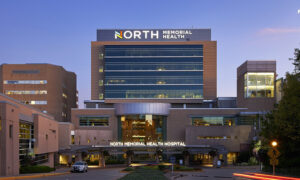
RELATED: North Memorial and Sanford Health Unveil Merger Deal
The proposed merger—subject to governmental review—came as North Memorial recorded a 2025 operating loss and sought subsidy funding from the Minnesota Legislature. Sawallish says the Robbinsdale hospital lost $50 million in 2025.
In 2024, North Memorial closed its mental health services and the neonatal intensive care unit in Robbinsdale. The health system then laid off more than 100 hospital employees.
The merger provides an important stabilization for the Robbinsdale hospital, which will remain a safety-net provider of Level I trauma and emergency services.
Sanford Health also plans to double the size of North Memorial’s Maple Grove hospital, which has Minnesota’s largest birth center. Further, Sanford pledged Maple Grove patients would see an expansion of emergency care, addition of inpatient and surgical capacity, and improved access to cardiology and interventional radiology to support minimally invasive procedures.
Sanford Health CEO Bill Gassen tells TCB, “North has done such a great job of crafting a vision for the future in the communities they provide service. Part of that strategy is the plan in Maple Grove. They are beyond capacity there. Maple Grove is one of the fastest growing communities in Minnesota, and demand is at peak levels. Sanford is coming in and partnering to double the physician capacity to meet those needs today and in the future.”
If the merger receives government approval, Gassen says emergency medical services and all other care response decisions will still be made locally, in the communities North Memorial serves. “We’re just [making care decisions] in partnership, to bring in additional resources [such as] our virtual care initiative and 1,100 active clinical trials,” he adds.
Sawallish says, amid all the changes, much will stay the same. “That’s because of our ability to have operations in the Twin Cities, to focus on the communities we have had for decades.”
Taking a Step Back to Look Ahead
In a nation watching hospitals merge and close at what can feel like a once-a-week rate, dominant health care systems are beginning to take over the industry.
“We, as community members and voters, really need to assess the value that our health systems have in our community,” Sielaff stresses. “If, by merging, you’re keeping the facility open, that’s really important. But what happens is that it doesn’t end up reducing insurance premiums.”
Hospital systems don’t dictate care prices. It’s a misconception in health care that industry leaders want the public to better understand. “We are price takers,” Gassen explains. “We don’t establish those prices that flow to patients. The government tells us reimbursement [rates] with contracts from commercial insurers. For many patients who can’t pay, they still receive world-class care.”
On June 8, Minnesota Attorney General Keith Ellison will host a community forum for Minnesotans to provide input on the planned North Memorial Health-Sanford Health merger.