

For Minnesota Internships, an In-Person Push
Providing interns with in-person experiences might be one solution to Minnesota’s population dilemma.
The state loses more young people to colleges in other states than it gains, and it does not counter the losses with those who migrate after college, according to a 2024 report from the Minnesota State Demographic Center. At the same time, almost 80% of Gen Z workers say they prefer in-person jobs, compared to 42% of Millennials, according to a 2023 survey from Joblist, a job board site. Local internship program leaders say interns are eager for an in-person experience.
Moving to Minneapolis for the in-person experience at her Medtronic engineering internship gave junior Lynn Ogot a chance to see where she might live after graduating from North Carolina Agricultural and Technical State University. Ogot’s priority for internships was living in a city with walkability and access to restaurants and recreation, similar to her home in a suburb of Raleigh, North Carolina.
“If I didn’t see myself moving there after college, then I wasn’t willing to go there,” Ogot said.

Almost three-quarters of Medtronic’s interns relocate to the Twin Cities from Greater Minnesota or out-of-state. Recruiting has largely shifted online, using virtual events and the platform Handshake to reach students from across the country, said program coordinator Becky Kieffer. Previously, on-campus recruiting was the go-to; now, only a few key schools are visited, such as the U of M. Even though interns might arrive at the company through digital means, in-person experiences are still prioritized.
And, since Medtronic isn’t a widely known consumer brand company, Kieffer said, it relies on former interns with return offers, called “intern ambassadors,” to host in-person events on their campuses and talk about the internship program.
“You can’t put a price on having another student being able to promote your company and talk about the experience that they have had,” Kieffer said.
Medtronic sponsors housing for its 170-person intern class with furnished apartments near the University of Minnesota campus and covers a transportation stipend for traveling the 8 miles to its Fridley office. In the past, the company would rent unused student dorms for the summer, Kieffer said.
Living in proximity to other interns also establishes familiar faces for interns who get return offers and will go on to work together at the company, Kieffer said.
“If I wasn’t living with other interns, and I wasn’t seeing them outside of work, I honestly probably wouldn’t talk to them outside of work just because I can get very comfortable being by myself,” Ogot said.
For Medtronic, which aims to hire 65% of its intern class each year, the program has grown as the company seeks to bring more talent to the Twin Cities.
Fostering intern connections
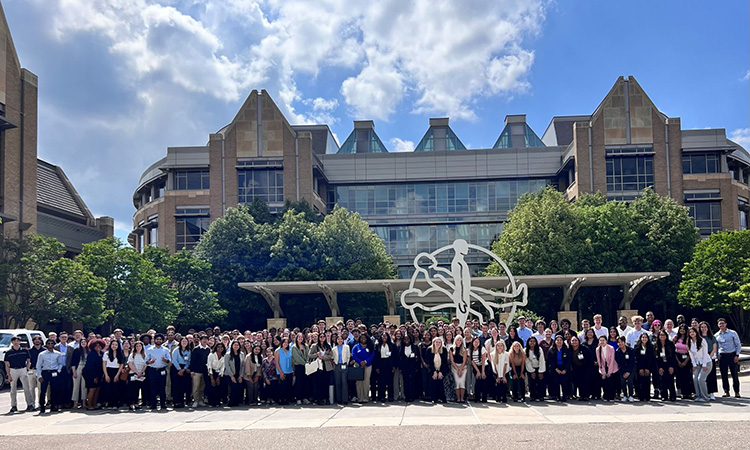
Medtronic is one of the sponsors of Discover MSP’s Intern Week, an event hosted by Make It MSP, an initiative by local economic development group Greater MSP. Thousands of interns from over 50 companies networked and engaged in volunteer outings, a tour of the Mall of America, and an innovation block party at University Enterprise Labs in June.
Greater MSP has been working for over a decade to attract and retain talent in the Twin Cities. The organization has, over the years, shifted to focus on interns who are considering next steps after graduation. Intern Week was held for the first time in 2017 at U.S. Bank Stadium, said Matt Lewis, vice president of strategic initiatives.
Connecting interns to the Twin Cities has meant highlighting the outdoors, with kayaking and biking outings, as Minneapolis and St. Paul have some of the most highly rated parks in the country, Lewis said. Another priority is involving interns with local volunteering experience in a state with one of the highest rates of volunteerism.
“If we could be the best place in the Midwest, if we have more internships and the internship experience was positive… that would help us over the long term,” Lewis said.
It’s difficult to track the impacts of Make It MSP’s efforts, Lewis said, as each internship program has different goals for retention. But the organization does try to measure conversion rates of interns to full-time employees for companies that encourage interns to participate in the programming during Intern Week and throughout the summer.
“We would love to see more companies expanding their programs and improving, even if that means they’re starting from a lower base versus a company that’s super mature,” Lewis said.
Lewis said Make It MSP worked with the University of Minnesota’s College of Liberal Arts to create a toolkit for organizations looking to start an internship. The toolkit strongly recommends paid internships, with 49% of student survey respondents saying they could only consider an unpaid internship if they received a scholarship or stipend.
About 77% of interns prefer working in-person at least half of the time, according to a survey from Discover MSP Intern Week in 2021.
“What I’ve noticed is people starting their careers are saying they want the opportunity to be in person. All people want flexibility,” Lewis said. “Nobody’s going to turn down flexible, but young people starting their careers value the in-person experience.”
Connecting with company culture
Ecolab, another Make it MSP partner, emphasizes to interns the value of connecting with other interns as a networking opportunity, said director of talent acquisition Mercedes Walker. Around 67% of Ecolab’s 263 interns relocated from 31 different states compared to 60% last year, and around one-third work from the company’s corporate offices in Eagan and Naperville, Illinois.
“We view them as future leaders of the organization, and so it’s really important for us to invest in their development as we continue to build that pipeline of talent,” she said.
Connecting interns inside and outside the company is a priority for Ecolab. Each internship program at Ecolab hosts summits for interns within a specific division to network and collaborate, Walker said. Technology and digital solutions interns, for instance, worked in small groups this year on a “hackathon” and presented feedback and findings to judges and senior leaders.
“They can really get a real-life view of what we are, a realistic view of what the job would look like full time for them post-graduation,” Walker said.
All interns have a full-time experience that aligns with the company’s hybrid model wherever they are working, with those at headquarters coming in three days a week.
“They want to be able to innovate,” she said. “They want to network, and we really, really strongly encourage our interns to network during their time with us.”
Ecolab lines each intern up with a “buddy” to be a resource and answer questions, and more than 200 interns opted in to being connected with a mentor in the same employee resource group this year, Walker said.
The value of recruiting in-person
The intern recruiting process has changed little for Ecolab, she said, but it has implemented a new tiered strategy, focusing time and resources into schools with the highest returns on investment. The most prominent changes have been simplifying the experience for interns by streamlining start dates and building strong relationships with historically Black colleges and universities, and local universities like the University of Minnesota and the University of St. Thomas.
As much as the recruiting process has become digitized and automated for Land O’Lakes, senior director of talent management Ann Taylor said the “high-touch experience” of college relations recruiters has been invaluable for bringing in students.
Land O’Lakes’ internship program aims to “create connectivity as much as possible” by bringing all 100-or-so interns to the Arden Hills headquarters for orientation, matching the younger generation’s desire for the in-person experience. Interns network with each other, attend summer feedback sessions, give presentations to senior leaders, and share in the corporate experience, bringing interns to town halls and employee celebrations, Taylor said.
The company expects the 70 interns at the corporate office to work in-person at least two days a week – as is standard for all employees at headquarters, Taylor said.
More than half of the interns at the corporate headquarters are from outside Minnesota, but interns relocating to any Land O’Lakes location receives a stipend to help with housing costs, Taylor said.
Austin-based Hormel, meanwhile, leverages its former interns to share their experiences with peers on campus, said director of talent acquisition Amy Sheehan. Some of the few interns who decided to not accept a return offer continued to tell fellow students their positive takeaways from working for the company, she said.
“They’re not going to listen to me. They’re going to listen to the person that had the experience,” Sheehan said.
Hormel offers virtual “mid-day connects” for interns to engage with people from across the company as well as hosting “backpack to briefcase” sessions on transitioning into the workforce, Sheehan said. The roughly 50 interns at headquarters follow the company-wide hybrid schedule, working four days a week in-person.
Hormel offered remote internships due to the pandemic, but elements of the internship program remained as manufacturing facilities stayed open, Sheehan said.
“Whether you’re in operations or engineering, we never closed during Covid events,” Sheehan said. “We were still making food for the world.”