

How Mayo and NASA Are Partnering With Colleges to Build MN’s STEM Workforce
As college graduates hit the job market this June, some young people are leveraging the Innovation Scholars program to launch their careers in Minnesota’s medtech and health care sectors.
That’s what John Hicke did in 2020 after graduating from St. John’s University with a double major in biology and integrative health science. He got hired by Medtronic, a global giant in developing and manufacturing medical devices, and he also enrolled in a University of Minnesota medical device innovation master’s program.

During his senior year, Hicke was on a five-student Innovation Scholars team that did technical and market research on new technology invented by Mayo physicians. “My role, and my teammates’ role, was analyzing other intellectual property out there to see if there’s any competitive technology,” Hicke recalled. “It was around cancer patients and reconstructive solutions.” In this context, reconstruction means restoring a patient’s physical form or specific function.
Hicke’s experience with the Innovation Scholars project helped differentiate him as a young college graduate. “The Mayo Innovation Scholars program was the best experience that set me up for success in my master’s program,” Hicke said.
Six years after graduating from St. John’s, he’s a senior clinical research specialist at Medtronic, which involves managing clinical trials in the cardiac ablation solutions business. “I definitely wouldn’t be where I am today without having that accelerated [master’s] education and starting to work full-time at a company like Medtronic” after earning his bachelor’s degree, Hicke said.
Intersection of science and entrepreneurship
Innovation Scholars marked its 20th anniversary this spring with a celebration at the Science Museum of Minnesota. It was originally called the Mayo Innovation Scholars program. But it shifted to Innovation Scholars over time as NASA and Minnesota-based medtech and health care companies got involved in the program and provided research projects for students.
The program defines itself as “working at the intersection of science, health care, and entrepreneurship” and offering “high-impact experiential learning programs for outstanding liberal arts students from Minnesota’s private colleges and universities.”
The founder of Innovation Scholars was the late John Meslow, who had a 31-year career at Medtronic that included tenure as president of the neurological and spinal business. Meslow died in 2024.
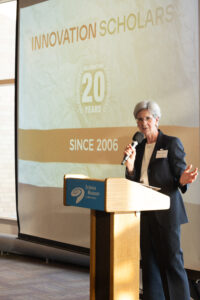
“This was John’s retirement project. He did this pro bono,” said Rebecca Hawthorne, Innovation Scholars program director and a former professor at St. Catherine University. “John was a St. Olaf grad and was very active in supporting the Minnesota private colleges and universities throughout his career.”
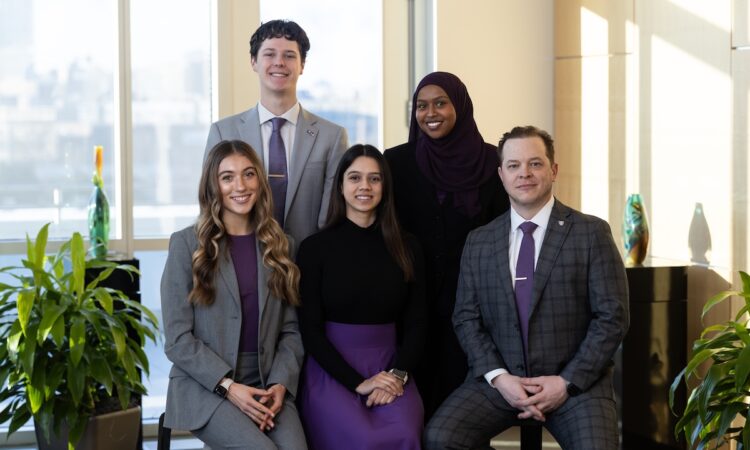
From the outset, the way Innovation Scholars works is that four students from different academic disciplines are selected to work together on a team from their college. “We might have a biology major, a computer science major, and an economics major,” Hawthorne said, and the fourth undergraduate would come from another academic area. “Then each team is assigned an MBA team leader.”
Three schools have supplied those team leaders. They’ve come from the MBA programs at the University of St. Thomas and Augsburg University and the Master of Arts in Organizational Leadership (MAOL) at St. Catherine University.
Often, the students don’t know each other when they are selected for their college teams. “If you’re majoring in organic chemistry, you may not know someone who’s majoring in entrepreneurship,” Hawthorne said. “So the students have to form a highly functional multidisciplinary team.” The teams have faculty mentors on their campuses, who represent different disciplines.
Founder Meslow enlisted Hawthorne, who has a Ph.D. from Stanford, to do a detailed evaluation of the initiative when it was still the Mayo Innovation Scholars Program (MISP). Her program outcomes study focused on the impact of the program on the 700 or so students who took part in it from 2006 to 2019.
The skill development categories that were ranked most highly by the student alumni were: teamwork (communication, collaboration, and team dynamics), interdisciplinary learning, professional presentation, ability to deal with ambiguity, and leadership.
“The director of operations at Mayo Clinic Ventures reported that more than 100 technologies had been evaluated through MISP as of 2019,” Hawthorne wrote in her report. “Collectively, these technologies produced 447 U.S. and foreign patent filings and 121 issued patents to date. In addition, 27 technologies were licensed with 18 currently licensed.”
Hawthorne also found that student participation in MISP drove a strong interest in graduate education. Nearly 77% of those included in her study pursued graduate education. About 20% earned a Ph.D., another 19% earned an M.D., and 28% completed MBA programs. Others pursued dual degrees.
“We have a very strong experiential learning model,” Hawthorne said. She noted that the Innovation Scholars program also drew the attention of Howard Gardner, a professor at the Harvard Graduate School of Education.
“Howard was conducting a study on what transformative educational experiences looked like in colleges across America,” Hawthorne said, and he included the Innovation Scholars program in his 2022 book The Real World of College that he co-authored with Wendy Fischman.
“He flew out to Minnesota, and he interviewed students, faculty, and project sponsors,” she said. “He attended presentation day at Mayo Clinic,” when the student teams presented their project recommendations to Mayo physicians, scientists, licensing managers, and business professionals. “He really learned the program from the inside out.”
Adding medtech startups
After the Covid-19 pandemic arrived in early 2020, leaders at the Mayo Clinic were focused on treatments for Covid and needed to take a break from Innovation Scholars. “So we approached Medical Alley at that point,” Hawthorne said.
“We grew the program with the early startups,” she said. “The projects are further along in the commercialization process. They actually have a product that they have developed, and they are now taking it to market. The students have the opportunity to experience different kinds of technology transfer projects. They also work directly with the CEOs and directors of research with these small companies, which is very exciting for the students. The companies love the pipeline to the talent because these are the top students from these colleges.”
For the 2025-26 academic year, there were 14 Innovation Scholars projects. Seven were Mayo Clinic projects, five were associated with private companies, and two were done for NASA.
The five businesses and the projects were: Egg Medical, a patient monitor system; YourSteps Health, a pediatric rehabilitation platform; Cytotheryx, cell-based therapies to treat liver disease; Collaborating Docs, exploring the feasibility of expanding the company’s services to pharmacists; and Cantata Health Solutions, advancing behavioral health access through collaborative consumer technology.
Egg Medical, based in Roseville, provides radiation protection products for staff that need to take X-rays.
Because Egg Medical has a radiation protection platform that is already in the marketplace, the company is exploring additional features that could increase the functionality for physicians and other staff, according to John Gainor, Egg Medical’s co-founder and chief technology officer.
The Innovation Scholars team working with Egg Medical did research on use cases, pricing, and competitors. “If we had more time, we would have loved to have them go out and interview a bunch of physicians,” Gainor said. “But they were able to dive pretty deep and get a lot of data.”
Gainor learned about Innovation Scholars because he was a next-door neighbor of Meslow, the program founder, in Mendota Heights. “I’m out mowing the backyard, and he wanders over and says ‘Hi’ and introduces himself,” Gainor recalled. “John was a super humble guy.”
The undergraduates who worked on the Egg Medical project were from Carleton College, and the team leader was an MBA student from Augsburg.
Real-world applications
Innovation Scholars helps students understand the major differences between academia and the business environment.
“There’s a huge benefit for students to see the practical application of some of the things they’re learning in school,” Gainor said. “If you’re taking a test, or you are studying, you think there’s a right answer.”
After graduation, students enter gray areas in workplaces. “In business or engineering or in science, in many cases, there maybe isn’t the right answer, or there are multiple right answers,” he said. “A lot of times, you won’t know for months or years until you have the right answer.”
Dealing with ambiguity is a reality in the business world, and Gainor said it surfaces in Innovation Scholars projects. “You have to make decisions based on limited information and limited time” in business, Gainor said.
“They’re working with the company to try and define what the problem statement is and what the requirements of the project are,” he said. Then there is some trial and error before the students “figure out what the right path is.”
In addition to working with private companies such as Egg Medical, in recent years some of the private college students have worked on projects with NASA. Hawthorne said that NASA heard about Innovation Scholars through Medical Alley.
NASA has a biomedical patent portfolio. “Part of NASA’s mission is to push their research out to the public,” she said, so its technology benefits can be shared broadly.
“NASA runs these technology programs across the country with a handful of different colleges and universities,” Hawthorne said. “They generally work with a graduate school, schools of engineering, business schools.” She emphasized that Innovation Scholars is one of the few undergraduate programs that has a partnership with NASA.
“One of our student teams, who worked on a NASA project, was so fired up with the findings of their project that they decided to form an LLC,” she said. That 2024-2025 project team was from the University of St. Thomas, and the students have formed a company called CognitionIQ.