

Higher-Ed Students Are Returning—But What Are They Studying?
After years of decline exacerbated by Covid-19, Minnesota colleges and universities are welcoming back more and more students.
In late January, the Virginia-based National Student Clearinghouse Research Center (NSCRC) released data showing that fall 2025 enrollment in Minnesota higher education institutions rose 2% over the previous year. This follows reports of significant enrollment increases at the University of Minnesota and the Minnesota State system.
Given the high costs of higher ed, it’s probably not surprising that this new wave of students appears to prefer programs and majors offering clear ROI. Technical colleges in particular are booming, in many cases seeing double-digit enrollment increases.
“Two-year colleges are really in a good spot from a return-on-investment standpoint,” says Jeff Wild, vice president of advancement and outreach at Alexandria Technical and Community College. According to school president Michael Seymour, ATCC experienced 33.4% enrollment growth from 2020 to 2025. He cites his school’s high placement rate for jobs with rising wages as two reasons for the jump.
One ATCC program that has seen skyrocketing demand is its online speech-language pathology assistant program, which Seymour says has experienced 92% growth from 2021 to 2025. Speech-language pathology practitioners assist schoolchildren needing help mastering their speaking and pronunciation skills, as well as older people, notably those with Parkinson’s disease, who are developing difficulties with talking. In addition to the high demand for these services, the program has grown thanks to recently established state requirements for speech-language pathologists and assistants to be licensed.
Related: Minnesota State Enrollment Continues to Rise
Some ATCC programs, such as those for diesel mechanics and welders, remained in demand during the pandemic, but others were hit hard, notably nursing and police training. Both have bounced back in recent years.
“Our traditional programming is still our bread and butter,” Seymour says. “But we now offer new opportunities for learners to engage with us that suit them better.”
While tech schools have seen some of the biggest enrollment increases, other higher education institutions have seen significant jumps since the end of the pandemic. Case in point: Concordia College in Moorhead. According to vice president of enrollment Ben Iverson, Concordia added about 600 new students in 2024, a 28% increase over 2023. Enrollment this academic year remained steady.
“Students are trending toward majors that lend themselves fairly directly to obvious career paths.”
–Ben Iverson, VP of Enrollment, Concordia College in Moorhead
Iverson notes that “in the past four to five years, students are trending toward majors that lend themselves fairly directly to obvious career paths.” These include new programs in cybersecurity and criminal justice, “and those seem to be taking off pretty well.” Concordia also has recently introduced a biochemistry major, which is attracting interest from students considering careers in health care, either as physicians or researchers.
Another health-related major that Concordia has launched is exercise science. “There’s a lot of interest among students to enter the professional sports world or perhaps owning a gym or having a career in professional training,” Iverson says.
The University of St. Thomas has consistently had a focus on “market demand,” says Kristen Hatfield, the university’s director of undergraduate admissions. Currently, she notes, “there’s market demand for all things health-related.” That’s one reason St. Thomas launched a nursing program in fall 2022, which now has an annual cohort of 125 students. In fall 2024, St. Thomas added a nutrition major, “an area of growing interest,” Hatfield says. Nutritionists and dietitians are in demand in hospitals and public health organizations, as well as in food sciences and sports.
“There’s still a lot of market demand for tech skills across all industries, data analysis being a key factor.”
–Kristen Hatfield, Director of Undergraduate Admissions, University of St. Thomas
“There’s still a lot of market demand for tech skills across all industries, data analysis being a key factor,” Hatfield notes. Business analytics, a recently introduced subject, has become St. Thomas’s most popular minor. “Students are combining it with different business majors,” Hatfield says. St. Thomas is currently developing an undergraduate curriculum for artificial intelligence, which Hatfield says will include instruction on AI’s ethical use.
The University of Minnesota Duluth has experienced enrollment growth in many of its health-oriented programs, which include exercise science. In addition, UMD executive vice chancellor and provost Rebecca Ropers reports growing participation in science and engineering programs, “and I know we’re not unique in that.” Not surprisingly, demand remains strong in business fields.

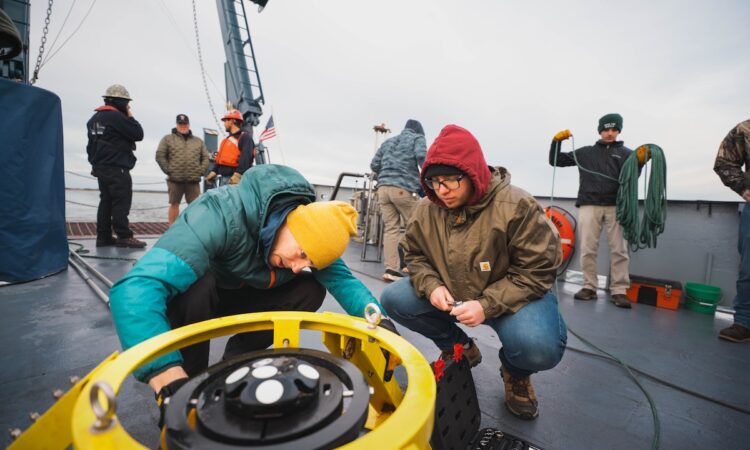
That noted, UMD also is continuing to focus on what makes it distinctive. For instance, it is taking advantage of its location by developing programs such as maritime engineering, which will be launched this fall as a “subplan” of the university’s existing mechanical engineering major. Maritime engineering is a field “where, because of Lake Superior, we are uniquely situated,” Ropers says.
Minnesota Public Radio recently reported that Washington, D.C.-based Spear.Ai and a related company called Anno.Ai have established offices in Duluth. They plan to test and train AI systems for autonomous underwater and underground vehicles. These companies see the Big Lake and abandoned mines on the Iron Range as ideal locations for testing and training this kind of technology. UMD could help provide the scientists these companies need to develop these vehicles.
Bemidji State University (BSU) also has seen growth in programs that are distinctive to its location and what might be termed its student “market.” This includes many Indigenous students as well as older learners. Marah Jacobson, BSU’s provost and vice president for academic affairs, cites as an example her institution’s online sociology program, whose enrollment has grown 40% since being launched in 2020. “That draws students from a wider area,” she says. It also addresses the needs of Northland students pursuing careers pertaining to regional social issues. “This program demonstrates how Bemidji State is both flexible and affordable,” Jacobson says.
BSU’s social work program also has grown in popularity in recent years. The university provides this program via what Jacobson terms “an integrative model” that offers students both online and in-person instruction. This approach benefits the many program students who live far from Bemidji and who often are having to manage complicated lives involving work and family.
According to Jacobson, BSU’s school design program—which includes graphic design, 3D modeling, and digital illustration and animation—has grown 62% since 2021. “Our faculty work very hard with our industry partners to constantly update the curriculum,” she adds. The bachelor-degree students in the design program “have a better than 90% job placement” after graduation, Jacobson says.
Also distinctive to BSU is the growth of its geography and geographic information systems (GIS) programs, which Jacobson says have seen 360% combined enrollment growth since 2020. She credits this growth not only to its real-world career opportunities in mining, government, and nongovernment relief organizations but also to the various “modalities” of program delivery (in-person, online, and hybrid).
With the success of professional programs in higher education in the post-pandemic period, the humanities seem to have gotten lost in the shuffle.
UMD’s Ropers notes that, like most higher education institutions, her university hasn’t seen the same increases in humanities enrollments that majors in professional fields have enjoyed in recent years. But she believes this might change, at least at UMD, in part because of Mellon Foundation grants it has received to develop humanities-related internships under the rubric “Humanities in Action.” “I can’t tell you right now that we’ve seen an enrollment shift in that area yet,” Ropers says. “But I predict we’ll see one because of what we’ll be offering.”