

B Corp Certification: Is It Worth It?
The B Corp movement has come a long way since it first started nearly two decades ago. What began as a small nonprofit group in Pennsylvania has grown into a global phenomenon.
For-profit companies earn B Corp certification by meeting a set of specific social and environmental standards set by B Lab, a nonprofit launched in 2006. The effort is aimed at “making business a force for good.”
A year after B Lab launched, just 82 companies earned B Corp certification. Now, there are more than 8,000 B Corps around the world, with more than 2,000 in the United States and Canada, according to B Lab data.
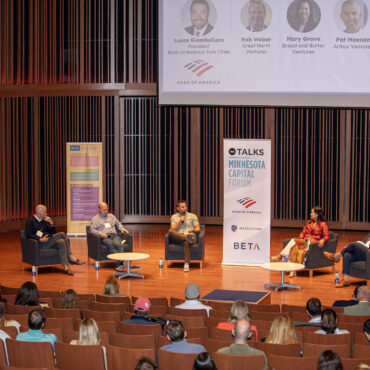
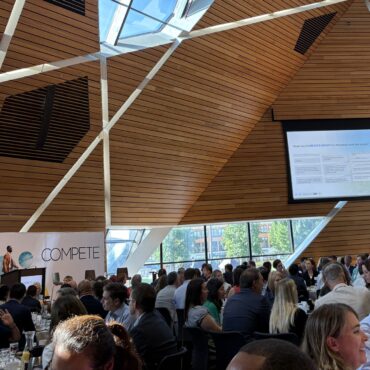
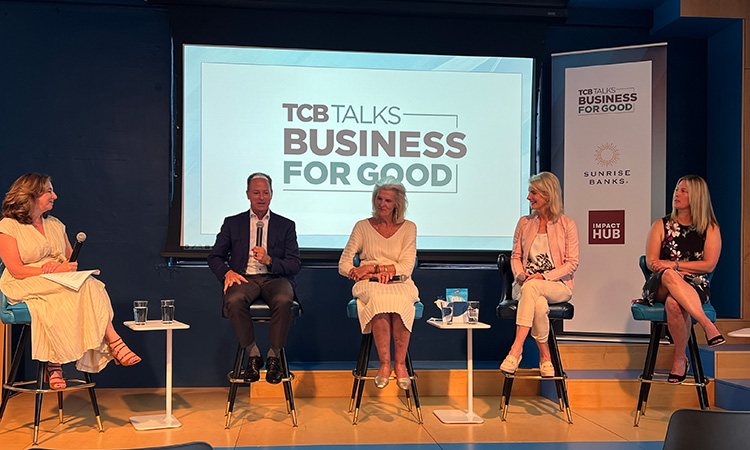
The movement has, of course, caught on in Minnesota, where about 50 companies have earned certification. At Minneapolis ad agency Colle McVoy’s downtown Minneapolis headquarters on Tuesday, TCB gathered a quartet of local B Corp leaders to understand what the designation means for customers, employees, and other businesses. TCB editor-in-chief Allison Kaplan moderated the discussion. Sunrise Banks sponsored the event, with proceeds from ticket sales going to Impact Hub Minneapolis, a nonprofit that helps businesses accelerate their social impact.
Here are some key takeaways for the “B Corp curious:”
B Corps tend to fare better than non-B Corps.
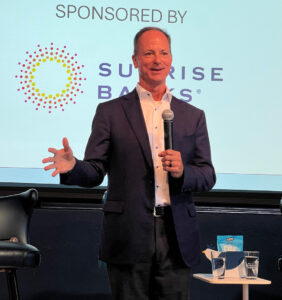
For those on the fence about pursuing the designation, David Reiling, CEO of St. Paul-based Sunrise Banks, said it’s paid off for his business and many others. Sunrise has been a B Corp since 2009, he noted.
“B Corps outperform traditional companies in the long term,” Reiling told attendees.
In general, businesses that prioritize “people over profit,” tend to have better prospects, he said. He drew a comparison between GE and Costco. Though neither is a B Corp, Costco has over the years prioritized its employees and their benefits. That wasn’t always well received – the company was often “hammered on the cost of overhead and employees” in investor calls, while GE was praised for trimming costs.
“Look at where we are today: GE got a bailout and was broken up; Costco kicks ass,” Reiling said. “When you think about putting people before profit or on the same plane, the company performs better.”
According to B Labs own data, B Corps were were more likely than “ordinary businesses” to have grown their revenue and worker base between 2019 and 2021. Coming out of the pandemic, B Corps were more resilient with 95% still operational in 2023 compared to 88% of non-B Corps.
Certification is grueling, but worth it …
Don’t expect to earn B Corp certification overnight. The certification process is arduous, and requires taking careful stock of nearly every aspect of operations. Emily McGarvey, director of sustainability at Golden Valley-based furniture retailer Room & Board, which earned B Corp certification in October, said there are three main elements to certification: Accountability, actual impact assessment, and transparency.
The accountability portion requires a significant change: Whereas for-profit companies generally have a fiduciary duty to their shareholders and profit alone, B Corps’ missions are a bit larger.
“When you become a B Corp,” McGarvey said, “there’s a legal requirement where you’re actually changing your articles of incorporation to move to a stakeholder model. So you not only have a fiduciary to profit, but also a fiduciary duty to environment, community, and staff. That is a big shift.”
A few months after becoming a B Corp last year, Room & Board flipped to an employee owned model.
… and recertification is just as arduous.
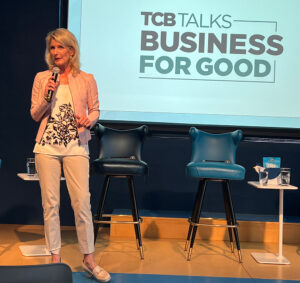
Fellow Minneapolis-based ad agency Russell Herder has been B Corp certified since 2017. CEO and partner Carol Russell noted that recertification is required every three years. Her firm had just recently completed the process before Tuesday’s panel.
“I equate it to running a marathon,” she said. “You have to plan. You have to dedicate resources. It’s just what it takes.”
Russell said she had to answer loads of questions: “Frankly, some of them are very inconvenient, meaning, time-consuming.” That included queries about what percentage of suppliers are local, how much was spent with each, who their CEOs are, and many more details.
But she said the process was worth it. The questions helped point her firm in a better direction. There were some items pointed out that spurred her to take action. “It sort of forces accountability,” she said.
Clients notice. Employees do, too.
Does B Corp certification mean anything to folks outside the business? For these four panelists, the answer was a resounding yes. Christine Fruechte, CEO of Colle McVoy, said that her firm’s certification in 2023 was a “very proud moment for a lot of clients.”
“Some of our clients are not in an industry where they can immediately race to becoming a B Corp,” Fruechte noted. “So, we became an extension of their team. A lot of them were proud to be associated with us. I think our employees were also proud.”
For Russell Herder, the designation has increased trust. In a client survey, 76% of respondents said that the firm’s B Corp status made them trust the company more, Russell noted.
McGarvey, meanwhile, said that it’s a bit too soon to understand how B Corp certification will impact Room & Board, but she’s hopeful. She noted that the company’s sustainability-oriented bent has already had an impact on sales.
“We do know when people come to our website and click on our sustainability company pages that we see a higher conversion rate. We see higher basket size,” she said. “I’m assuming adding B Corp to that message is only going to help.”
B Corp status as a longevity play?
Panelists suggested that earning B Corp certification is one way to ensure business longevity. Russell pointed back to Patagonia founder Yvon Chouinard, who said that the designation would “protect the mission.”
“If something evolved with the company and he wasn’t there, he wanted to ensure it was still [on mission],” she said. “That was a piece of it for us.”
Fruechte described the designation as a “compass.”
“All of us are not going to be in our roles forever, so if you create a legacy of doing good and putting a framework in place, that lasts long after we’re there,” she said. “That makes a real impact.”