


Pulsar Helium Picks Two Harbors For Facility Location
The company that has been conducting exploration of northern Minnesota’s helium deposits has added some significant weight to its extractive endeavors.
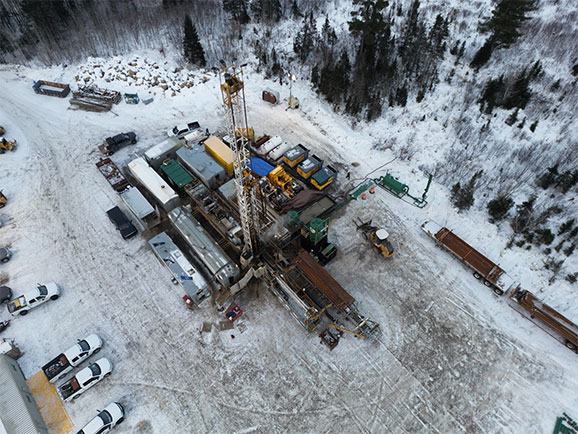
After many months of exploration at its Topaz Project well sites near Babbitt, Portugal-headquartered Pulsar Helium has chosen a location for a facility that will liquefy that gas for commercial sale. On Oct. 12, the Two Harbors City Council approved a purchase and development agreement with Pulsar’s Minnesota subsidiary, establishing a development framework for a proposed “rare gas hub” on the city’s northern edge.
The company has good reason to call the project a rare gas hub. Though it’s the second-most abundant element in the known universe (after hydrogen), here on Earth it’s hard to find. (And when it is found, it must be extracted carefully, lest the helium atoms escape into the atmosphere—think of a helium balloon.)
Helium is also one of the most essential elements of the high-tech ecosystem. In semiconductor manufacturing, for instance, it’s used to cool silicon wafers so they don’t warp or otherwise become damaged. And in recent months, this rare gas has become even rarer. The Iran conflict has severely disrupted the global helium supply, with the resulting “helium crunch” driving up the cost of computer chips and other digital components. Minnesota helium could have a worldwide impact.
The agreement between Pulsar and Two Harbors suggests that there’s enough Minnesota helium to justify a liquefaction facility. All five appraisal wells at the Topaz site have encountered gas under high pressure. The Two Harbors site offers access to a rail line that would connect the facility to the Topaz location, as well as proximity to roads, utilities, and Two Harbors’ lake port.
Pulsar is getting a good deal in the agreement. It would be able to acquire the 62-acre property, appraised at $143,000, for $1. The city of Two Harbors would also contribute up to $1 million toward rail construction, site clearing, and utility extensions, as well as reimbursement of some property tax payments. “Two Harbors’ industrial location and transportation infrastructure offer a strong foundation for this proposed facility,” Pulsar CEO Thomas Abraham-James said in a press release.
There are still several hoops to jump through before the deal closes and construction begins. These include a final survey of the site, an environmental review, financing and utility arrangements, and land-use approvals. Pulsar will be funding construction with debt and public-sector financing, plus existing cash reserves. If and when the purchase is completed, construction would take about a year and a half.
Once it’s up and running, Pulsar expects to see heavy demand from semiconductor and AI chip manufacturers, medical imaging labs, and aerospace and defense programs. Pulsar also is optimistic that the Topaz wells will generate significant quantities of helium-3. This especially rare form of helium is used in highly specialized applications, including dilution refrigerators for quantum computing systems.
Helium isn’t the only gas that the Pulsar facility would be handling. The company says that its proposed plant will capture 100,000 tons of liquid CO2 annually, a secondary product it could market to food and beverage, refrigeration, and agricultural businesses.
It’s early yet, but the Two Harbors proposal suggests that Minnesota helium could have a surprisingly solid future.