


What’s With the $15 Side Salad?
We all have our restaurant pricing stories. The $15 side salad is my biggest head-scratcher. (Weren’t they $5 or $6 just a few years ago?) For some, it’s the $14 fast food burger that rankles (we’re looking at you, Shake Shack). For others, it’s the $38 Bolognese at a basic South Minneapolis bistro. That’s $50 with tax and tip, mind you.
None of this is to imply said pricing is unjustified, but the value quotient of dining out has gone pear-shaped for many customers.

“You’re not paying for food,” explains Tim Niver, owner of Mucci’s in St. Paul and the late, lamented Saint Dinette and Strip Club. “Every other cost has gone up. The margin on that salad is great, so it pays for my 25% insurance increase [or] the last $1 minimum wage increase.” Niver has expanded into consulting to help make ends meet and hosts the Niver Niver Land podcast.
Restaurateurs also say they are being inundated with new costs. “You always had food, payroll, rent, utilities, linen, cleaning service … then came Toast (payment software), Grubhub, loyalty (rewards program)—they all want 1%, and you feel you have to keep up. You have to pay to be prominent on Door Dash. You keep adding payees.”
That’s Eddie Lakin, who for years operated the acclaimed burger joint Edzo’s in Evanston, Illinois, just outside Chicago. He now writes a Substack (edzos.substack.com) about food and the restaurant industry and penned a recent missive on the wackiness of burger pricing.
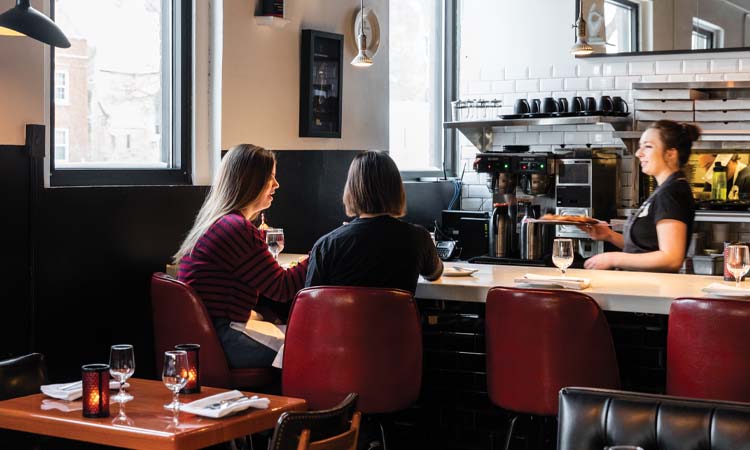
Customers are also choosing to eat less (see Wegovy) and drink at home. The increasingly ubiquitous “pregame” cocktail on your living-room couch is a $30 loss, Niver notes. He thinks this is the new reality—we’re not going back—and has responded accordingly: “Our prices have adjusted up to what they need to be for the business to survive.”
As for the suddenly ubiquitous double-digit green salad, “We need a certain amount of revenue per seat,” says Lakin. “A $5 side salad is too inefficient.”
That makes sense, but not every trend in the industry is so easily justified. The sudden ubiquity of the wagyu smashburger and burrata everything (Lakin penned a recent post called “Your burrata dish sucks.”) reflects restaurateurs gaming luxury ingredient social media trends.
“Premium ingredients definitely can drive up check average,” says Niver. “We need our tricks, too. It’s a bit of a head game.”
But if selling a burger at a profit requires a luxury ingredient that makes the burger no better, do restaurants have a future? “A midrange bar and grill [now] has half a million in startup costs,” says Niver. “I fail to see the economic promise in opening a restaurant.”
“Ten percent of us are still killing it. But for the rest, it’s really hard.”
—Tim Niver, owner, Mucci’s
And doing it the old-fashioned way is just a recipe for losses. “Now,” says Lakin, “it costs more to make a pan of scratch lasagna than to buy [a pre-made food-service] product. Grinding your own beef for burgers costs more than pre-ground,” because labor has never cost more.
Jon Maze is editor-in-chief of national trade journal Restaurant Business. He notes that more independent restaurants closed than opened last year, and the industry remains oversaturated. He says the average Starbucks saw 15% fewer customers in 2025 than 2018. “It’s a tough environment,” he notes, “but not so tough that it’s fundamentally remaking the business.”
Lakin tried to resurrect Edzo’s after the pandemic destroyed the vitality of downtown Evanston, but he couldn’t make the numbers work. “Commercial real estate hasn’t made the down-adjustment to reflect the new reality. So you have empty storefronts,” he says.
That’s true all over the Twin Cities as well (see Uptown). Niver, hardly a conservative firebrand, would like the state to take another look at a sub-minimum wage for tipped workers, one of the most lavishly demagogued issues in recent memory (the typical full-service restaurant server in the core metro now earns $30 to $40 an hour). “Every price increase we take is a raise for them,” Niver says. “There’s a growing city/suburb [minimum] wage differential. It amounts to hundreds of thousands of dollars in cost per year” for city restaurants.
Read more from this issue

To make it, small operators need an edge, says Lakin. “You know the landlord or own the building, or you’re in a competitive desert. And that assumes you have an excellent concept, personal service, a lot of discipline, you buy used equipment, and DIY everything.”
“Ten percent of us are still killing it,” adds Niver. “But for the rest, it’s really hard.”