

First Take: Matt Hickey, Managing Director of MN’s Defense Innovation OnRamp Hub
Today, Minnesota ranks last in defense spending per capita. But the state has a new defense technology player in town that’s aiming to help bring together a group of innovative local businesses to work alongside the federal defense industry.
In 2015, the U.S. Department of Defense launched a Defense Innovation Unit in an effort to rapidly increase innovation in the defense sector. As a part of that, the department created eight Defense Innovation OnRamp Hubs across the country to serve as regional catalysts for innovation within the defense technology ecosystem. Minnesota was given one of those OnRamp Hubs.
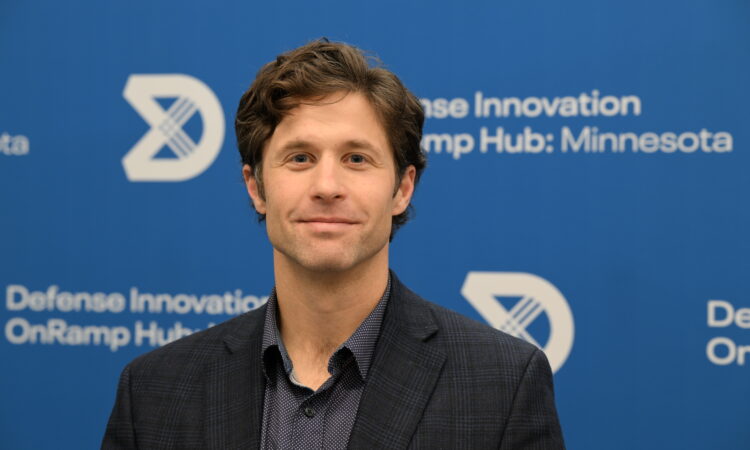
At the beginning of this year, Matt Hickey joined the team as its new managing director. Before joining, Hickey served as the associate director for strategic engagement at the Ted Stevens Center for Arctic Security Studies, where he led the Strategic Engagement Division; the legislative assistant for National Security Affairs and Arctic Policy for U.S. Senator Lisa Murkowski; and an officer in the U.S. Army, where he led combat operations in Afghanistan, taught and specialized in Arctic and mountain warfare, and participated in security cooperation operations in Europe and South Asia.
Three recent episodes of The Twin Cities Business Show featuring interviews with Bill Harper, the board president of the Minnesota National Security Ecosystem; Artie Mabbett, the CEO of North Wind; and Cora Leibig, the CEO of Chromatic 3D Materials, dig deeper into some of the companies and workstreams that Hickey and his team will be working with.
We asked Hickey a few questions about his background, his role, and what he expects the Defense Innovation OnRamp Hub’s office to do for the defense technology market across Minnesota and the Upper Midwest.
The following interview has been edited and condensed.
You’ve spent time working in the Arctic. What would surprise people about that space?
One thing that often surprises people is that operations in extreme environments depend on logistics, infrastructure, and system reliability, not just geography or weather.
Cold-weather conditions place unique demands on equipment, energy systems, communications, mobility platforms, and supply chains. Batteries perform differently, materials can become brittle, sensors may degrade, and sustainment becomes significantly more complex.
My time at the Ted Stevens Center for Arctic Security Studies reinforced how rapidly the Arctic is evolving as a region of growing strategic importance, with implications for security, infrastructure, and allied cooperation.
Minnesota’s extreme climate lends itself well to understanding the demands of Arctic and austere operations. That creates a meaningful opportunity for Minnesota. Our climate, industrial capabilities, and research strengths position the state to support cold-weather readiness, testing, and operational problem-solving. We also see strong potential to support mission partners, such as U.S. Northern Command, as Arctic activity increases and homeland defense priorities continue to evolve.
As the Arctic becomes more strategically important, Minnesota can be a valuable partner in helping advance preparedness, resilience, and technologies suited for northern environments.
How did that experience prepare you for this role?
My time in military operations, Capitol Hill policy work, and the Ted Stevens Center for Arctic Security Studies provided firsthand insight into how operational requirements translate into real capability needs. It also reinforced the importance of coordination across government, industry, academia, and allied partners to solve complex challenges.
Just as importantly, it showed that many of today’s most relevant advances are emerging from the commercial sector, startups, and research institutions. Areas such as autonomy, advanced manufacturing, resilient energy, data systems and communications often have clear dual-use potential that can serve both commercial markets and national security missions.
Those same dynamics apply here. OnRamp Hub: Minnesota helps bridge that gap by connecting regional organizations with [Department of War] needs and helping more technologies find practical pathways to support mission outcomes while also creating economic opportunity.
What is Defense Innovation OnRamp Hub: Minnesota?
It serves as a local front door to the Department of War, helping companies, startups, and researchers better understand how to engage with national defense opportunities.
Launched in December, it is part of a growing national network that includes Arizona, Hawaii, Kansas, Ohio, Washington, Montana, and Kentucky. This expanding network reflects a broader recognition that many of today’s most advanced technologies are developed outside traditional government channels.
We work closely with partners such as the Minnesota National Security Ecosystem, Metro State University, and stakeholders across industry, government, and higher education to strengthen pathways for engagement.
Through the Defense Innovation Unit and its OnRamp Hubs, the goal is to speed up how new technology reaches the military. In Minnesota, that means finding the right companies, connecting them with defense partners, and helping move technologies from early-stage development into testing, validation, and potential use.
Minnesota ranks last in per-capita defense spending. Why? And how could the Hub change that?
For Minnesota, the opportunity is not starting from scratch. We already have strong capabilities in advanced manufacturing, aerospace, medical technology, artificial intelligence, energy, robotics, and research that align with Department of War priorities. The challenge has often been visibility, coordination, and access. Many organizations simply have not known where to start, who to connect with, or how to navigate defense pathways.
OnRamp Hub: Minnesota was created to help change that. We serve as the front door for industry looking to better understand and engage with [Department of War] opportunities. Our role is to create a more accessible and streamlined contracting journey for commercial companies. Collectively, these efforts progress the discovery, maturation, and adoption of commercially driven technologies that address real-world national security challenges.
What strengths does the state have?
Minnesota has many strengths that matter most in today’s innovation economy. Manufacturing is a backbone of Minnesota’s economy, supported by a highly skilled workforce and deep expertise in designing, producing, and scaling complex products. That foundation is especially relevant as the DoW looks to strengthen domestic industrial capacity and resilient supply chains.
The state also has significant capabilities in medical technology, artificial intelligence, advanced materials, cybersecurity, and R&D. We’re already seeing momentum through efforts such as BioMADE, which is advancing biomanufacturing in Minnesota, and the Minnesota Aerospace Complex, which is expanding aerospace testing and engineering capacity.
What makes Minnesota especially competitive is that many of these strengths were built for commercial markets and have clear dual-use applications that can support both national security and economic growth. OnRamp Hub: Minnesota helps connect those capabilities to mission needs and new opportunities.
Are there specific technology areas where Minnesota could be competitive?
Minnesota has several existing strengths that align with priority national security needs and the DoW’s Critical Technology Areas. Our state’s commercial innovation base, research institutions, and advanced industrial capabilities create meaningful opportunities to contribute.
Minnesota is particularly well positioned in areas connected to applied artificial intelligence through data, automation, and decision-support technologies; biomanufacturing through medical technology, life sciences, and resilient supply chain capabilities; and contested logistics technologies through manufacturing, mobility, and cold-weather operational environments.
Overall, Minnesota is well positioned to compete where commercial expertise and mission needs increasingly overlap, and we help connect regional organizations to those evolving opportunities.
What is your five-year vision for the OnRamp Hub?
Over the next five years, success means becoming the leading catalyst for defense innovation in the region and a nationally recognized model for how states can connect commercial capability to mission needs.
It means helping hundreds of Minnesota companies, startups, and research institutions understand where they fit and compete for meaningful DoW opportunities. It means enabling more organizations to enter the National Security Innovation Base and helping generate a measurable increase in contracts, partnerships, and transitioned technologies tied to Minnesota capabilities.
It means building a durable pipeline where promising technologies move faster from concept to fielded capability, whether through dual-use partnerships, prototype programs, manufacturing scale-up, or operational testing.
It also means positioning Minnesota as a trusted place to test, build, and scale solutions in areas critical to the future of national security, including autonomy, resilient energy, advanced manufacturing, AI, and cold-weather readiness. Ultimately, success means we are delivering advanced technologies to real users, strengthening national security, and saving lives.